What You Need to Know About Walmart Hazardous Waste & Spill Cleanup Question 17
Walmart hazardous waste & spill cleanup question 17 is a training assessment question from Walmart’s internal ULEARN compliance modules, focused on proper spill response and hazardous material handling procedures at the store level.
Here is a quick-reference summary of what Question 17 typically addresses:
| Topic | Key Point |
|---|---|
| Spill response priority | Ensure personal safety first, then contain the spill |
| Reporting | Notify a manager immediately after any hazardous spill |
| Cleanup tools | Use designated spill kits, not general cleaning supplies |
| Hazardous product examples | Aerosols, pesticides, bleach, hand sanitizer |
| Regulatory basis | RCRA compliance for hazardous waste at retail stores |
If you manage a commercial property or work in a facility that handles hazardous materials, understanding how major retailers like Walmart train their teams on spill cleanup is directly relevant to your own compliance obligations.
Walmart operates more than 4,800 retail facilities in the U.S., serving over 140 million customers every week. That kind of scale means spills happen – from a dropped bottle of bleach in aisle 7 to larger incidents involving damaged pesticides or aerosol cans. As one regulatory filing from Walmart notes, tracking every minor spill would be equivalent to logging every dropped item in the store.
The stakes are real. In 2013, Walmart paid over $110 million to resolve federal hazardous waste violations tied to mismanaged consumer products across hundreds of stores. Proper spill training – including what Question 17 tests – is a direct response to that kind of regulatory and financial risk.
This guide breaks down exactly what Question 17 covers, the regulatory context behind it, and what it means for anyone responsible for keeping a commercial facility clean and compliant.
Understanding the Walmart Hazardous Waste & Spill Cleanup Question 17
When we talk about walmart hazardous waste & spill cleanup question 17, we are diving into the heart of retail compliance. For those of us in the professional cleaning and remediation industry here in Watertown, WI, and across Dodge County, these protocols aren’t just “store rules”—they are life-saving procedures designed to prevent environmental disasters.
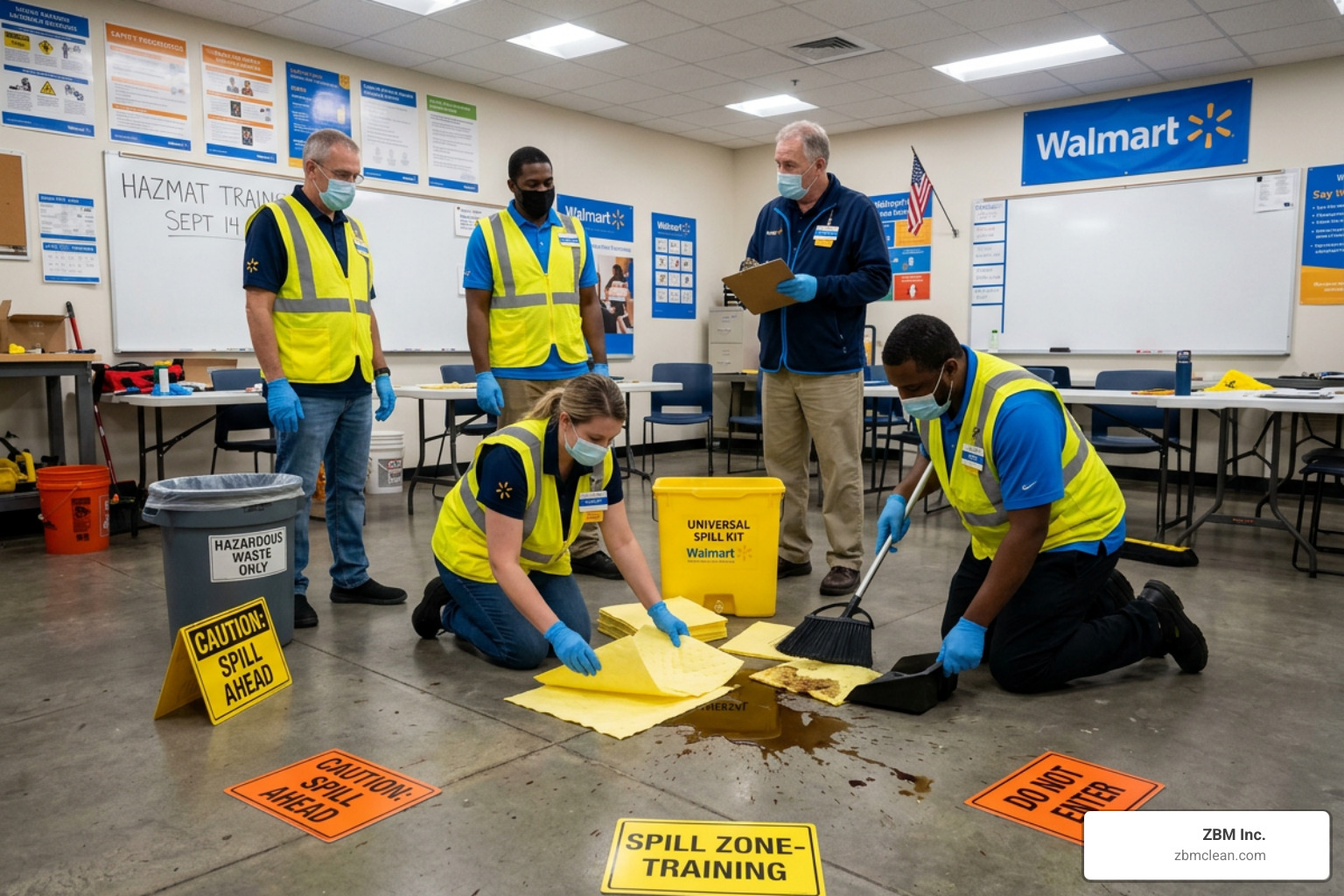
Walmart uses a sophisticated training system called ULEARN to ensure its 1.3 million domestic associates know exactly what to do when a bottle of industrial-strength cleaner shatters or a car battery leaks in the automotive section. These modules include Standard Operating Procedures (SOPs), computer-based training, and physical job aids.
The goal of these training modules is to move beyond “cleanup on aisle 7” and into the realm of professional Hazardous Waste Disposal In Large Distribution Facilities. In a warehouse or large retail setting, a spill isn’t just a slip hazard; it’s a potential EPA violation.
The Core of Walmart Hazardous Waste & Spill Cleanup Question 17
So, what is the actual answer to the question? While the exact wording can vary slightly between training cycles, the core of the assessment focuses on the order of operations during a spill.
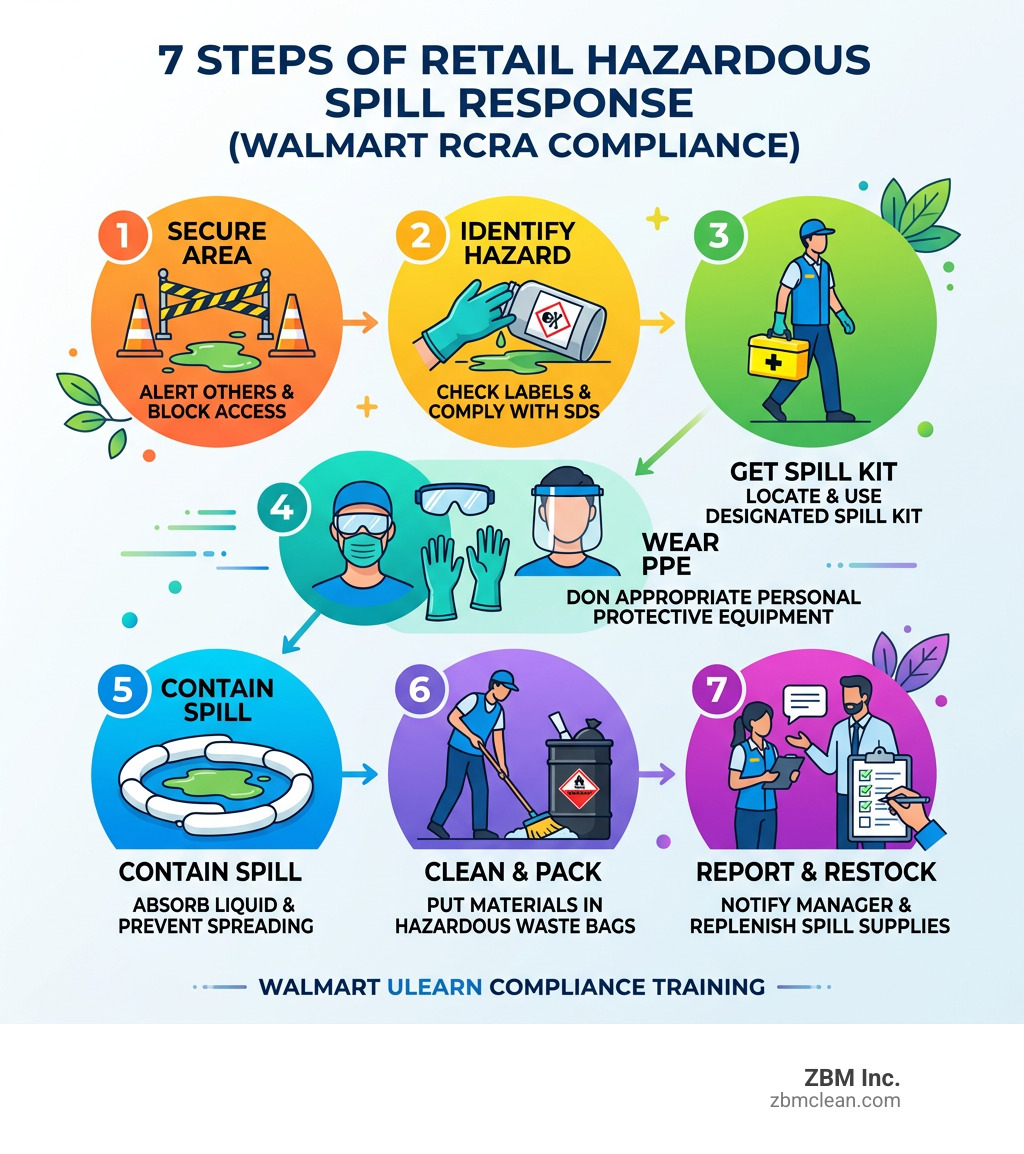
In retail hazardous materials, the “Question 17” answer usually emphasizes these three steps:
- Safety First: Never rush into a spill without assessing the danger. If a product is smoking, bubbling, or has a strong chemical odor, associates are trained to keep customers away.
- Notification: You must notify a member of management or a designated “spill responder” immediately.
- Containment: Using a spill kit—which typically contains absorbent pads, socks, and neutralizers—to stop the liquid from reaching floor drains or traveling under shelving.
This isn’t just for heavy chemicals. Items like aerosols, pesticides, and even high-alcohol hand sanitizers are considered hazardous under certain conditions.
How Question 17 Reflects Corporate Spill Procedures
Walmart’s written procedures are exhaustive. We’ve found that large retailers must maintain these strict SOPs because their “generator status” can change overnight.
In the eyes of the law, a store is a “generator” of waste. Most stores are Conditionally Exempt Small Quantity Generators (CESQGs), meaning they produce very little hazardous waste. However, an “episodic event”—like a major recall of a pesticide or a massive spill in the warehouse—can temporarily bump them up to a Small Quantity Generator (SQG) or even a Large Quantity Generator (LQG) status.
Question 17 ensures that every associate, from Minocqua to Lake Mills, understands that damaged goods and customer returns are not just “trash.” If a bottle of nicotine-based smoking cessation gum is returned opened and damaged, it becomes a “P-listed” hazardous waste that requires special handling.
The Regulatory Context: Why RCRA Compliance Matters for Retailers
To understand why Walmart spends so much time on a single training question, we have to look at the “Big Brother” of waste management: the Resource Conservation and Recovery Act (RCRA).
Signed into law in 1976, RCRA (often pronounced “rick-rah” by those of us in the industry) governs hazardous waste from “cradle-to-grave.” This means from the moment a product is manufactured until it is finally disposed of, its journey must be tracked. You can read more about the see source to see how these laws evolved.
Challenges in the Retail Sector Under RCRA
For a local business in Southeastern WI, RCRA might seem like something only chemical plants worry about. But for a retailer, the challenges are unique:
- Unpredictable Waste: Unlike a factory that knows exactly what chemicals it uses, a retail store deals with thousands of different consumer products.
- Nicotine Waste: Products like nicotine patches and e-cigarettes are highly regulated. If a store collects more than 2.2 pounds of acutely hazardous waste (like nicotine) in a month, they become an LQG, which comes with massive paperwork and inspection requirements.
- Toxicity: Many everyday items meet the EPA’s definition of toxicity, requiring them to be sent to specialized facilities rather than a standard landfill.
Lessons from the 2013 Environmental Settlement
The Wal-Mart Stores, Inc. Settlement in 2013 was a watershed moment. The company pleaded guilty to federal environmental crimes because associates were inadvertently throwing hazardous waste into trash dumpsters or pouring it down sewer drains.
One major part of the case involved a third-party facility called Greenleaf, which handled two million pounds of damaged pesticides. Because the pesticides were mismanaged and misbranded (a violation of FIFRA—the Federal Insecticide, Fungicide, and Rodenticide Act), it led to significant environmental risks.
Beyond the $110 million in fines, the damage to the company’s brand image was substantial. This is why Question 17 exists today: to ensure that every associate knows that a leaking bottle of bug spray is a legal and environmental liability, not just a mess to be mopped up.
Walmart’s Proposals for Amending Federal Waste Regulations
Walmart hasn’t just sat back and accepted these regulations; they have actively lobbied the EPA to change how retail waste is classified. They argue that the current system, designed for industrial factories, doesn’t make sense for a store selling hairspray and vitamins.
Classifying Discarded Products as Household Waste
Walmart’s primary proposal involves amending 40 CFR 261.4(b). Currently, if you throw a bottle of bleach away at home, it’s “household hazardous waste” and is exempt from RCRA. But if a Walmart associate in Dodge County throws that same bottle away because the cap cracked, it’s “industrial hazardous waste.”
Walmart points out some startling statistics:
- Retail facilities generate about 80 million pounds of RCRA hazardous waste annually.
- U.S. households generate 3.2 billion pounds of the exact same types of waste.
They argue that because these products are ultimately destined for households, they should be managed under Subtitle D landfills (standard trash) rather than Subtitle C (hazardous waste) facilities, provided they are managed safely. They believe this would reduce the complexity of ignitability and corrosivity testing for every broken bottle.
The Role of Reverse Distribution in Sustainability
Walmart also wants to amend 40 CFR 261.4(a) regarding “reverse distribution.” This is the process where damaged or returned goods are sent back to a central warehouse.
In their sustainability strategy, Walmart aims for “zero waste.” Currently, about 97.2% of products in their reverse distribution system are reused, donated to charities, or liquidated. Only a tiny fraction is actually discarded. By changing the rules, they could more easily donate items like slightly dented cans of soup or opened boxes of laundry detergent without fearing a “hazardous waste” label.
At ZBM Inc., we see the value in this. Whether we are performing office cleaning or More info about biohazard cleanup services, we know that proper classification saves time, money, and the environment.
Environmental Impact: From Parking Lot Runoff to Fuel Station Spills
Hazardous waste isn’t just about what’s on the shelves. For a large retailer, the exterior of the property is just as much of a concern as the interior. This is particularly true for locations with gasoline service stations.
Addressing Pollution at Gasoline Service Stations
Large fuel stations pose a double threat. First, there are the daily “micro-spills” from customers overfilling tanks. Second, there are the massive tanker spills. Research shows that a service station tanker spill occurs about every two years in areas with high retail density.
Shockingly, 80% of large spills at these facilities come from faulty transfer piping, hoses, or fittings—not the tanks themselves. To combat this, modern retail designs include:
- Containment Curbs: To keep fuel from running into the street.
- Sewer Blocks: Manual or automatic valves that stop flow into the municipal system.
- Monitoring: Constant electronic checking of TSS (Total Suspended Solids) and potential leaks.
Stormwater Management and Retail Operations
Parking lots are actually major sources of “non-point source pollution.” As rain falls on a massive asphalt lot in Watertown or Jefferson County, it picks up oil, rubber particles, heavy metals, and sediment.
This runoff can drastically change the BOD (Biochemical Oxygen Demand) of local streams. If the pH levels of the water change too much, it can kill off local fish and plants. That’s why you’ll often see detention ponds or “infiltration trenches” near large retail sites—they are designed to catch and filter this water before it hits our Wisconsin waterways.
Frequently Asked Questions about Walmart Hazardous Waste & Spill Cleanup Question 17
What is Walmart’s position on RCRA regulations for consumer products?
Walmart believes that the current RCRA regulations are an “impediment” to recycling and sustainability. They argue that because the volume of retail hazardous waste is less than 3% of the volume of household hazardous waste, the rules should be simplified to allow retailers to manage these goods more like households do.
How does Walmart handle hazardous waste from recalls?
When a recall happens, products are immediately pulled from the sales floor. They are “held” in a designated area. Walmart then works with the supplier to determine the “disposition.” If the item is truly dangerous, it is managed as hazardous waste. If it’s just a labeling error, it might be liquidated or donated.
What are the benefits of Walmart’s proposed RCRA amendments?
Walmart claims that by treating discarded consumer products as household waste, they could:
- Save millions in administrative costs.
- Reduce the number of “generator status” changes that trigger heavy inspections.
- Encourage more recycling and donation of items that are currently thrown away out of an abundance of “regulatory caution.”
What happens if an associate fails the spill training?
In most large retail environments, associates who do not pass their compliance modules (like the one containing Question 17) are not allowed to work on the sales floor until they receive remedial training. Safety and compliance are tied directly to job performance.
Conclusion
Whether you are an associate trying to ace your ULEARN assessment or a property manager in Southeastern WI looking to improve your facility’s safety, the lessons from walmart hazardous waste & spill cleanup question 17 are clear: preparation is the only way to prevent a mess from becoming a disaster.
Managing hazardous materials—from a broken bottle of nail polish to a leaking car battery—requires a “cradle-to-grave” mindset. It’s about knowing the difference between a simple spill and a RCRA-regulated event.
At ZBM Inc., we understand the complexities of cleanup. While Walmart trains its associates for those immediate “aisle 7” moments, we provide the deep-cleaning expertise required for long-term safety and compliance. From Watertown to the Northwoods, our family-owned team is licensed, bonded, and insured to handle the tough jobs.
If you find yourself facing a situation that a standard spill kit can’t handle—whether it’s a biohazard, a major chemical release, or a disaster recovery scenario—don’t guess on “Question 17.” Call the professionals who live and work right here in your community.
For more information on staying safe, check out our guide on human-waste-cleanup-unveiled-understanding-the-dangers or visit us at https://www.zbmclean.com/ to see how we can help keep your facility spotless and compliant.