Blood Borne Pathogen Cleanup: What Every Property Manager Needs to Know
Blood borne pathogen cleanup is the process of safely removing, disinfecting, and disposing of blood and other potentially infectious materials (OPIMs) — and it carries serious legal, health, and safety responsibilities.
Here’s a quick overview of what’s required:
- Isolate the area – Block off the contaminated zone immediately
- Put on full PPE – Gloves, mask, eye protection, gown, and shoe covers
- Remove bulk material – Use absorbent materials, then scrape into a red biohazard bag
- Disinfect with an EPA-registered product – Follow the label’s contact time exactly
- Dispose of waste properly – Red biohazard bags, sharps in puncture-resistant containers — never standard trash
- Remove PPE carefully – Follow the correct doffing sequence to avoid self-contamination
- Wash hands thoroughly – Immediately after PPE removal
- Report the incident – Document and notify the appropriate parties
If you manage a commercial property in Watertown, WI, this isn’t a rare edge case. Any facility — not just hospitals — can face a blood spill. A workplace injury, a medical emergency, or even a minor accident can create a serious biohazard situation fast.
The stakes are real. According to the National Institutes of Health, about 3 million workers experience bloodborne pathogen exposure every year. The most common infectious agents — Hepatitis B (HBV), Hepatitis C (HCV), and HIV — can survive on surfaces far longer than most people realize.
And here’s what many property managers don’t know: OSHA compliance obligations begin the moment another person could be exposed, regardless of intent. That means a janitor handed a roll of paper towels to clean up a blood spill — without proper training or PPE — is already a violation.
This guide walks you through everything: the science, the step-by-step procedures, OSHA requirements, and when to call in a certified professional.
Understanding Bloodborne Pathogens and Transmission Risks
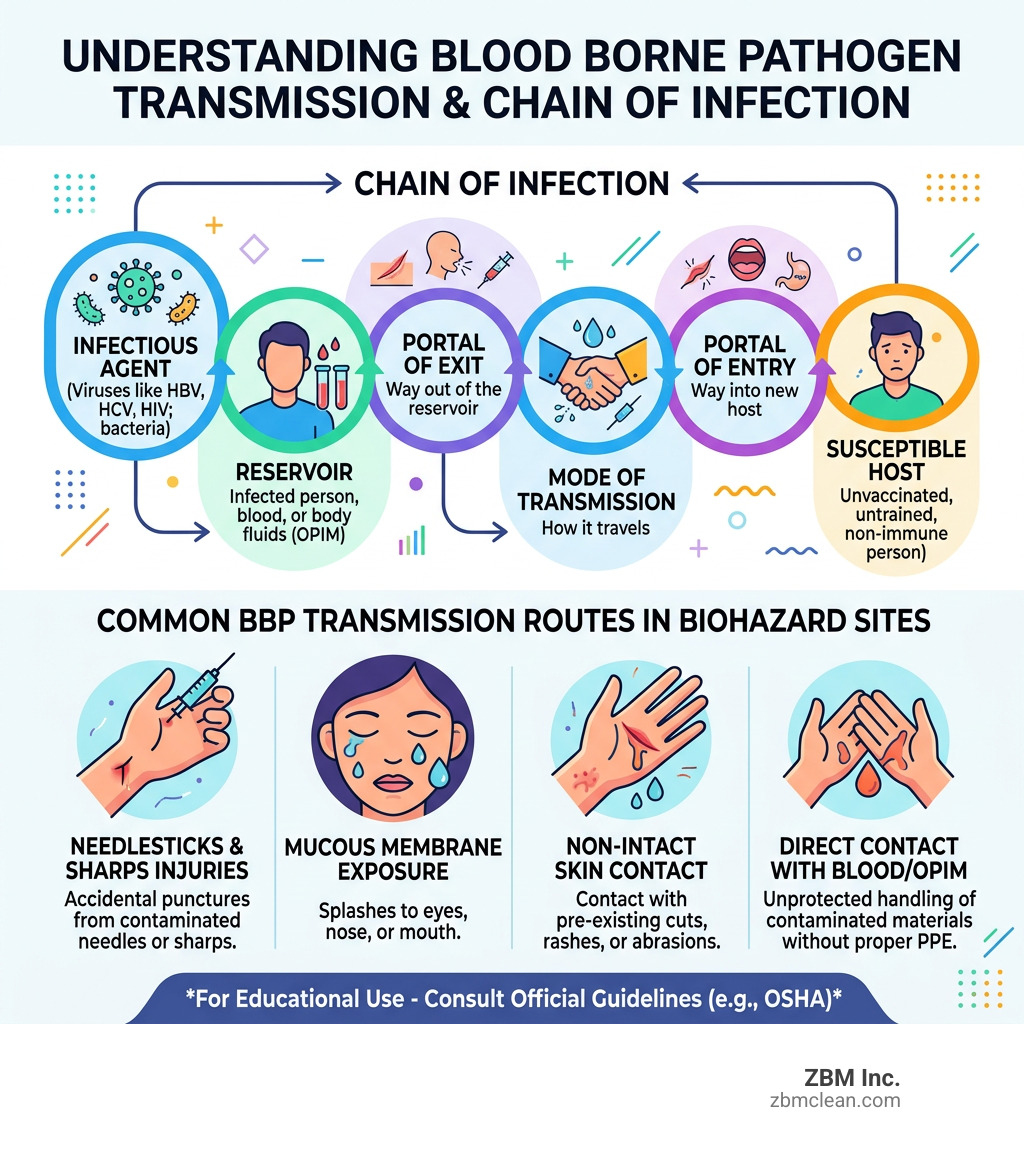
To handle a spill safely, we first need to understand what we are fighting. Bloodborne pathogens (BBPs) are microorganisms such as viruses or bacteria that are carried in human blood and can cause disease in humans. While there are many types, the “Big Three” that cause the most concern in workplace safety are Hepatitis B (HBV), Hepatitis C (HCV), and the Human Immunodeficiency Virus (HIV).
However, the risk isn’t limited to just red liquid. OSHA uses the term “Other Potentially Infectious Materials” (OPIM) to cover things like semen, vaginal secretions, cerebrospinal fluid, and any body fluid that is visibly contaminated with blood. In some cases, fluids like vomit or diarrhea are also treated with the same level of caution because they can harbor pathogens like Norovirus or C. diff.
How Transmission Happens
Transmission usually occurs through four primary routes:
- Direct Contact: This happens when infected blood or OPIM enters your body through an open wound, a nick in the skin, or mucous membranes (like your eyes, nose, or mouth).
- Indirect Contact: This is a sneaky one. It occurs when you touch a contaminated surface—like a doorknob or a tool—and then touch your face or an open cut.
- Airborne Transmission: While less common for blood, some pathogens can be spread through droplets if a spill is handled roughly, creating a mist or aerosol.
- Vector-Borne: This involves spread via animals or insects, such as ticks or mosquitoes, though this is rarely a factor in indoor facility cleanup.
The risks are significant. Scientific research on percutaneous exposure risks shows that about 3 million healthcare workers experience needle-stick or sharps injuries annually. In a local context, whether you are in Dodge County or Jefferson County, maintaining “Universal Precautions” is the gold standard. This means we treat all human blood and OPIM as if it is known to be infectious. It’s better to be safe than sorry!

For a deeper dive into the types of waste you might encounter, check out our guide on understanding biohazardous waste.
Essential PPE and Supplies for blood borne pathogen cleanup
You wouldn’t head into a blizzard without a coat, and you definitely shouldn’t head into a biohazard zone without the right gear. Personal Protective Equipment (PPE) is your primary barrier against infection.
The BBP Cleanup Kit Checklist
Every facility in Watertown or Lake Mills should have a dedicated blood borne pathogen cleanup kit ready to go. We recommend including:
- Nitrile Gloves: Double-gloving is often a smart move.
- Gowns or Aprons: Disposable and fluid-resistant to protect your clothing.
- Face Shields or Goggles: To prevent splashes from reaching your eyes.
- Disposable Masks: To protect your nose and mouth.
- Shoe Covers: To prevent tracking pathogens across the building.
- Absorbent Powder: To solidify liquid spills.
- EPA-Registered Disinfectant: Specifically labeled to kill HIV and HBV.
- Red Biohazard Bags and Zip Ties.
- Sharps Container: Puncture-resistant for needles or broken glass.
The Correct Order: Donning and Doffing
It’s not just about wearing the gear; it’s about how you take it off. The CDC provides specific guidelines to prevent “self-inoculation” (accidentally rubbing pathogens on yourself while undressing).
Donning (Putting it on):
- Gown
- Mask/Respirator
- Goggles/Face Shield
- Gloves (pull them over the cuffs of the gown)
Doffing (Taking it off):
- Gloves: These are the most contaminated.
- Goggles/Face Shield: Handle by the head strap, not the front.
- Gown: Pull away from the body and roll into a bundle.
- Mask: Remove by the ties or elastics.
- Wash Hands: Use soap and running water immediately.
Before you start any work, it’s helpful to review 5 things to do before cleaning biohazard damages.
Step-by-Step Procedures for Biohazard Remediation
When a spill occurs, the clock is ticking. Pathogens can begin to “set” into porous surfaces, and foot traffic can quickly spread the mess. Bio-hazard remediation is a systematic process designed to ensure nothing is left behind.
Initial Containment and Bulk Removal
First, isolate the area. Use “Caution” tape or floor signs to keep people away. If the spill is large, you may need to “berm” the perimeter—using absorbent powder or socks to create a dam so the liquid doesn’t travel.
Once contained, use an absorbent material (like kitty litter or specialized cellulose powder) to soak up the bulk of the liquid. Wait 1-2 minutes for the material to work. Use a scraper and a dustpan (which must be disinfected or disposed of afterward) to move the solidified material into a red biohazard bag. For broken glass, never use your hands. Use tongs or a mechanical brush.
Deep Cleaning and Disinfection Protocols
Cleaning and disinfecting are two different steps. You can’t effectively disinfect a surface that is still covered in organic matter.
- Clean: Scrub the surface with soap and water or a general cleaner to remove any remaining visible residue.
- Disinfect: Apply an EPA-registered disinfectant. This is where many people fail—you must check the “dwell time” on the label. Most professional-grade disinfectants require the surface to stay wet for 10 minutes to effectively kill pathogens like Hepatitis B.
| Surface Type | Primary Method | Key Consideration |
|---|---|---|
| Solid (Tile/Vinyl) | Scrape & Disinfect | Use EPA-registered liquids |
| Carpet/Rug | Absorb & Steam | May require replacement if heavily soaked |
| Outdoor (Concrete) | Contain & Saturate | Prevent runoff into storm drains |
| Furniture | Launder or Extract | Check manufacturer for chemical tolerance |
After the job is done, proper handwashing steps are the final line of defense. Scrub for at least 20 seconds, paying attention to your fingernails and the backs of your hands.
Safe Disposal of Biohazardous Waste and Sharps
You can’t just throw a red bag in the dumpster. That’s a one-way ticket to a massive OSHA fine and potential environmental contamination. OSHA guidelines for biohazard waste disposal require that all regulated waste be placed in leak-proof, labeled containers.
If you have sharps, they must go into a puncture-resistant container. If a red bag is used, it should be double-bagged and tied securely. In Dodge County, we follow strict protocols for cleaning biohazard damages to ensure that waste is transported by licensed haulers to facilities equipped for medical waste incineration or autoclaving.
OSHA Standards and Regulatory Compliance in Watertown
If you have employees, OSHA’s Bloodborne Pathogens Standard (29 CFR 1910.1030) is not optional. It applies to any workplace where it can be “reasonably anticipated” that employees might come into contact with blood.
Key Requirements Include:
- Exposure Control Plan (ECP): A written document outlining how your facility handles BBP risks. It must be updated annually.
- Annual Training: Anyone with potential exposure must be trained every year.
- Hepatitis B Vaccinations: Employers must offer this vaccine for free to employees with occupational exposure.
- Record-Keeping: You must maintain a “Sharps Injury Log” and keep medical records for the duration of employment plus 30 years.
Choosing the right partner is vital for compliance. You can learn more about hiring the right cleanup company to ensure your facility meets these rigorous standards.
Common Mistakes in blood borne pathogen cleanup
We’ve seen it all in the Northwoods and Southeast Wisconsin. Here are the most common errors to avoid:
- Using the wrong disinfectant: Standard “all-purpose” cleaners usually won’t kill HBV or HIV. Always look for the EPA registration number.
- Inadequate PPE: Wearing just gloves but no eye protection during a splash-prone cleanup.
- Improper Sharps Handling: Picking up broken glass with gloved hands.
- Standard Trash Disposal: Throwing blood-soaked rags in the kitchen trash can.
Reporting and Post-Exposure Requirements
If someone is exposed—meaning blood got into a cut or splashed in their eyes—you must act immediately.
- Wash the area: Rinse mucous membranes for at least 10 minutes.
- Report: Document the route of exposure and the circumstances.
- Medical Evaluation: The employee should receive a confidential medical evaluation and follow-up at no cost.
Knowing what to expect during biohazard cleanup can help lower the stress of these high-pressure situations.
Frequently Asked Questions about Biohazard Remediation
How do I clean blood out of a carpet or porous surface?
Carpets are tricky because they are “porous,” meaning they can trap pathogens deep in the fibers and padding. For small spills, use an absorbent barrier to prevent the blood from spreading. Use an antimicrobial carpet shampoo and consider a professional steam cleaning (at temperatures high enough to kill germs). However, if the spill is large or has soaked into the subfloor, the affected carpet section and padding usually need to be cut out and replaced. Check out more common biohazard situations for similar challenges.
Is blood in a swimming pool a public health hazard?
Surprisingly, the CDC notes that a properly maintained pool with correct chlorine levels is generally safe. Chlorine kills most bloodborne pathogens relatively quickly. While there is no strict public health requirement to close a pool for a small blood spill, many facilities in Watertown or Minocqua choose to close briefly to satisfy patrons and ensure the chemistry is balanced.
When should I call a professional biohazard cleanup service?
You should call the pros if:
- The spill is larger than a dinner plate.
- There is significant “soak-through” into flooring or walls.
- The incident involves a crime scene or an unattended death.
- You lack the proper PPE or EPA-registered chemicals.
- You want to transfer the legal liability of cleanup and disposal to a certified firm.
There are many reasons why biohazard cleanup is necessary beyond just the “ick” factor—it’s about professional-grade safety.
Conclusion
When it comes to blood borne pathogen cleanup, there is no room for “good enough.” Whether you are managing an office in Watertown, a retail space in Lake Mills, or a facility in the Northwoods, the safety of your occupants and employees depends on a rigorous, compliant approach.
At ZBM Inc., we are more than just a cleaning company—we are your neighbors. As a family-owned, licensed, and insured business, we take pride in restoring safety to our community. Our certified professionals are trained to handle the most sensitive biohazard situations with discretion and technical expertise.
Don’t leave your facility’s safety to chance. If you’re facing a biohazard challenge, reach out to the experts who know Wisconsin best. For more information or immediate assistance, visit our main page for biohazard cleanup in Wisconsin. We’re here to help you get back to business safely.