What Is Biohazard Cleaning Certification — and Do You Actually Need It?
Biohazard cleaning certification is specialized training that qualifies professionals to safely handle and remove dangerous biological materials — including blood, bodily fluids, and infectious waste — in compliance with OSHA and other regulatory standards.
Here’s a quick snapshot of what you need to know:
| Question | Quick Answer |
|---|---|
| Is there one universal certification? | No — no single national license is required |
| What is required by law? | OSHA compliance training (e.g., Bloodborne Pathogens, HAZWOPER) |
| Who offers recognized certifications? | IJCSA, ABRA, ISSA/GBAC, Hazmat School |
| How long does training take? | As little as 10 hours up to 40+ hours depending on the program |
| Are there state-specific requirements? | Yes — some states require additional permits (e.g., California, Florida) |
| Do certifications expire? | Yes — most require renewal every 1–3 years |
Biohazard cleanup is not ordinary cleaning work. A crime scene, an unattended death, a sewage backup — these situations carry serious health risks if handled incorrectly. The gap between a trained professional and an uncertified one can mean the difference between a truly safe environment and an ongoing exposure hazard.
That’s exactly why certification matters — even when it isn’t legally mandated.
Whether you’re a property manager in Watertown, WI trying to vet a cleanup company, or someone exploring a career in biohazard remediation, this guide walks you through exactly what certification involves, which programs are legitimate, and what the real requirements are.
I’m Terry Zastrow, owner of ZBM, Inc., a firm with nearly 30 years of field experience and multiple IICRC technician and master technician certifications — including extensive HAZWOPER training and OSHA compliance programs directly relevant to biohazard cleaning certification. That hands-on background informs everything covered in this guide.
The Importance of Professional Biohazard Cleaning Certification

When we talk about biohazard remediation, we aren’t just talking about a mop and a bucket. We are talking about the intersection of public health, occupational law, and technical precision. A professional biohazard cleaning certification serves as a benchmark for safety.
In our work across Southeast Wisconsin, from Dodge County to the Northwoods, we see why these standards exist. Without proper training, a “cleaner” might inadvertently spread pathogens like Hepatitis B or HIV throughout a property. According to Biohazard Remediation Industry Standards: Certification and Best Practices | Biohazard Authority, the difference between a competent practitioner and an uncertified one can mean the difference between a safe home and a “slow-motion exposure event.”
Certification provides several critical benefits:
- Regulatory Compliance: It ensures the team follows federal and state laws regarding hazardous waste.
- Risk Management: It protects the property owner from liability by ensuring the scene is verified as safe through scientific testing.
- Safety: It protects the technicians themselves from life-threatening infections.
- Compassion: Certification programs often include training on how to interact with grieving families during trauma or crime scene cleanup.
Key Regulations: OSHA Standards for Biohazard Professionals
While there isn’t a “National Biohazard License,” there are very strict federal regulations that we must follow. If you are looking to get into this field or hire a professional, you need to be familiar with these acronyms.
OSHA 1910.1030: The Bloodborne Pathogens Standard
This is the big one. This standard requires that any employee with “occupational exposure” to blood or other potentially infectious materials (OPIM) receives annual training. It mandates the use of Universal Precautions—treating all human blood and certain body fluids as if they are known to be infectious.
HAZWOPER 1910.120
HAZWOPER stands for Hazardous Waste Operations and Emergency Response. This is a more intensive 40-hour training program. As noted by the Certified Bio Recovery Technician – American Bio Recovery Association, having a 40-hour HAZWOPER card is often a prerequisite for advanced technician status. It covers how to handle large-scale spills and dangerous chemical environments.
The General Duty Clause
Section 5(a)(1) of the OSHA Act is a “catch-all” that requires employers to provide a workplace free from recognized hazards. Since bloodborne pathogens are a recognized hazard, this clause essentially makes training mandatory for anyone doing crime scene or trauma cleanup.
Waste Transport and Disposal
It isn’t just about cleaning; it’s about where the waste goes. The Department of Transportation (DOT) under 49 CFR Parts 171–180 regulates the transport of hazardous materials. Furthermore, the EPA and state-specific agencies in Wisconsin regulate how medical waste is tracked from “cradle to grave” using waste manifests.
How to Get a Biohazard Cleaning Certification: A Step-by-Step Guide
If you’re ready to start your journey, the process usually follows a standard path. Because there is no single governing body, you have to choose a reputable organization that aligns with industry benchmarks.
| Program Provider | Typical Duration | Focus Area |
|---|---|---|
| IJCSA | Under 40 Hours | Comprehensive: Safety + Business + Marketing |
| Hazmat School | ~10 Hours | OSHA Compliance & Spill Procedures |
| ABRA (CBRT) | 16-40+ Hours | Technical Bio-Recovery & Field Assessment |
| ISSA/GBAC | Self-paced | Scientific Disinfection & Outbreak Response |
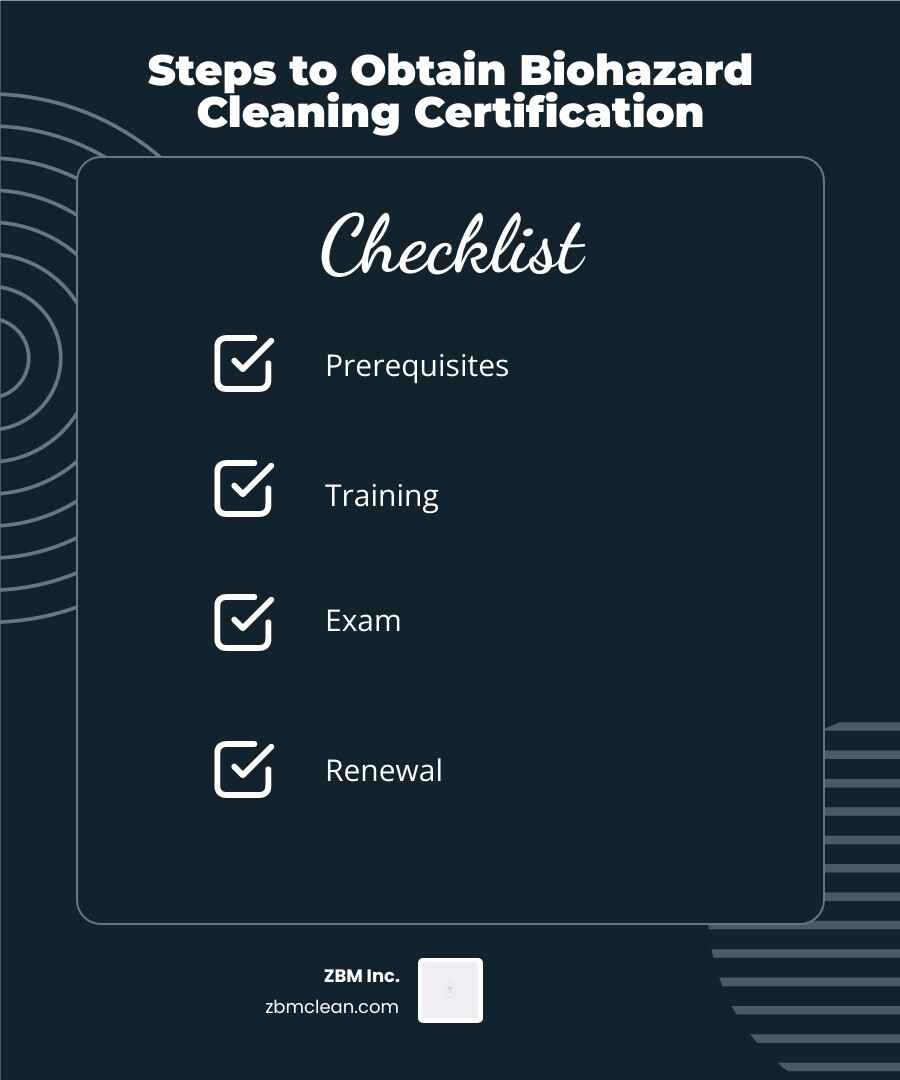
Step 1: Research Prerequisites Most advanced courses require you to already have a Bloodborne Pathogens (BBP) certificate. Some, like the IJCSA program, require foundational knowledge in carpet cleaning and chemical hazards before you can unlock the biohazard module.
Step 2: Enroll in a Reputable Program Choose a program that offers third-party validation. This means an independent organization verifies that the training meets high standards. For more information on how we apply these standards in the field, you can view our biohazard cleanup services.
Step 3: Complete Coursework and Exams You will study everything from the biology of viruses to the chemistry of disinfectants. Most exams require a passing score of at least 75%.
Step 4: Maintain Your Credentials This industry moves fast. Most certifications require annual BBP refreshers and continuing education (CE) credits every 1 to 3 years to remain active.
Choosing the Right Biohazard Cleaning Certification Program
When selecting a program, consider your goals.
- ABRA (American Bio Recovery Association) is highly respected for field technicians and requires a proctored exam.
- ISSA’s Global Biorisk Advisory Council (GBAC) is excellent for those focusing on infectious disease and large-facility disinfection.
- Hazmat School is a great, affordable entry point for those needing to meet basic OSHA requirements quickly (often costing around $129).
Prerequisites and Coursework for Biohazard Cleaning Certification
A solid biohazard cleaning certification curriculum isn’t just about “blood.” It covers:
- Epidemiology: Understanding how HBV, HCV, and HIV live and die on surfaces.
- Hazard Communication: Learning how to read Safety Data Sheets (SDS) so you don’t mix chemicals that create toxic gas.
- Psychology/Etiquette: How to handle a trauma scene with the necessary sensitivity.
- Microbiology: Basics of mold, bacteria, and zoonotic diseases (diseases from animals).
Essential Safety Protocols and PPE in Biohazard Training
In our training, we always say: “If it’s wet and it’s not yours, don’t touch it.” But even if it’s dry, biohazards remain dangerous. Training emphasizes a “Safety First” culture.
Personal Protective Equipment (PPE)
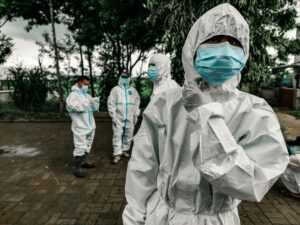
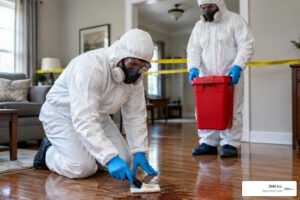
We don’t just wear “suits” for show. PPE is a layered defense system:
- Respirators: N95 or full-face respirators are used to prevent inhaling aerosolized pathogens or odors.
- Gloves: Usually double-nitriling. The inner layer is often taped to the suit.
- Tyvek Suits: These are fluid-resistant coveralls that protect your skin and personal clothing.
- Eye Protection: Goggles or face shields to prevent splashes into the mucous membranes.
Donning and Doffing
The most dangerous part of the job is actually taking the gear off. This is called “doffing.” If you touch the outside of a contaminated glove with your bare hand, the entire job was a failure from a safety standpoint. Training involves practicing these sequences until they are second nature.
Engineering Controls and Disinfection
We use negative air machines to ensure pathogens don’t drift into other rooms. We also only use EPA-registered disinfectants. It’s important to note the “dwell time”—the amount of time a disinfectant must sit wet on a surface to actually kill the target virus. Just spraying and wiping immediately doesn’t cut it in the biohazard world.
State Licensing and Starting a Biohazard Cleaning Business
Starting a business in this field requires more than just a biohazard cleaning certification. You have to navigate a “patchwork” of state laws.
While states like California require a “Trauma Scene Waste Practitioner Permit,” Wisconsin has its own set of expectations. In our service areas—like Jefferson County and Lake Mills—we focus on staying compliant with the Wisconsin Department of Natural Resources (DNR) regarding medical waste disposal.
Essential Startup Checklist:
- Insurance: You need specialized “Pollution and Professional Liability” insurance. Standard janitorial insurance usually excludes biohazards.
- Licensing: Ensure you are registered as a medical waste generator if you plan to transport waste.
- Equipment: You’ll need HEPA-filtered vacuums, fogging machines for odor control, and ATP monitors (which use light to test for biological matter left on a surface).
- Marketing: This is a “referral-heavy” business. Building relationships with local law enforcement, coroners, and insurance adjusters is key.
Frequently Asked Questions about Biohazard Certification
Is there a mandatory national biohazard cleaning certification?
No. There is no federal law that says “You must have a Biohazard License to mop up blood.” However, there is a federal law (OSHA) that says your employer must train you if you are exposed to blood. Most reputable companies use voluntary industry benchmarks like the IICRC S540 standard to prove they are doing the work correctly.
How long does it take to become a certified biohazard cleaner?
It depends on the depth of the course. A basic OSHA-compliant BBP course takes about an hour. A “Crime Scene Cleanup” course from Hazmat School takes about 10 hours. A full biohazard cleaning certification from IJCSA can take up to 40 hours. If you pursue the ABRA CBRT credential, you’ll need at least 16 hours of lecture plus a 40-hour HAZWOPER foundation.
How do I verify a biohazard cleaning certification?
If you are hiring a company, ask for their “Certificate of Training” and their “Proof of Insurance.” Legitimate certifications will have an expiration date and a unique credential number. You can often verify members through directories like the ABRA member list or by contacting the issuing body (like ISSA or IJCSA) directly.
Conclusion
The world of biohazard remediation is challenging, but it is incredibly rewarding. As “second responders,” we have the privilege of helping people during their darkest hours, turning a scene of tragedy back into a place of peace.
At ZBM Inc., we take this responsibility seriously. Being a family-owned business based in Watertown, WI, our reputation is built on the safety and trust we provide to our neighbors in Dodge County, Jefferson County, and throughout Southeastern WI. We aren’t just a cleaning crew; we are a team of licensed, bonded, and insured professionals who stay current on every biohazard cleaning certification required to keep our community safe.
If you are facing a difficult situation—whether it’s a hoarding cleanup, a traumatic event, or a commercial disinfection need—don’t handle it alone. Reach out to professionals who have the training and the heart to do the job right. Explore our professional commercial cleaning services to see how we can help you restore your property and your peace of mind.