What to Expect from a Cleaning Service After Renovation
If you’ve just finished a renovation, a cleaning service after renovation is probably the most important call you haven’t made yet.
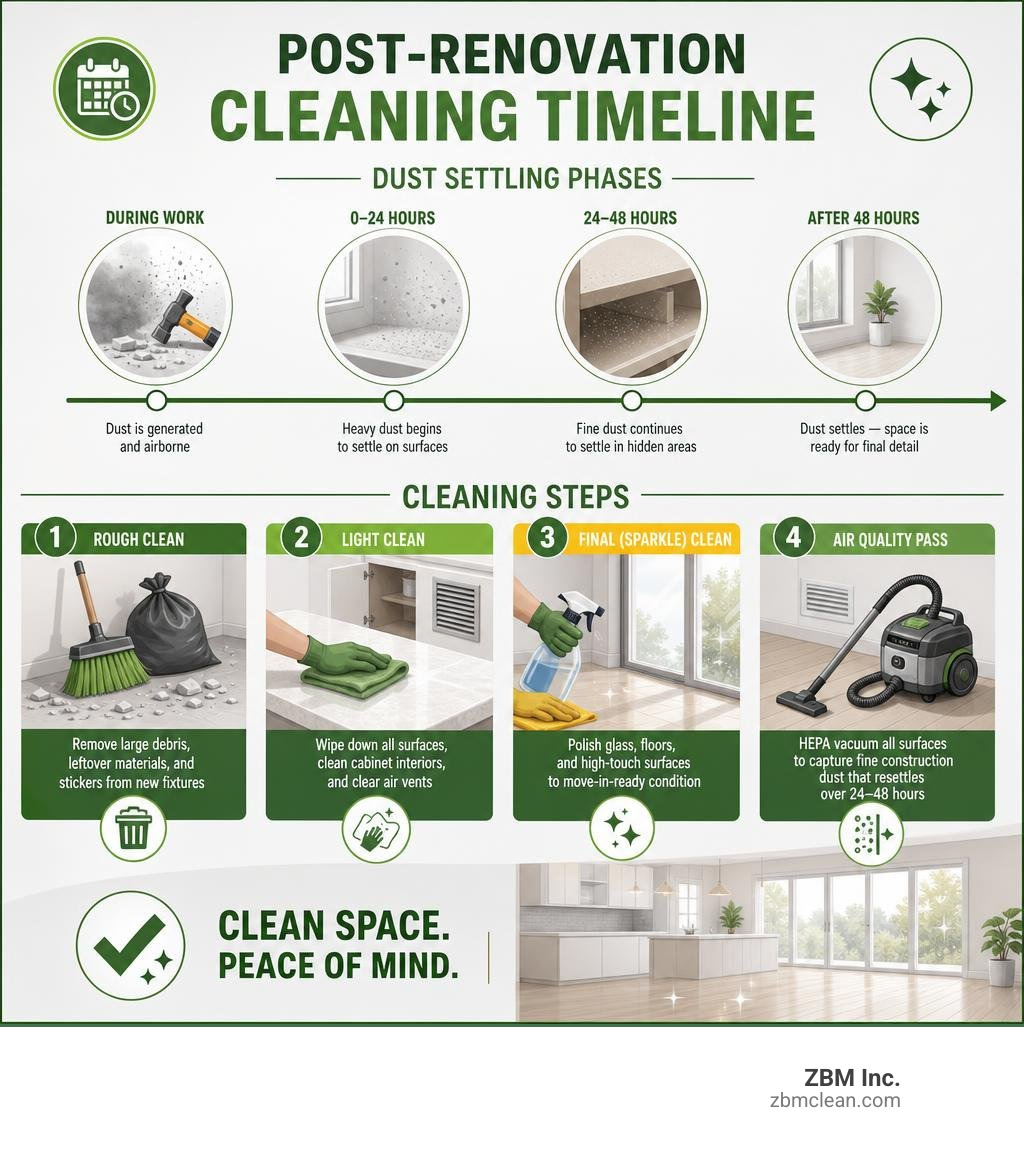
Here’s a quick overview of what post-renovation cleaning involves:
- Rough clean — Remove large debris, leftover materials, and stickers from new fixtures
- Light clean — Wipe down all surfaces, clean cabinet interiors, and clear air vents
- Final (sparkle) clean — Polish glass, floors, and high-touch surfaces to move-in-ready condition
- Air quality pass — HEPA vacuum all surfaces to capture fine construction dust that resettles over 24–48 hours
Quick answer: Post-renovation cleaning is a specialized, multi-phase process that removes construction dust, debris, adhesive residue, and fine particulate from every surface in a renovated space. It typically takes 3–10 hours depending on the scope of work and requires professional-grade equipment — not standard household cleaning tools.
The renovation is done. The contractors are gone. But if you walk back into that space and find a fine white film coating every surface — the countertops, the windowsills, the inside of the cabinets — you’re not imagining things.
Construction dust is stubborn. It’s ultra-fine, it travels far, and it resettles for up to 48 hours after work ends. For a busy commercial property manager, that means you can’t just hand a mop to your maintenance crew and call it done.
The mess left behind after a renovation is a different category of problem entirely.
I’m Terry Zastrow, owner of ZBM Inc., an IICRC-certified firm with approximately 30 years of experience providing specialized cleaning service after renovation to commercial properties, municipalities, and private-sector clients across the region. In this guide, I’ll walk you through exactly how to approach post-renovation cleanup — step by step — so you can get your space back into safe, professional condition fast.
Discover more about cleaning service after renovation:
- after construction cleaning company
- certified post construction cleaners
- construction cleaning cost per square foot
Why You Need a Professional Cleaning Service After Renovation
Many property owners and businesses assume they can handle the post-remodel cleanup themselves or delegate it to a standard janitorial team. However, post-construction cleaning is typically 3 to 5 times more labor-intensive than standard cleaning. This isn’t your average weekend dusting; it’s a deep-level extraction of microscopic pollutants.
When builders cut drywall, sand plaster, or saw wood, they release millions of tiny particles into the air. The most dangerous of these is silica dust, which is created when cutting or grinding materials like concrete, mortar, sandstone, and tile.
According to OSHA safety standards, breathing in silica and other fine construction dust over prolonged periods can cause severe respiratory issues. This dust is so fine that it behaves almost like a gas, penetrating deep into wall cavities, settling inside cabinet hinges, and coating the interior of your HVAC ductwork.
To safely eliminate these hazards, we utilize specialized commercial equipment equipped with HEPA filters. True HEPA filtration is designed to capture at least 99.97% of dust, pollen, mold, and bacteria down to 0.3 microns. Standard household vacuum cleaners simply lack the filtration power to trap these microscopic particles; instead, they end up blowing the fine dust right back into your breathing zone.
Furthermore, newly renovated spaces feature fresh materials that require delicate care. If an untrained cleaner uses the wrong cleaning agents on your newly installed marble countertops, or a harsh abrasive on freshly stained woodwork, they can easily cause permanent, costly damage. Working with professionals ensures your investment is protected from day one.
Understanding the value of certified experts is key to a successful property handover. To learn more about why specialized expertise is crucial, check out our guide on why certified post-construction cleaners are worth every penny.
Contractor Cleanup vs. Professional Deep Cleaning
A common point of confusion for property owners is understanding what the construction contractor is actually responsible for cleaning.
Most construction contracts specify that the crew will leave the site in “broom-swept” condition. This is an industry-standard term which means the builders will:
- Remove large construction debris, scrap lumber, and metal studs.
- Sweep up heavy sawdust and drywall chunks.
- Remove protective plastic sheets and cardboard floor coverings.
While this makes the site safe to walk through, it does not make it livable or ready for business operations. The contractors are specialists in building, not detailing. They focus on structural integrity and safety, leaving the meticulous, surface-by-surface sanitation to specialized cleaners.
| Cleanup Task | Contractor “Broom-Swept” Standard | Professional Post-Renovation Cleaning |
|---|---|---|
| Large Debris & Trash Removal | Yes | Yes |
| Heavy Sawdust Sweeping | Yes | Yes |
| Microscopic Dust Extraction (HEPA) | No | Yes |
| Inside Cabinets & Drawers Detailed | No | Yes |
| Paint Splatter & Adhesive Removal | No | Yes |
| Air Vent & HVAC Cover Cleaning | No | Yes |
| Window Sill, Track, & Glass Polishing | No | Yes |
| Wall & Ceiling Vacuuming | No | Yes |
As you can see, a professional cleaning service after renovation goes infinitely deeper than a standard broom-sweep. If you want to dive deeper into what to look for when hiring commercial experts, take a look at our essential guide on what to look for in a commercial cleaning service.
The 3 Phases of Post-Construction Cleanup
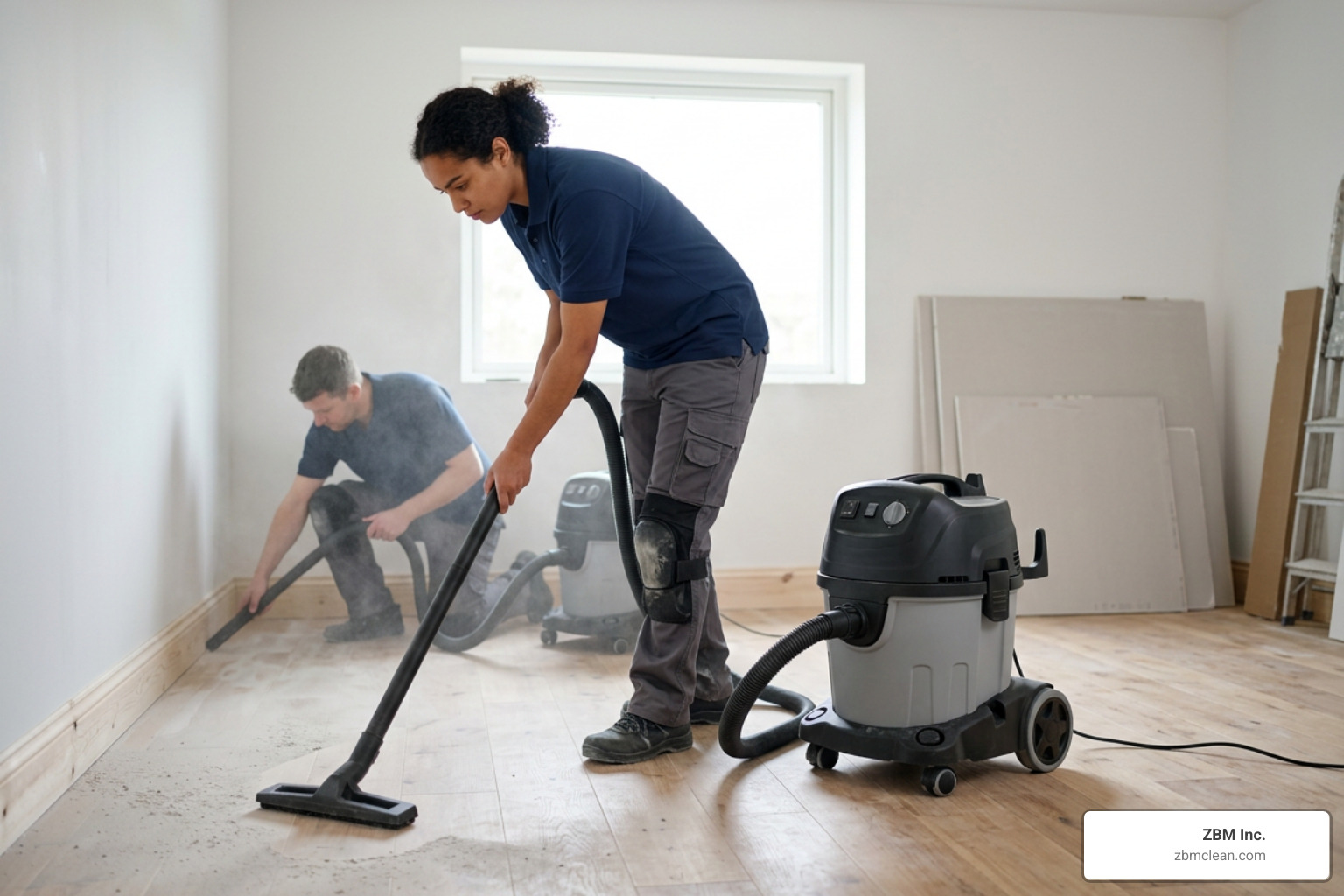
To achieve a truly spotless, dust-free environment, professional cleaners do not just start wiping surfaces at random. We follow a highly structured, multi-phase cleaning framework. This ensures that we don’t waste time cleaning a surface only for falling dust to dirty it again an hour later.
If you are coordinating a large commercial project, you can read more about managing these stages in our resource, the essential guide to cleaners for construction sites.
Phase 1: The Rough Clean
The rough clean takes place as soon as the heavy construction trades have officially finished their work but before any furniture or delicate fixtures are installed.
During this initial phase, we focus on:
- Removing any remaining small construction debris, packaging materials, and leftover drywall scraps.
- Peeling off protective plastic coatings, stickers, and manufacturer labels from newly installed windows, toilets, sinks, and appliances.
- Performing a comprehensive sweep and vacuum of all floors to collect the heaviest layers of dust before they can be kicked back up into the air.
Phase 2: The Light Clean
This is the most labor-intensive phase of the entire project. During the light clean, we focus on detailed, surface-level dust extraction. We work systematically from the ceilings down to the floors, ensuring that no corner is overlooked.
Key tasks in this phase include:
- Vacuuming and wiping down walls, door frames, baseboards, and moldings.
- Thoroughly cleaning the interiors and exteriors of all cabinets, drawers, shelving units, and closets.
- Cleaning light fixtures, ceiling fans, electrical outlets, and light switches.
- Detailing bathroom tile, sanitizing new plumbing fixtures, and removing grout haze.
- Vacuuming air vents, registers, and visible duct openings to prevent dust recirculation.
Phase 3: The Sparkle Clean
The final phase, often called the “sparkle clean” or “handover clean,” takes place shortly before the occupant moves in or the business opens. This stage is all about presentation and polishing.
Our focus during the sparkle clean includes:
- Polishing glass surfaces, mirrors, and interior windows until they are completely streak-free.
- Applying specialized polishes to stainless steel appliances, chrome fixtures, and high-gloss surfaces.
- Damp-mopping hard floors with material-specific cleaners (such as hardwood, tile, or luxury vinyl plank) to remove any lingering micro-dust.
- Conducting a final walkthrough to touch up any areas where airborne dust may have resettled over the previous 24 hours.
Timing and Preparation: When to Schedule Your Cleanup

One of the most common mistakes property owners make is scheduling their cleaning service too early. It is incredibly tempting to book the cleaners for the exact hour the contractors are scheduled to walk out the door. However, doing so can result in wasted money and a dusty result.
As a golden rule, we recommend waiting 24 to 48 hours after all construction work has completely ceased before beginning the detailed cleaning process.
Why? Because construction dust is incredibly light and can remain suspended in the air for up to two days after sanding or drilling ends. If you clean immediately, that airborne dust will simply resettle onto your freshly polished countertops and floors within 24 hours, making the space look dirty all over again.
Before our team arrives, there are a few simple ways you can prepare the space to ensure the most efficient cleanup possible:
- Turn off the HVAC system: If possible, keep your heating and cooling system turned off during the final hours of construction to prevent dust from being drawn into the ductwork.
- Coordinate water and power: Ensure that the property has active electricity and running water, as our commercial equipment and deep-cleaning processes require both.
- Clear out leftover materials: Ask your contractor to remove any leftover paint cans, spare tiles, or trim pieces that you do not wish to keep, so our team has clear access to every square inch of the space.
For more insights on managing the aftermath of a remodeling project, read our expert advice on why you shouldn’t let the dust settle on your new renovation.
What to Expect from a Cleaning Service After Renovation
When you hire a professional post-construction cleaning service, you should expect a meticulous, room-by-room approach that treats your new finishes with absolute care.
Our professional teams are trained to handle delicate, newly finished surfaces with specialized techniques:
- Fresh Paint and Woodwork: Newly painted walls and stained trim are highly susceptible to scuffing and scratching. We use ultra-soft microfiber cloths and low-moisture wiping techniques to clean these surfaces without damaging the fresh finishes.
- Paint Splatter and Adhesive Residue: It is common to find minor paint splatters or adhesive residue left behind from painter’s tape. We use professional-grade, surface-safe solvents to gently dissolve these residues without stripping away the underlying finishes or sealants.
- Masonry and Tile: Newly laid tile often has a dull, chalky film known as grout haze. We use specialized, pH-balanced solutions to safely dissolve the grout residue without etching the brand-new tile or damaging the grout lines.
Understanding the Costs of Post-Renovation Cleaning
Because post-construction cleaning is highly specialized and significantly more labor-intensive than standard residential or commercial cleaning, pricing is calculated differently.
Several key factors influence the overall cost of your cleanup:
- Square Footage: Larger spaces naturally require more labor, time, and materials.
- Scope of the Renovation: A single-room bathroom remodel requires far less time and equipment than a full-building gut renovation.
- Amount of Fine Dust: Spaces with extensive drywall sanding or tile cutting will require multiple cleaning passes, which increases labor hours.
- Accessibility: Multi-story buildings or spaces with hard-to-reach high ceilings may require specialized scaffolding, lifts, or extension equipment.
While hiring a professional team is an investment, it saves you days of exhausting physical labor and protects your property from accidental damage. To learn more about the broader benefits of professional residential cleaning, check out our article on 5 reasons to hire a home cleaning service.
How to Choose the Right Cleaning Service After Renovation
When choosing a partner to handle your post-renovation cleanup, it is vital to select a company that is fully prepared for the unique demands of construction sites.
Here is what you should look for before signing a contract:
- Licensing, Bonding, and Insurance: This is non-negotiable. Post-construction sites present unique safety hazards. Working with a fully licensed, bonded, and insured company like ZBM Inc. protects you from any liability in the unlikely event of property damage or worker injury.
- Certified Professionals: Ensure the cleaning team has specific training in post-construction dust extraction and surface safety.
- Commercial-Grade Equipment: Ask if the company uses true HEPA-filtered vacuums and specialized floor scrubbers, rather than standard household uprights.
If you are a business owner or commercial project manager, selecting the right partner is critical to keeping your project on schedule. For a detailed roadmap on making the right choice, read our guide on the blueprint for choosing a commercial construction cleaning partner.
Frequently Asked Questions About Post-Renovation Cleaning
How long does post-construction cleaning take?
The duration of a post-renovation cleanup varies based on the size of the space and the intensity of the dust. A single-room remodel (like a bathroom or kitchen) typically takes 3 to 5 hours. A full home or commercial office suite renovation can take anywhere from 7 to 10+ hours and often requires multiple cleaning passes over a couple of days to capture resettling dust.
Can I use my regular household vacuum for construction dust?
We strongly advise against this. Standard household vacuums are designed for larger particles like pet dander, hair, and dirt. Fine drywall and silica dust will immediately clog standard filters, bypass the filtration system entirely to blow back into your air, and can quickly burn out your vacuum’s motor. Professional post-construction cleaning requires industrial-strength vacuums equipped with certified HEPA filters.
Should I clean my air ducts after a remodel?
Yes, absolutely. If your heating and cooling system was running at any point during the renovation, fine construction dust was likely drawn into the return vents. We recommend replacing your HVAC system’s air filters immediately after construction ends, and again 30 days later. For extensive renovations, a professional duct cleaning is highly recommended to prevent dust from recirculating throughout your property for months to come.
Conclusion
A renovation is a major investment of your time, energy, and money. But the job isn’t truly finished until the very last speck of construction dust is gone and your new space is safe, clean, and ready to enjoy.
At ZBM Inc., we are proud to be a family-owned, licensed, bonded, and insured cleaning provider. Based in Watertown, WI, our certified professionals deliver exceptional cleaning services across Dodge County, Jefferson County, Lake Mills, and the surrounding Southeastern Wisconsin communities, as well as Minocqua and the Northwoods region.
Whether you need commercial post-construction detailing, residential deep cleaning, or specialized disaster recovery, our team has the tools, training, and 30 years of experience to do the job right.
Don’t let post-renovation dust ruin your excitement. Let us handle the hard work so you can step into a pristine, healthy, and beautiful new space.