Why Hiring Certified Post Construction Cleaners Is One of the Smartest Decisions You Can Make After a Build
Certified post construction cleaners are specialized professionals trained to remove the fine dust, debris, adhesive residue, and hazardous particulate that construction and renovation projects leave behind — work that goes far beyond what a regular cleaning crew or DIY effort can handle.
Quick answer — here’s what certified post construction cleaners do and why they matter:
| What They Handle | Why It Matters |
|---|---|
| Fine drywall dust and particulate | Spreads through HVAC and poses health risks if not properly extracted |
| Adhesive residue, paint splatter, grout haze | Requires finish-safe products — wrong tools damage new surfaces |
| Vents, cabinets, fixtures, window tracks | Hidden dust settles fast and is missed by basic cleaning |
| OSHA-aware site protocols | Keeps crew and occupants safe during and after cleanup |
| Phased cleaning (rough, builder, final) | Ensures the space is truly move-in or inspection ready |
| Licensed, insured, and bonded status | Protects property owners from liability and damage claims |
Most people assume their contractor will leave the site clean. In reality, job-site cleanup typically means a broom sweep and debris haul — not the detailed, surface-safe clean that makes a renovated space truly livable or ready for handover.
Construction dust is not ordinary dust. It’s ultra-fine particulate that works its way into vents, behind trim, inside cabinets, and across every new surface — and standard household vacuums can actually be damaged trying to handle it. Getting it wrong means re-cleaning, surface damage, and in some cases, real indoor air quality problems.
I’m Terry Zastrow, owner of ZBM, Inc. — a certified firm of the Institute of Inspection, Cleaning and Restoration Certification (IICRC) and a member of the Building Service Contractors Association International (BSCAI), with nearly 30 years of experience providing certified post construction cleaners and specialized cleaning services to commercial, municipal, and private-sector clients. In the sections below, I’ll walk you through exactly what separates a certified professional from the rest — and why it’s worth every penny.
Certified post construction cleaners terms to learn:
- after construction cleaning company
- cleaners for construction sites
- commercial construction cleaning company
1. What Certified Post Construction Cleaners Actually Do
Post-construction cleaning is a specialized service performed after new construction, remodeling, tenant buildouts, or major renovations. It is designed to remove not just visible debris, but also the less obvious mess: fine drywall dust, sawdust, grout haze, caulk smears, paint specks, stickers, adhesive residue, and the film that seems to appear on every flat surface no matter how many times you look away.
How post-construction cleaning differs from regular or deep cleaning
Regular cleaning handles day-to-day dirt. Deep cleaning goes further into neglected buildup. Post-construction cleaning is different from both because it deals with construction-specific contaminants and newly installed surfaces that can be damaged if cleaned the wrong way.
That means we use methods such as:
- HEPA vacuuming for fine particulate
- Top-down cleaning so dust does not fall onto already cleaned areas
- Detail cleaning in trim lines, vents, cabinets, fixtures, and tracks
- Finish-safe methods for stone, stainless, hardwood, LVP, glass, and painted surfaces
- Multiple passes when dust continues to settle for 24 to 48 hours after trades finish
A regular house cleaner may be excellent at cleaning a lived-in home. That does not automatically mean they are equipped for a post-build cleanup. Construction dust is sneakier, clingier, and honestly a little rude.
Why contractor cleanup is not the same as a true final clean
Contractor cleanup usually focuses on job-site readiness: removing trash, sweeping floors, and clearing large debris so the next trade can work. That is important, but it is not the same as a final clean.
A true final clean is about making the property:
- Inspection ready
- Walkthrough ready
- Move-in ready
- Listing-photo ready
- Safe for occupants, staff, or tenants
It also accounts for dust resettling. Even after the last saw stops, fine particulate can keep floating down onto horizontal surfaces. That is why many projects need a rough clean, then a builder clean, then a final or touch-up clean near handoff.
The rooms, surfaces, and hidden areas that need special attention
Professional post-construction cleaning covers far more than floors and counters. Typical focus areas include:
- Entries and exits
- Carpets and hard-surface floors
- Bathrooms and kitchens
- Cabinet interiors and exteriors
- Vents, returns, and visible duct openings
- Light fixtures and ceiling fans
- Blinds, doors, walls, and trim
- Window glass, sills, and tracks
- Switch plates, outlet covers, and baseboards
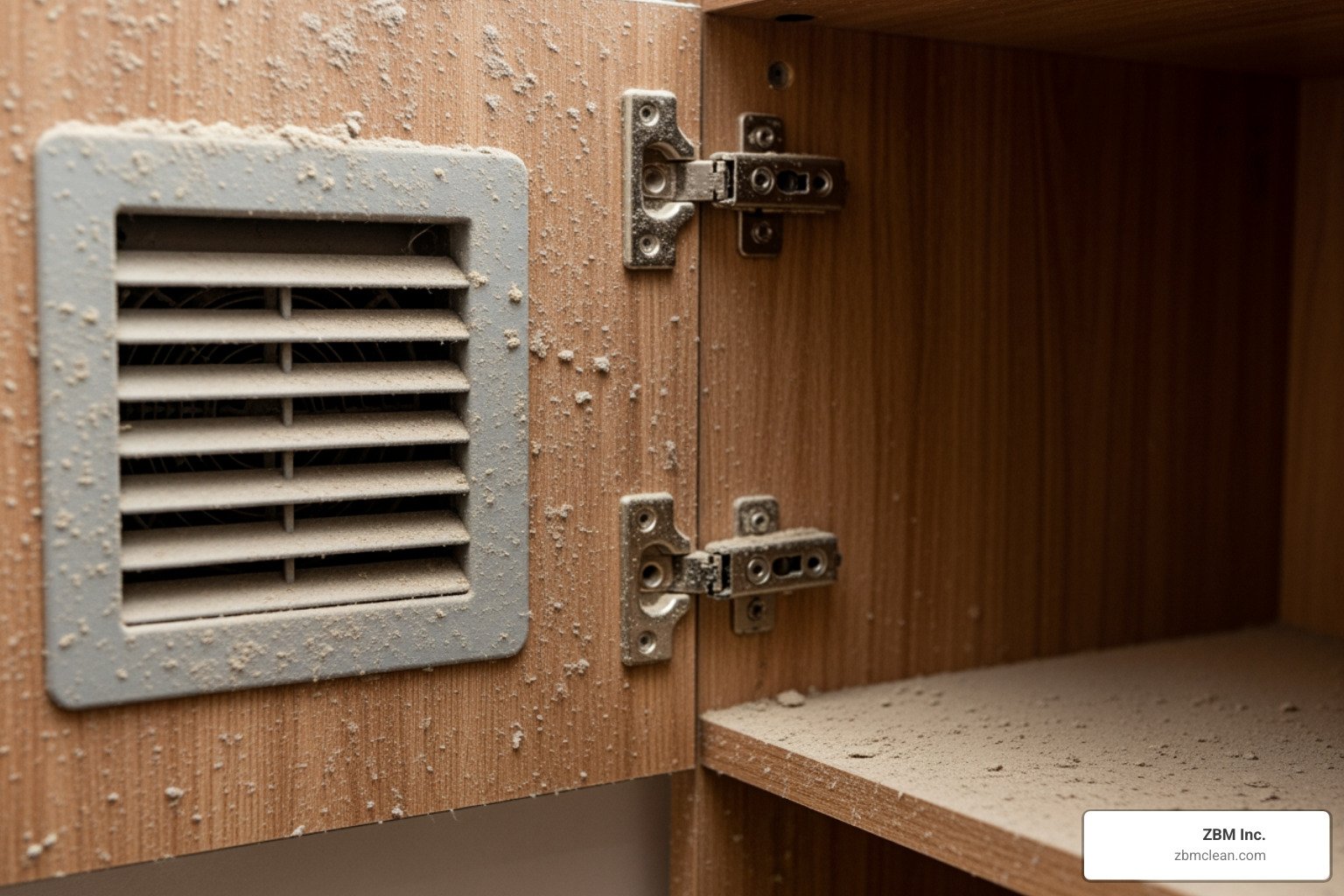
If those areas are skipped, the property may look clean at first glance but still feel dusty, smell stale, or fail a close walkthrough.
2. 10 Reasons Certified Post Construction Cleaners Are Worth Every Penny
1-3: Better dust removal, safer occupancy, and faster project turnover
They remove dust more effectively. Fine construction dust is exactly why HEPA filtration matters. Brooms and standard vacuums often push particulate around instead of capturing it. Certified crews use filtration and methods designed for ultra-fine dust, including dust hidden in vents, fixtures, trim, and cabinet interiors.
They help create a healthier indoor environment. Research consistently points to construction particulate as an indoor air quality concern. Dust from drywall, wood, insulation, and masonry can linger in the space and circulate through HVAC systems if not properly extracted. The EPA’s indoor air quality guidance is a helpful reference for understanding why airborne particulate and ventilation concerns matter after renovation work.
They speed up turnover. Whether you are a homeowner in Watertown waiting to move back in or a contractor trying to hit a handoff date in Southeast Wisconsin, specialized crews work faster because they know the sequence, tools, and problem spots.
4-7: Less damage, fewer callbacks, proper safety, and accurate scope control
They protect new finishes. New quartz, tile, hardwood, stainless steel, and painted trim all require the right chemistry and technique. Harsh abrasives, excessive moisture, or the wrong scraper can turn a cleaning bill into a repair bill.
They reduce callbacks and re-cleans. One industry lesson is clear: poor documentation and weak scope control lead to recleaning and lost time. Trained crews use walkthroughs, checklists, and clear scopes so expectations match results.
They follow safety-aware practices. Construction environments can include sharp debris, ladders, unfinished surfaces, trip hazards, and chemical residues. OSHA-aware crews understand how to work more safely around those conditions.
They control the scope better. Good post-construction cleaning is not guesswork. It includes site visits, surface review, labor planning, and sometimes change orders if the scope expands. That is especially valuable on larger commercial and municipal jobs.
8-10: Better presentation, better client satisfaction, and better long-term value
They improve the final presentation. A proper final clean makes the work itself look better. Floors shine, fixtures sparkle, windows are clear, and surfaces look finished instead of freshly disturbed.
They improve satisfaction for owners, tenants, and buyers. A clean handoff reduces stress. It also helps with staging, listing photos, tenant turnover, and first impressions. No one wants their first memory of a renovation to be wiping dust out of silverware drawers.
They protect long-term value. Dust trapped in vents, abrasive particles on floors, and residue left on surfaces can create wear over time. Proper cleaning is not just cosmetic. It helps preserve the investment.
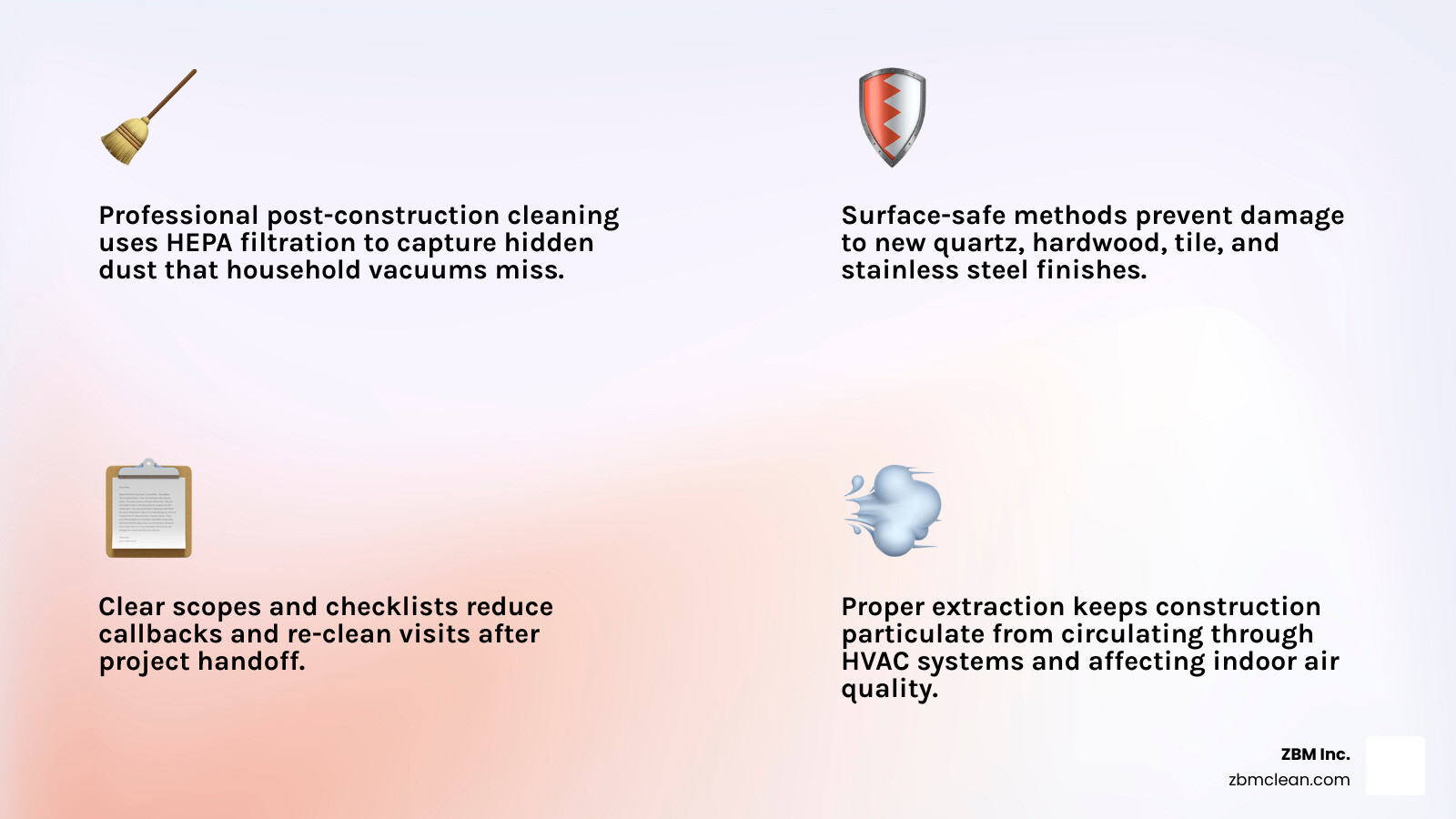
| DIY or General Cleaning | Professional Post-Construction Cleaning |
|---|---|
| Household vacuum or broom | HEPA filtration and specialty tools |
| Focus on visible dirt | Focus on visible and hidden particulate |
| Limited finish knowledge | Surface-safe methods for new materials |
| No formal site protocols | Safety-aware workflow and documentation |
| Often takes multiple frustrating weekends | Usually completed in one visit or planned phases |
3. Certifications, Training, and Credentials to Look For in Certified Post Construction Cleaners
The certifications and training that matter most
When evaluating certified post construction cleaners, look for a mix of formal training, practical site experience, and company-level protections.
Important signs include:
- IICRC-related training or continuing education
- OSHA awareness for job-site safety
- ISSA-aligned best practices
- Knowledge of manufacturer cleaning methods for specialty finishes
- Experience conducting site walkthroughs and identifying hazards before work begins
In our case, ZBM Inc. is licensed, bonded, insured, family-owned, and staffed by certified professionals serving Watertown, Dodge County, Jefferson County, and surrounding Southeast Wisconsin communities.
How to verify insurance, bonding, and real-world experience
Do not be shy about asking for proof. A qualified company should be able to provide documentation and answer questions clearly.
Ask for:
- Certificate of insurance
- General liability coverage details
- Workers’ compensation information
- Bonded status confirmation
- Written proposal or scope sheet
- Experience with similar residential or commercial projects
- References or examples of completed work
- Pricing method, whether hourly, per square foot, or custom by scope
A polished proposal matters too. If the estimate is vague, the job may be vague.
Questions homeowners and contractors should ask before hiring
Before signing anything, ask:
- Have your crews been trained specifically for post-construction cleanup?
- Do you use HEPA vacuums for fine dust?
- How do you protect new floors, counters, and fixtures?
- What is included in the written scope?
- Do you clean vents, cabinet interiors, and window tracks?
- How do you handle change orders if the scope grows?
- What is the expected timeline?
- Are you licensed, bonded, and insured?
For more guidance, see More info about choosing a cleaning service.
4. How Professionals Handle Dust, Debris, and Delicate New Finishes
How certified post construction cleaners remove fine dust without spreading it
The biggest mistake in post-construction cleanup is treating fine dust like normal dust. It is not. It spreads easily, settles repeatedly, and can get pulled into HVAC systems.
Our preferred professional approach includes:
- HEPA extraction instead of dry sweeping
- Ceiling-to-floor cleaning sequence
- Anti-static microfiber cloths for detail wiping
- Cleaning vents, returns, and high ledges early in the process
- Multiple passes when needed
- Damp wiping after vacuuming to collect remaining particulate
This is why crews often wait until most trades are done and dust-producing work has stopped. Cleaning too early can mean doing the same work twice.
Removing stickers, glue, paint specks, and grout haze safely
Residue removal is where inexperience shows quickly. Sticker adhesive, caulk smears, dried paint, and grout haze all require care.
Professionals use:
- Surface-appropriate adhesive removers
- Non-abrasive pads and tools
- pH-neutral cleaners where needed
- Controlled moisture on wood and LVP
- Glass-safe detailing methods
- Test spots before treating sensitive finishes
The goal is simple: remove the residue, not the finish.
Equipment, products, and site safety protocols pros use
A properly equipped post-construction crew may use:
- HEPA vacuums
- Microfiber cloths and dusters
- Industrial floor scrubbers
- Extension tools and ladders
- PPE such as gloves, eye protection, and respirators when needed
- Area closed signs
- Site inspection forms
- Safety sign-off procedures
- Eco-friendly or low-residue products when appropriate
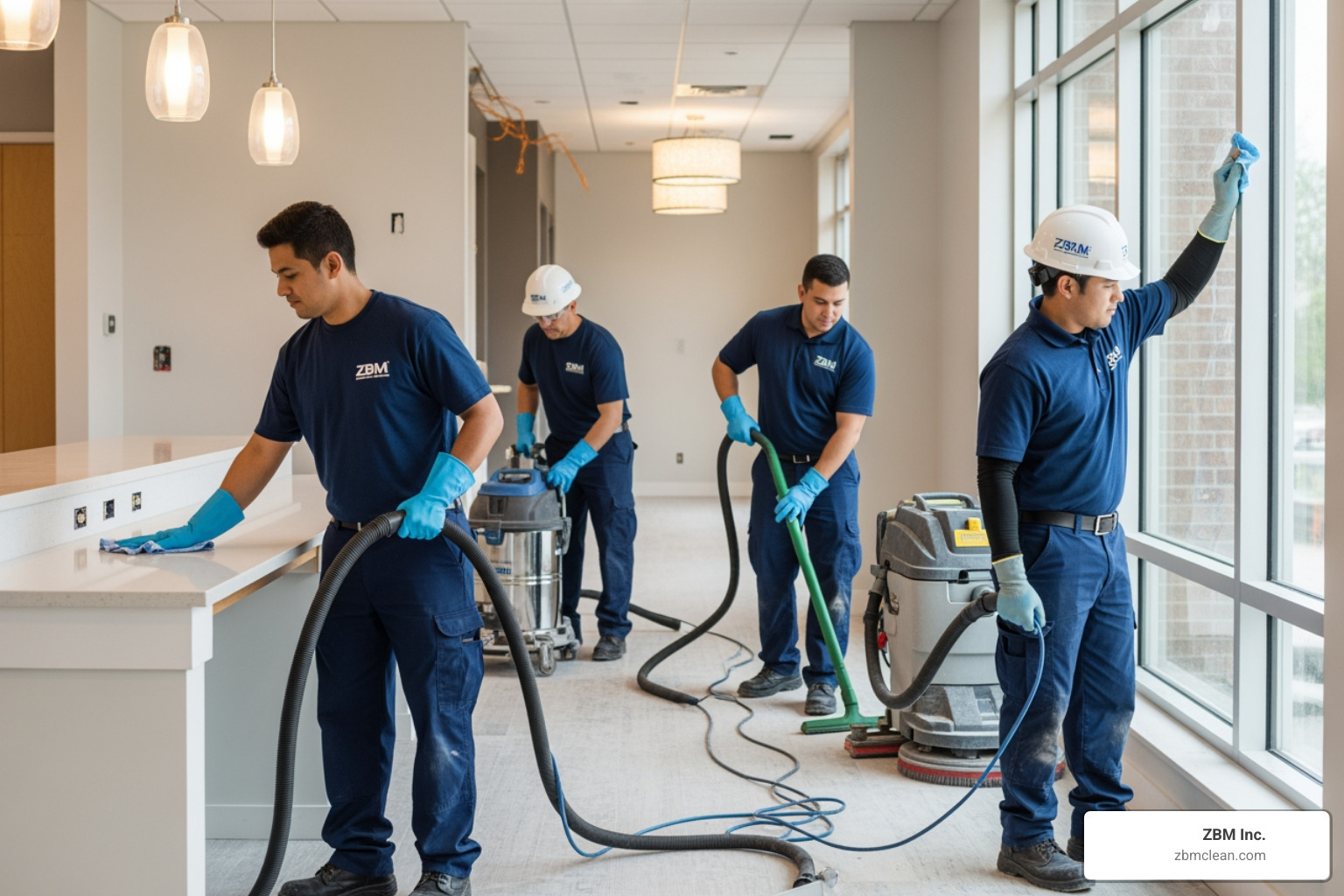
If you want a deeper look at site-ready cleaning methods, read More info about cleaners for construction sites.
5. Cost, Timing, and Scheduling: What to Expect Before You Book
Typical post-construction cleaning costs in 2026
Pricing in 2026 usually depends on:
- Square footage
- Type of project
- Amount of dust and residue
- Number of rooms and levels
- Surface sensitivity
- Whether the project needs one clean or multiple phases
Based on current market ranges in the research, common examples include:
- Bathroom remodel cleanup: about $245 to $325
- Kitchen remodel cleanup: about $325 to $455
- Major renovation cleanup: about $325 to $650 and up
- Some providers also price hourly or by square foot on larger jobs
These are broad benchmarks, not one-size-fits-all promises. A full home renovation with cabinetry, windows, vents, and floor detailing will price differently than a single finished bathroom.
How long a post-construction cleaning usually takes
Timing varies with size and complexity.
Typical ranges from the research include:
- Single-room renovation: half a day in some cases
- Full-home renovation cleanup: roughly 5 to 10 hours depending on scope
- Larger projects: 1 to 3 days is common
- Commercial work: often based on crew size, access, and schedule coordination
Kitchen and bathroom remodels often take longer than people expect because they create lots of dust and have many detail surfaces.
When to schedule cleaning in the construction timeline
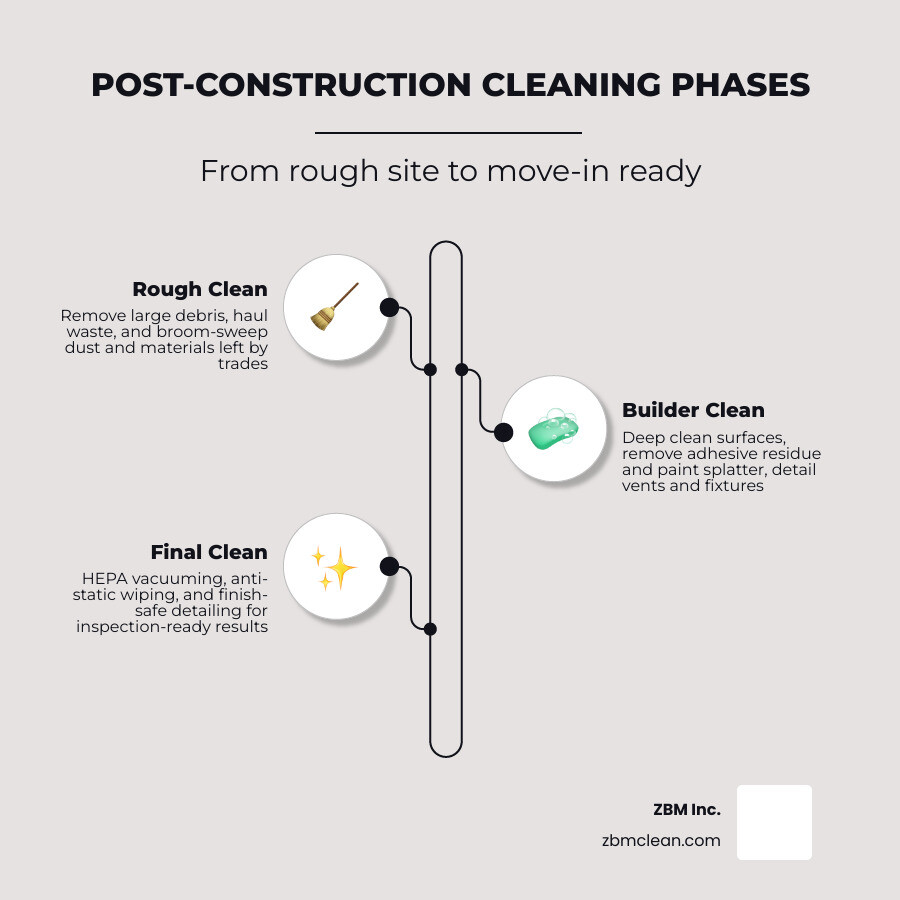
The best timing is usually after all major trades are finished and dust-producing work is complete. Many projects benefit from this phased approach:
- Rough clean: during construction to remove bulk debris
- Builder clean: after finish installation
- Final clean: before move-in, handoff, inspection, or staging
- Touch-up clean: after punch-list work if needed
It is also smart to allow 24 to 48 hours for dust settling before the final pass. For more on service timing and planning, visit More info about what to expect.
6. How to Choose the Right Certified Post Construction Cleaners for Your Project
Red flags that signal a company is not qualified
Watch out for companies that:
- Cannot show insurance or bonding
- Offer no written scope of work
- Use household vacuums for construction dust
- Give vague or suspiciously low pricing
- Skip the site visit or walkthrough
- Do not ask about finishes or surfaces
- Cannot explain their dust-control process
- Have no references or relevant project history
Green flags that show a company is worth hiring
Good signs include:
- Licensed, insured, and bonded status
- Certified professionals
- Family-owned accountability
- Experience with residential and commercial projects
- Clear communication and scheduling
- Quality checks or walkthrough verification
- Ability to coordinate with contractors and property managers
- Service in your local Wisconsin area
At ZBM Inc., that local focus matters. We serve Watertown, Dodge County, Jefferson County, Lake Mills, Southeastern WI, and nearby areas with full-service cleaning solutions that go beyond a basic wipe-down.
Best next step for homeowners, builders, and property managers
The smartest next step is to request an on-site estimate and a written checklist. That gives everyone a shared understanding of:
- Scope of work
- Timing
- Access
- Surface concerns
- Completion standards
You can also explore:
- The Blueprint for Choosing a Commercial Construction Cleaning Partner
- Don’t Let the Dust Settle on Your New Renovation
Frequently Asked Questions about Certified Post Construction Cleaners
Is hiring certified post construction cleaners really better than DIY?
Yes. DIY cleanup usually misses hidden dust, lacks HEPA equipment, and increases the risk of scratching or dulling new finishes. It also takes far longer than most people expect. If you value your time, your lungs, and your brand-new floors, professional help is usually the better bargain.
Can a general cleaning company handle post-construction cleanup?
Sometimes, but only if they have the right training, equipment, and experience. General cleaning and post-construction cleaning are not automatically the same service. Ask specifically about debris, fine dust, specialty residues, site hazards, and finish-safe methods.
What paperwork should I ask for before the job starts?
Ask for:
- Certificate of insurance
- Scope sheet or proposal
- Change order form
- Any applicable waiver
- Checklist or completion standards
- Timeline and access plan
That paperwork protects both sides and helps prevent misunderstandings.
Conclusion
Hiring certified post construction cleaners is about more than making a project look nice. It is about protecting new finishes, improving indoor air quality, reducing liability, shortening punch-list delays, and delivering a space that actually feels finished.
For homeowners, builders, and property managers in Watertown and across Southeast Wisconsin, the real value is peace of mind. You get a healthier space, better presentation, and one less post-renovation headache to manage.
If you are planning a cleanup after construction, remodeling, or a major renovation, learn more about Commercial cleaning services how we can help or Visit ZBM.