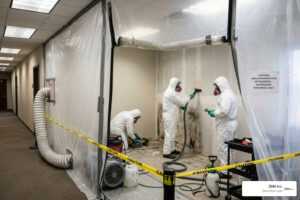
What Are Mold Abatement Services (And Why They Matter)
Mold abatement services are professional treatments that identify, contain, remove, and prevent mold growth in buildings — restoring safe indoor air quality and protecting the structure from further damage.
Here’s a quick breakdown:
- What it is: A professional process to control and eliminate mold colonies in homes or commercial buildings
- Who needs it: Property owners or managers with visible mold, musty odors, water damage, or worsening allergy symptoms indoors
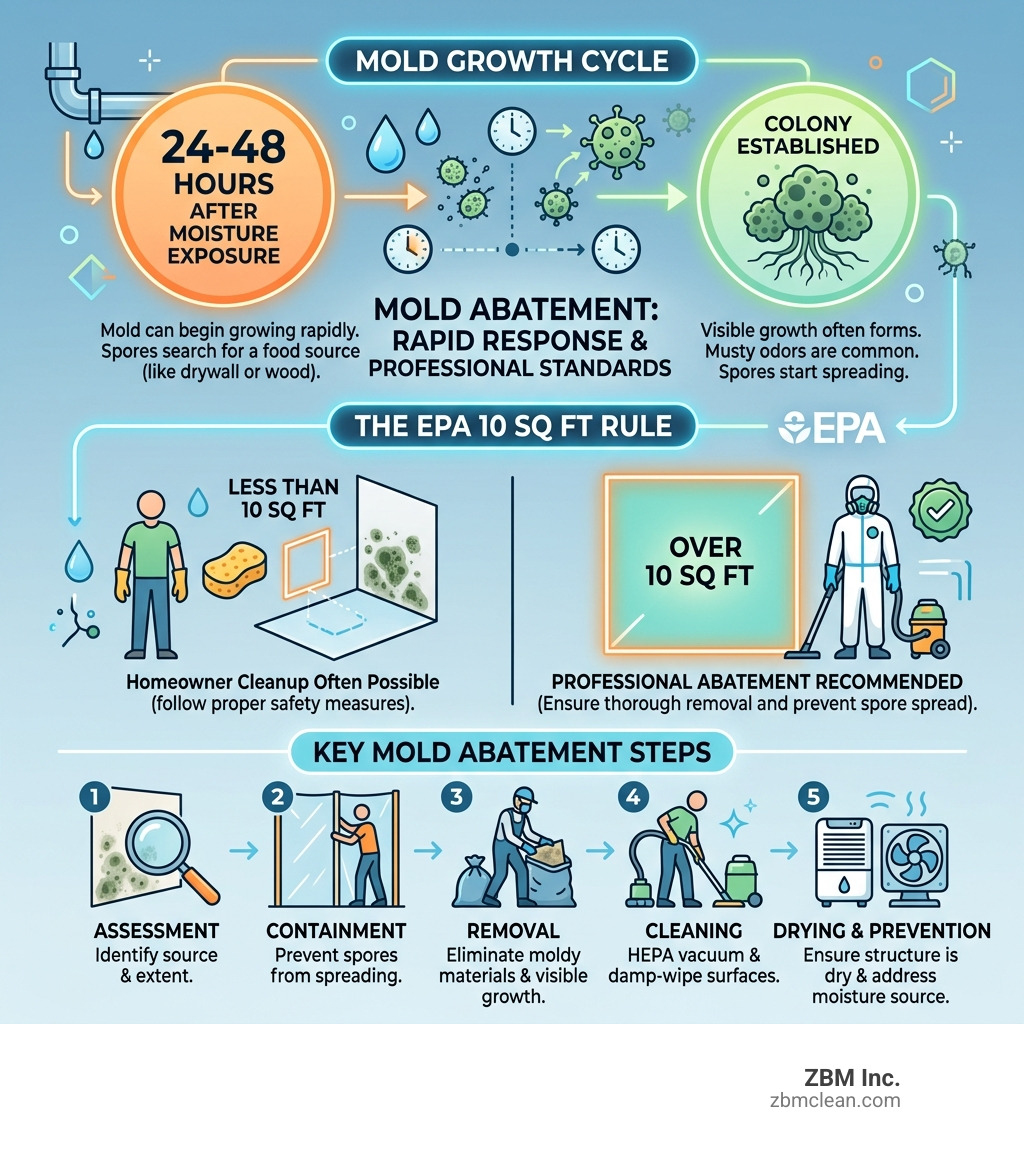
- When to act: Mold can begin growing within 24–48 hours after moisture exposure — fast action is critical
- EPA guideline: Professional abatement is recommended when mold covers more than 10 square feet
- Key result: Mold levels are reduced to safe, normal levels — protecting occupants and the building itself
Mold doesn’t wait. Once moisture finds its way into a wall, ceiling, or floor, spores can spread quickly — often in hidden places you’d never think to look. For a commercial property manager, that means potential health complaints from tenants, structural damage, and liability exposure if left unaddressed.
The problem is that wiping down a visible patch of mold rarely solves anything. Without treating the source and containing the spores, the mold simply comes back — or spreads somewhere worse.
I’m Terry Zastrow, owner of ZBM, Inc., a certified IICRC firm with nearly 30 years of experience delivering professional mold abatement services to municipal agencies, housing authorities, and commercial clients throughout Wisconsin. In this guide, I’ll walk you through everything you need to know to handle mold the right way.
Understanding Mold Abatement Services vs. Remediation
When you start searching for help with a fungal problem, you’ll run into three terms: removal, remediation, and abatement. While they are often used interchangeably in casual conversation, in the restoration industry, they carry distinct meanings.
Mold Removal is exactly what it sounds like—physically getting rid of the mold. However, as experts, we know that “total removal” of every single mold spore is technically impossible. Spores are microscopic and exist naturally almost everywhere, both indoors and outdoors. Any company promising “100% mold removal” isn’t being entirely honest with you.
Mold Remediation focuses on returning the mold levels in your property to a “normal” or “natural” state. This involves cleaning and treating the area so that the spore count indoors is no higher than the spore count outdoors.
Mold Abatement Services, however, represent the most comprehensive approach. Abatement is a term often used in regulated environments (like asbestos or lead) that refers to the act of “ending” or “suppressing” the nuisance. Mold abatement encompasses the entire lifecycle of the project: identifying the moisture source, containing the area to prevent cross-contamination, removing the growth, and implementing long-term suppression strategies so the mold doesn’t return.
| Feature | Mold Removal | Mold Remediation | Mold Abatement |
|---|---|---|---|
| Primary Goal | Physical cleaning of visible spots | Balancing spore counts to safe levels | Total suppression and source control |
| Moisture Repair | Not always included | Usually included | Mandatory part of the process |
| Containment | Basic | Standard (IICRC) | High-level/Environmental |
| Post-Testing | Rare | Recommended | Standard practice |
Health Risks and the Need for Mold Abatement Services
We don’t just provide mold abatement services to keep your walls looking pretty; we do it because mold is a biological hazard. When mold colonies are disturbed, they release microscopic spores, mycotoxins, and allergens into the air you breathe.
For many people, this leads to “hay fever” symptoms: sneezing, runny noses, red eyes, and skin rashes. However, for those with asthma or weakened immune systems, the reactions can be much more severe. Certain types of mold are particularly notorious for their impact on human health. You can learn more about these in our guide on The 5 Types Of Toxic Mold Why You Need Biohazard Cleanup.
One of the most dangerous forms of exposure is “Stachybotryotoxicosis,” caused by Stachybotrys chartarum, commonly known as black mold. This can lead to chronic fatigue, persistent headaches, memory loss, and even neurological issues. If you find yourself feeling sick only when you are inside your home or office, your building might be making you ill.
When to Call for Professional Mold Abatement Services
How do you know if you can handle a spot with a bucket of soapy water or if you need to call us in Watertown? The Environmental Protection Agency (EPA) provides a very clear rule of thumb: if the mold growth covers more than 10 square feet (roughly a 3-foot by 3-foot patch), you need professional mold abatement services.
Other signs that it’s time to call in the pros include:
- The “Nose Test”: A persistent, earthy, or musty odor that doesn’t go away with cleaning.
- Visible Spots: Clusters of black, green, or white fuzzy growth on walls, baseboards, or ceilings.
- Water History: If you’ve recently had a pipe burst, a roof leak, or a basement flood in Southeastern WI, mold is likely lurking behind the scenes.
- Structural Damage: Peeling paint, warped wood, or “bubbling” wallpaper are all signs that moisture—and mold—are trapped inside the structure.
The Professional Remediation and Abatement Process
When ZBM Inc. arrives at a property in Lake Mills or Minocqua, we follow a strict, science-based protocol. We don’t just start scrubbing; we follow a process designed to protect the rest of your building from becoming contaminated.
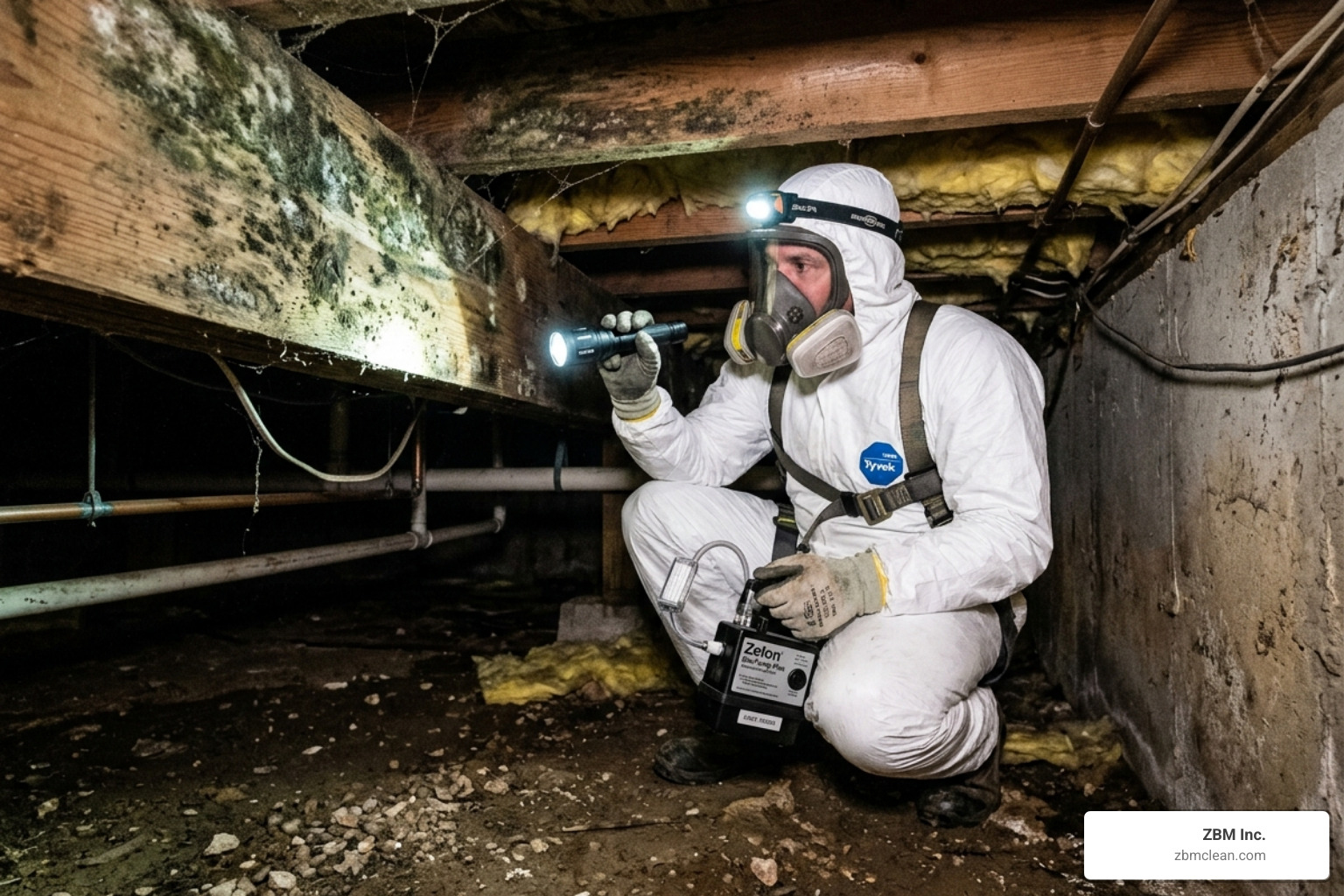
- Inspection and Assessment: We use moisture meters and thermal imaging to find where the water is coming from. We also collaborate with industrial hygienists when necessary to perform air quality testing.
- Containment: This is the most critical step. We use heavy-duty polyethylene sheeting to seal off the affected room. We also turn off the HVAC system and seal vents so spores can’t travel through the ductwork.
- Negative Air Pressure: We use “air scrubbers” to create negative pressure. This ensures that when we open the door to the containment area, air flows into the dirty room, not out into the clean parts of your house.
- HEPA Filtration: Our equipment uses High-Efficiency Particulate Air (HEPA) filters, which are capable of capturing 99.97% of particles as small as 0.3 microns.
- Removal and Cleaning: We remove “porous” materials that cannot be saved, such as moldy drywall or insulation. For “non-porous” surfaces like studs or concrete, we use antimicrobial treatments and specialized cleaning techniques. For valuable items, check out The Ultimate Guide To Hiring Furniture Mold Remediation Experts.
Equipment Used in Professional Mold Abatement Services
Professional mold abatement services require more than a sponge and a prayer. We utilize industrial-grade technology to ensure the job is done right:
- HEPA Vacuums: These are not your standard household vacuums. They are designed to trap microscopic spores without exhausting them back into the room.
- Air Scrubbers: These machines continuously filter the air inside the containment zone, removing spores and odors.
- Dehumidifiers: We use high-capacity LGR (Low Grain Refrigerant) dehumidifiers to pull moisture out of the air and the building’s structure.
- Moisture Meters: These allow us to “see” inside walls to determine if the wood studs are truly dry before we seal them back up.
- Personal Protective Equipment (PPE): Our technicians wear N-95 masks or respirators, gloves, and full-body suits to stay safe during the process.
Prevention and Maintenance After Abatement
Once we have completed the mold abatement services, the goal is to make sure we never have to come back! Mold is an opportunistic organism; it only needs three things to grow: organic food (like drywall or wood), oxygen, and moisture. Since you can’t remove the food or the oxygen, you must control the moisture.
Long-Term Strategies for a Mold-Free Environment
The most important rule for property owners in Wisconsin is to keep indoor humidity levels below 45%. When humidity climbs above 60%, mold can start growing even without a liquid water leak.
- Moisture Mapping: Regularly check “wet” areas like bathrooms, laundry rooms, and basements. If you see condensation on windows, your humidity is too high.
- Ventilation: Use exhaust fans in bathrooms and kitchens. Ensure your clothes dryer is vented correctly to the outside.
- Roof and Gutter Maintenance: In places like Dodge County, heavy snow and rain can tax your drainage system. Keep gutters clear so water moves away from the foundation.
- Plumbing Checks: A tiny “pinhole” leak in a pipe can feed a massive mold colony behind a wall for months before you notice it. Check under sinks and around water heaters monthly.
- Air Duct Cleaning: Dust and debris in your HVAC system can hold moisture and provide a food source for mold. Regular cleaning keeps the air moving and the system dry.
Frequently Asked Questions about Mold Abatement
How long does the mold abatement process typically take?
The timeline depends entirely on the size of the infestation. A small job (under 10 square feet) can often be completed in 2 to 3 days. However, larger residential or commercial infestations in Southeastern WI may take a week or longer.
Mold can grow in as little as 24 to 72 hours, but drying out the structure properly takes time. We cannot rush the drying process; if we seal up a wall while the studs are still damp, the mold will be back in a matter of days.
Does homeowners insurance typically cover mold remediation?
This is a tricky one. Generally, insurance covers mold if it was caused by a “sudden and accidental” event, such as a pipe bursting or a water heater failing. If the mold is the result of long-term neglect (like a roof that has been leaking for five years) or high humidity from a lack of maintenance, it is often excluded.
We always recommend documenting everything with photos and logs. We work closely with adjusters to provide the necessary documentation to help support your claim.
What are the licensing and certification requirements for professionals?
In the state of Wisconsin, it is vital to hire a company that follows IICRC S520 standards (the “bible” of mold remediation). While some states like Texas have very specific state-level licensing (managed by the TDLR), Wisconsin relies heavily on national certifications and OSHA safety standards.
At ZBM Inc., our technicians are specifically trained in biohazard and mold protocols. We are licensed, bonded, and insured, which protects you as the property owner. Never hire a “handyman” for mold; if they don’t use proper containment, they could spread the mold throughout your entire HVAC system, turning a $2,000 problem into a $20,000 disaster.
Conclusion
Dealing with mold is stressful, but you don’t have to handle it alone. Whether you are managing a commercial facility in Watertown or a home in the Northwoods, ZBM Inc. provides the expert mold abatement services you need to breathe easy again.
As a family-owned, licensed, bonded, and insured firm, we take pride in our “no shortcuts” approach. We don’t just hide the problem; we solve it. If you suspect you have a fungal issue, don’t wait for it to spread. Check out our resource on The 5 Types Of Toxic Mold Why You Need Biohazard Cleanup to understand the risks, and then give us a call. We’re here to help our neighbors across Jefferson County and beyond stay safe, dry, and mold-free.