1. Establishing Accountability with Professional Commercial Cleaning Partners
To find the right commercial kitchen cleaning company for your schedule checklist, evaluate prospective contractors on their verified certifications, specialized industrial equipment capabilities, and capacity to handle high-risk zones like hot cooklines, sub-floor grease drainage, and ventilation systems. Facility managers should confirm that providers offer documented compliance records aligned with local health codes and can seamlessly execute scheduled deep sanitation alongside routine facility maintenance.
Accountability frameworks track certified commercial service visits, ensuring specialized deep-cleaning teams handle heavy restorative maintenance on a predictable schedule. Partnering with professional cleaning contractors provides facility managers with verified service documentation and reliable oversight across all operational areas.
Utilizing structured management tools eliminates guesswork and ensures consistent oversight throughout your facility. Reviewing our commercial cleaning checklist and tips helps operators understand how structured service tracking prevents operational gaps while maintaining rigorous facility standards.
2. Structuring Your Commercial Kitchen Cleaning Schedule Checklist with Professional Providers
Managing commercial kitchen hygiene requires coordinating everyday facility upkeep with specialized heavy-duty sanitation contracts. When evaluating professional cleaning providers, a well-designed commercial kitchen cleaning schedule checklist enables facility managers to outline service scopes, verify vendor capabilities, and schedule industrial degreasing and deep sanitation.
Selecting Commercial Cleaning Specialists for Front-of-House and Back-of-House Needs
A comprehensive facility plan unites dining areas and prep stations under structured commercial service agreements. Back-of-house areas require heavy grease extraction, commercial appliance maintenance, and strict pathogen control, while front-of-house sanitation shapes guest perception and safety. Choosing a qualified commercial cleaning company equipped to handle both zones ensures high-touch dining fixtures and high-risk prep surfaces receive proper sanitization. Operators can review the Ultimate Cleaning Checklist for Restaurants to see how unified front- and back-of-house tracking protocols protect customer health across every touchpoint.
Aligning Contractor Services with Health Code Regulations
Health inspectors evaluate commercial food facilities based on state food safety codes, FDA Food Code benchmarks, and Hazard Analysis Critical Control Point (HACCP) standards. Hiring certified sanitation contractors creates an auditable compliance record, documenting that hot holding surfaces, refrigeration units, and sanitizing systems undergo certified commercial maintenance at verified intervals. Incorporating a quick and complete checklist for kitchen cleaning into your facility management routine ensures complete audit readiness during unannounced health inspections.
3. Segment Equipment Care and Preventative Maintenance Frequencies
Commercial kitchen appliances represent major capital investments. When layers of baked-on carbon, grease, and hard-water scale accumulate on mechanical components, equipment must work harder, resulting in elevated utility costs and premature mechanical breakdowns. Partnering with a dedicated commercial cleaning contractor ensures that critical cooking and refrigeration systems receive certified maintenance before expensive disruptions occur.
When vetting service providers, facility managers should verify the company’s capabilities across specialized equipment categories. A qualified commercial contractor handles coil vacuuming and motor decontamination on refrigeration systems to avoid regulatory temperature excursions, executes industrial deliming on high-temperature warewashers to preserve sanitizing efficacy, and performs restorative chemical degreasing on heavy cooking lines to eliminate fire hazards. Establishing scheduled preventative service contracts protects expensive kitchen assets, reduces long-term operational overhead, and eliminates the disruption of emergency repairs during peak service hours.
4. Differentiate In-House Staff Duties from Specialized Deep Cleaning
A critical responsibility for commercial facility operators is understanding the boundary between everyday station resets and specialized deep cleaning that requires certified commercial contractors. Routine staff duties involve surface organization and station upkeep, whereas industrial degreasing, sub-floor rotary scrubbing, and commercial exhaust duct remediation require certified professionals equipped with commercial extraction machinery.
| Maintenance Category | Routine In-House Scope | Certified Commercial Cleaning Scope |
|---|---|---|
| Cooking Line Surfaces | Basic surface clearing, crumb tray emptying | Complete equipment teardown, carbon removal, behind-line wall restoration |
| Floor & Drainage Care | Surface sweeping, basic mop passes | High-pressure rotary extraction, tile grout chemical restoration, deep drain remediation |
| Refrigeration Units | Basic spill clearing, interior organizing | Condenser coil vacuuming, evaporator housing decontamination, mechanical sanitization |
| Ceilings & Ventilation | Exterior hood wiping, filter swaps | NFPA 96 certified duct cleaning, rooftop fan degreasing, ceiling tile restoration |
| Sanitation & Hygiene | Routine food-contact surface wiping | Facility-wide antimicrobial fogging, biohazard cleanup, odor neutralization |
Relying on certified commercial contractors for specialized restoration tasks guarantees code compliance, minimizes staff turnover, and keeps cooking personnel focused on food quality and service delivery.
5. Prevent Cross-Contamination with Standardized Chemical and Tool Protocols
When selecting an outside sanitation partner, commercial facility managers must ensure the provider enforces rigorous chemical handling and cross-contamination standards. Professional cleaning companies implement disciplined color-coding systems that separate tools and microfibers across distinct kitchen environments, preventing bacteria transfer between raw protein prep lines, cooking stations, guest dining spaces, and back-of-house utility areas.
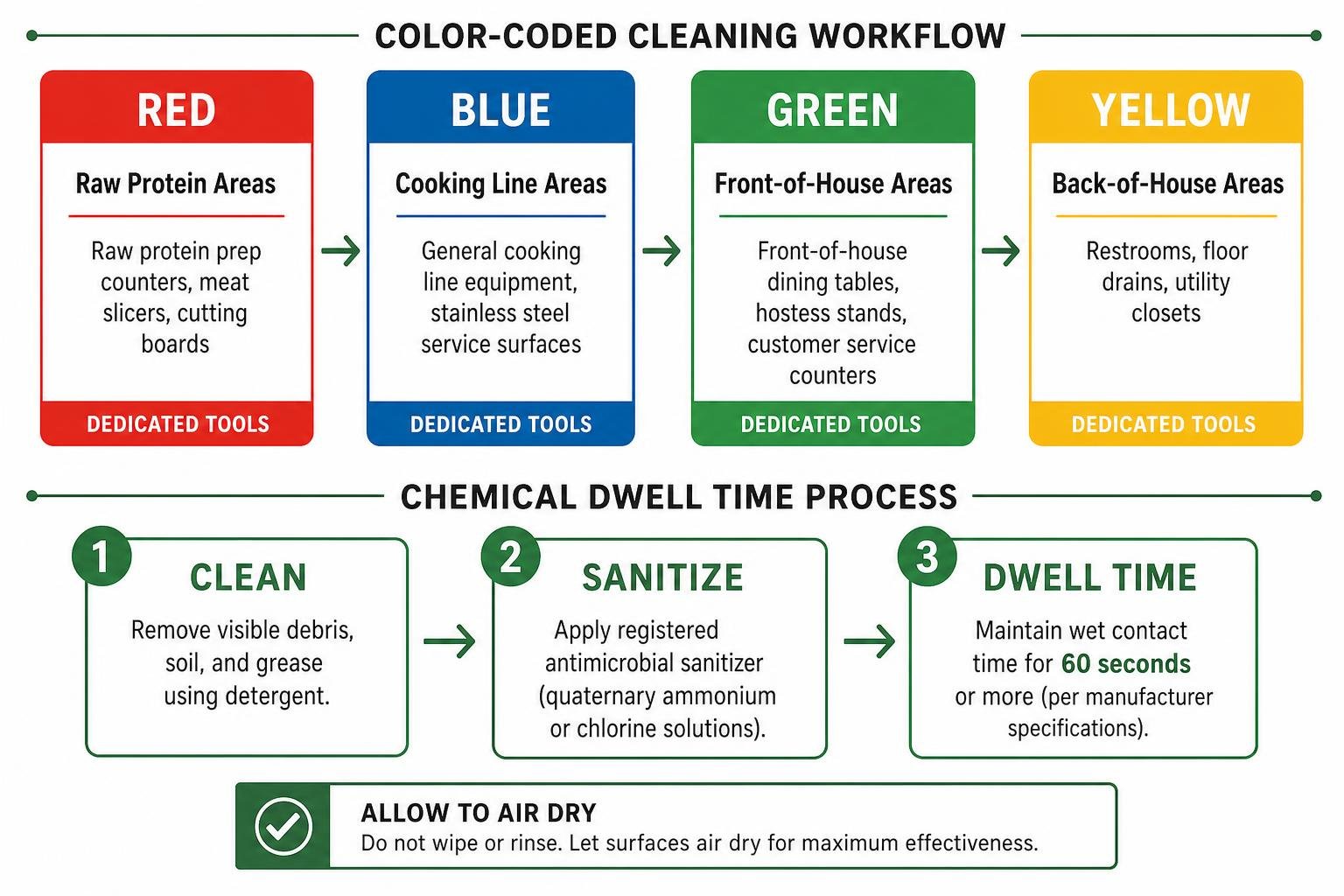
Top-tier commercial cleaning providers also manage chemical dwell times according to EPA registration standards, ensuring hospital-grade disinfectants and quaternary ammonium sanitizers achieve complete microbial elimination without damaging sensitive food prep surfaces. Reviewing our guide on how to set up a stress-free office cleaning schedule provides valuable perspective on evaluating OSHA-compliant commercial cleaning contracts and sanitation standards before hiring a service team.
6. Audit Operational Cleanliness and Address Chronic Sanitation Blindspots

Even in well-run kitchens, chronic sanitation blindspots develop over time as grease, moisture, and organic soils accumulate in out-of-sight structural zones. Finding the right commercial cleaning company ensures these hidden risks are identified and remediated through professional audits before health inspectors arrive.
An experienced commercial sanitation partner targets structural problem areas that standard janitorial routines miss, including descaling internal ice machine components, extracting heavy grease trapped behind and beneath hot cooklines, degreasing ceiling diffusers to protect air quality, and chemically treating floor drain systems to eradicate pest breeding grounds. Contracting a certified cleaning team to audit and resolve these critical zones ensures your facility remains consistently compliant with health codes.
7. Partner with Certified Commercial Cleaning Professionals for Regulatory Compliance
While daily station upkeep belongs in the hands of your staff, maintaining complete regulatory compliance requires professional commercial cleaning support. Heavy-duty tasks such as sub-floor grease extraction, high-temperature pressure washing, biohazard sanitization, and certified exhaust hood degreasing require specialized commercial machinery and certified technicians.
Professional cleaning providers bring industrial truck-mounted extraction equipment, commercial rotary floor scrubbers, and hospital-grade EPA-registered disinfectants that everyday staff cannot deploy. Scheduling routine commercial deep cleans relieves pressure on your kitchen team, protects your equipment assets, and ensures your facility is always prepared for municipal inspections. Professional intervention also prevents long-term structural deterioration that can threaten your operating license.
When your facility needs restorative maintenance beyond everyday staff capabilities, scheduling a comprehensive company kitchen deep clean restores prep areas, tile grout, and equipment lines to pristine, food-safe conditions.
Frequently Asked Questions About Kitchen Sanitation Protocols
How often should high-risk equipment like grease traps and vent hoods be serviced?
Grease traps require regular pumping and servicing every 1 to 4 weeks, depending on kitchen volume and interceptor capacity, to prevent sewer backups and plumbing blockages. Commercial exhaust hoods, fans, and duct systems must receive certified professional servicing compliant with NFPA 96 standards—typically quarterly for high-volume cooking operations (such as 24-hour diners or charbroil kitchens) and semi-annually for moderate-volume facilities.
How does a structured cleaning schedule extend commercial kitchen equipment lifespan?
Consistent cleaning prevents carbonized grease, mineral scale, and particulate dust from degrading heating elements, fan motors, and refrigeration compressors. Removing scale from dishwashers reduces pump motor strain, while keeping refrigeration condenser coils clean prevents compressor burnout. This routine maintenance saves thousands of dollars in premature replacement costs and emergency service calls.
When should a facility hire certified cleaning contractors instead of relying on in-house staff?
A facility should partner with certified cleaning professionals when tasks involve specialized machinery, structural areas, or high-liability sanitation. In-house staff are ideal for daily surface cleaning, prep sanitizing, and shift resets.
However, certified cleaning contractors should always handle intensive floor restoration, sub-surface grease extraction, structural high-dusting, mold remediation, and certified kitchen exhaust cleaning to maintain complete safety, insurance, and regulatory compliance.
Conclusion
Maintaining a spotless commercial kitchen requires combining clear daily staff accountability with routine professional deep cleaning. Utilizing a commercial kitchen cleaning schedule template ensures that everyday surface sanitization occurs consistently while protecting high-value equipment from premature failure, grease buildup, and regulatory penalties.
When everyday staff maintenance is not enough to eliminate embedded grease, restore tile and grout lines, or address deep sanitation requirements across Southeastern Wisconsin, working with certified professionals makes all the difference. ZBM Inc. is a family-owned, licensed, bonded, and insured cleaning company based in Watertown, WI, with certified technicians serving Dodge County, Jefferson County, Lake Mills, Minocqua, and the Northwoods. We deliver specialized, heavy-duty commercial kitchen sanitation that keeps your business compliant, safe, and spotless.
Explore how our full range of certified commercial cleaning services can support your facility’s long-term cleanliness and regulatory compliance today.