Why Your Office Needs a Cleaning Checklist (And What to Do Right Now)
An office cleaning checklist is one of the simplest tools a property manager can use to keep a workplace healthy, professional, and running smoothly.
Here’s a quick overview of what a complete office cleaning checklist covers:
| Frequency | Key Tasks |
|---|---|
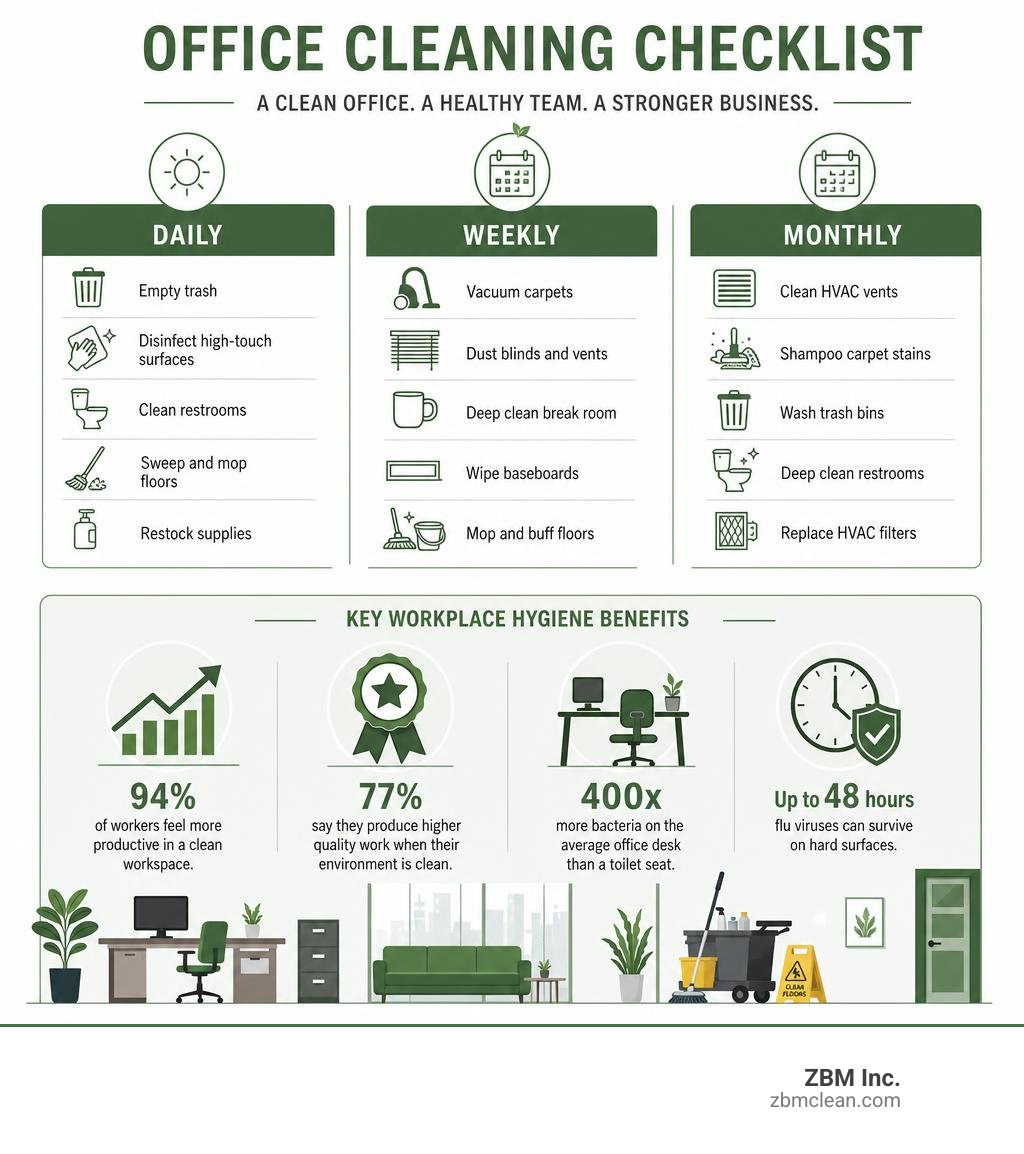
| Daily | Empty trash, disinfect high-touch surfaces, clean restrooms, sweep/mop floors, restock supplies |
| Weekly | Vacuum carpets, dust blinds and vents, deep clean break room, wipe baseboards, mop and buff floors |
| Monthly | Clean HVAC vents, shampoo carpet stains, wash trash bins, deep clean restrooms, replace HVAC filters |
| Quarterly | Strip and refinish hard floors, deep clean upholstery, clean exterior windows, review checklist |
The numbers behind office hygiene are hard to ignore. Research shows that 94% of workers feel more productive in a clean workspace — and 77% say they produce higher quality work when their environment is clean. Meanwhile, the average office desk harbors 400 times more bacteria than a toilet seat, and flu viruses can survive on hard surfaces for up to 48 hours.
For busy commercial property managers in Wisconsin, grime buildup, shared surfaces, and high foot traffic make a structured cleaning plan not just helpful — it’s essential.
I’m Terry Zastrow, owner of ZBM, Inc., a certified IICRC firm with approximately 30 years of experience providing commercial cleaning services to businesses, municipalities, and private-sector clients across Wisconsin — including developing and implementing office cleaning checklist systems that meet OSHA and industry standards. In the sections below, I’ll walk you through everything you need to build, manage, and scale a cleaning program that works for your facility.
Why a Structured Office Cleaning Checklist is Essential for Business Success
Many business owners view office cleaning as a purely cosmetic chore. But keeping a commercial facility clean is actually a form of asset management and risk mitigation. When you establish a structured cleaning routine, you are protecting your physical property, defending your team from seasonal illnesses, and securing your brand’s reputation.
A lack of structure leads to what we call “visual cleaning”—only wiping down what looks dirty while leaving microscopic pathogens to multiply. Over time, neglected dust, grime, and moisture will degrade office assets. Carpets wear out faster when abrasive dirt is left ground into the fibers, and HVAC systems work twice as hard when dust clogs the vents.
Just like you would follow a Spring Home Maintenance Checklist for Wisconsin to protect your home from harsh local weather, you need a systematic approach to protect your commercial space. Implementing a structured schedule ensures you Don’t Let Your Office Get Grimy and suffer unnecessary wear and tear.
Boosting Employee Health, Productivity, and First Impressions
When a client or a high-value job candidate walks into your lobby, they form an opinion about your business within the first three seconds. Smudged entry glass, a faint odor from an unemptied breakroom trash bin, or dusty reception chairs instantly signal a lack of attention to detail.
On the flip side, a sparkling entryway, polished brightwork, and fresh air build immediate trust. We have seen this transformation when taking clients From Drab to Fab in the Watertown Office, proving that cleanliness directly influences visitor perception.
Furthermore, employee morale is closely tied to physical surroundings. Working in a cluttered, dusty office is draining. When employees see that their company invests in a clean, hygienic workspace, they feel valued. This respect translates directly into performance: healthy employees take fewer sick days, focus better, and produce higher-quality work.
Identifying and Eliminating Germ Hotspots in the Workplace
Most people assume the dirtiest place in an office is the restroom. In reality, studies show that shared office technology and breakroom surfaces are often far more contaminated.
Let’s look at the most common germ hotspots where bacteria and viruses thrive:
- Computer Keyboards and Mice: The average desk is a breeding ground for microbes, harboring hundreds of times more bacteria than a toilet seat because workers touch them constantly without sanitizing their hands.
- Breakroom Sink Faucet Handles: Because employees touch these handles before washing their hands, faucet knobs accumulate massive bacterial loads.
- Microwave and Refrigerator Door Handles: These are high-traffic touchpoints used by dozens of people daily, rarely getting cleaned between uses.
- Water Fountain Buttons: Moisture combined with frequent finger contact makes these buttons prime real estate for virus transmission.
- Light Switches and Elevator Buttons: These small, vertical surfaces are touched by almost everyone but are frequently missed during routine dusting.
By identifying these areas on your office cleaning checklist, you can target your disinfection efforts where they will actually break the chain of infection.
The Ultimate Daily, Weekly, and Monthly Cleaning Schedule
To keep your office consistently clean without disrupting daily business operations, you must divide tasks by frequency. Trying to do everything at once leads to burnout, while leaving everything for a monthly deep clean creates a hazardous environment.
We recommend establishing a “scheduling window.” Most intensive cleaning should take place after hours—typically between 6:00 PM and midnight—to avoid chemical odors, loud vacuum noise, and slip hazards for employees. However, high-traffic restrooms and breakrooms should receive quick midday touch-ups.

For a complete breakdown of how to structure these schedules, you can download Your Daily Office Housekeeping Guide and Excel Template.
Daily Maintenance: The Core Office Cleaning Checklist Tasks
Daily cleaning keeps your office presentable and prevents germ transmission. These tasks focus on high-touch surfaces, waste removal, and basic floor care:
- Waste Management: Empty all trash and recycling bins, replace liners, and spot-clean the interiors and exteriors of the receptacles.
- High-Touch Disinfection: Wipe down light switches, door handles, push plates, elevator buttons, shared copiers, and desks.
- Restroom Sanitation: Clean and sanitize toilets and urinals (inside and out), scrub basins, polish mirrors, and mop floors with an EPA-registered disinfectant.
- Restroom Restocking: Refill hand soap, paper towels, toilet tissue, and seat covers.
- Breakroom Reset: Wipe down countertops, clean and sanitize the sink, wipe appliance exteriors, and damp-wipe tables and chairs.
- Floor Care: Sweep and damp-mop hard surface floors; vacuum high-traffic carpeted areas and entry mats.
Weekly and Monthly Deep Cleaning Protocols
Weekly and monthly tasks address the areas where dirt accumulates slowly but surely. These tasks prevent long-term wear and maintain indoor air quality.
Weekly Tasks:
- Detailed Dusting: Dust vertical surfaces, baseboards, window sills, door frames, and blinds.
- Upholstery Care: Vacuum upholstered office chairs and lobby seating to remove dust and allergens.
- Glass and Mirrors: Clean interior glass partitions, entry door glass, and polish brightwork.
- Floor Buffing: Buff hard floors to maintain their protective finish.
- Breakroom Fridge Purge: Discard expired food and wipe down interior shelves.
Monthly Tasks:
- High Dusting: Dust ceiling fans, light fixtures, air diffusers, and return grilles.
- HVAC Maintenance: Check and replace HVAC filters (every 30 to 90 days depending on your office’s allergy sensitivity and occupancy).
- Hard Floor Deep Clean: Machine-scrub tile-and-grout lines or refinish composition flooring.
- Deep Disinfection: Wash trash receptacles with disinfectant and perform deep carpet spot extraction.
Cleaning vs. Sanitizing vs. Disinfecting: What is the Difference?
One of the most common mistakes in commercial facility management is using the terms “cleaning,” “sanitizing,” and “disinfecting” interchangeably. They are actually three distinct steps in a professional hygiene program.
| Process | Primary Action | Target Outcome | Typical Products Used |
|---|---|---|---|
| Cleaning | Removes loose dirt, dust, and organic matter through friction. | Visually clean surfaces; prepares the surface for sanitizing or disinfecting. | Soap, water, neutral multi-surface cleaners. |
| Sanitizing | Reduces bacteria on surfaces to safe public health levels. | Prevents foodborne illness and minor germ spread. | Food-safe sanitizers (ideal for breakroom tables). |
| Disinfecting | Kills 99.999% of microscopic pathogens, including viruses and fungi. | Stops the spread of infectious diseases (cold, flu, etc.). | EPA-registered disinfectants. |
To achieve true disinfection, you must respect dwell time—the amount of time a surface must remain visibly wet with a disinfectant to kill target pathogens. Simply spraying and immediately wiping a surface does not disinfect; most professional disinfectants require 1 to 10 minutes of wet contact time to work effectively.
Essential Supplies, Tools, and Safety Protocols
To execute your office cleaning checklist safely and effectively, you need the right professional tools:
- Microfiber Cloths: Unlike cotton rags that spread dirt around, microfiber traps and lifts dust, bacteria, and allergens. Use a color-coded system to prevent cross-contamination (e.g., Red for restrooms, Green for breakrooms, Blue for general dusting).
- HEPA-Filter Vacuums: Standard vacuums spit fine dust back into the air. Commercial vacuums equipped with HEPA filters trap 99.97% of particles down to 0.3 microns, drastically improving indoor air quality.
- Personal Protective Equipment (PPE): Cleaners should always wear appropriate gloves, eye protection, and masks when handling concentrated chemicals.
- Safety Data Sheets (SDS): Keep a dedicated binder containing OSHA-compliant SDS for every chemical used on-site. This must be easily accessible to all staff in case of accidental exposure.
Adapting Your Office Cleaning Checklist for Different Office Sizes
No two offices are identical. A small, five-person real estate office in Lake Mills has different cleaning needs than a multi-story corporate headquarters in Watertown or a heavy-duty industrial warehouse in Dodge County.
For smaller offices (under 1,500 sq. ft.), daily cleaning might be handled in-house with a professional deep clean scheduled once or twice a month. In contrast, multi-story buildings require daily, zone-based cleaning schedules to keep up with foot traffic.
If your business includes industrial components, you will need a specialized checklist that blends office hygiene with industrial safety standards. For these environments, refer to The Watertown Business Guide to Janitorial and Warehouse Cleaning to ensure your plan covers high-ceiling dusting, heavy floor scrubbing, and warehouse safety protocols.
Managing Your Cleaning Program: Accountability vs. Outsourcing
An office cleaning checklist is only as good as the system used to enforce it. Without clear accountability, tasks will inevitably be skipped, and standard operating procedures will slowly fall apart.
Ensuring Accountability and Consistency
To prevent “checklist fatigue” and ensure every task is completed to standard, we recommend implementing the following management tools:
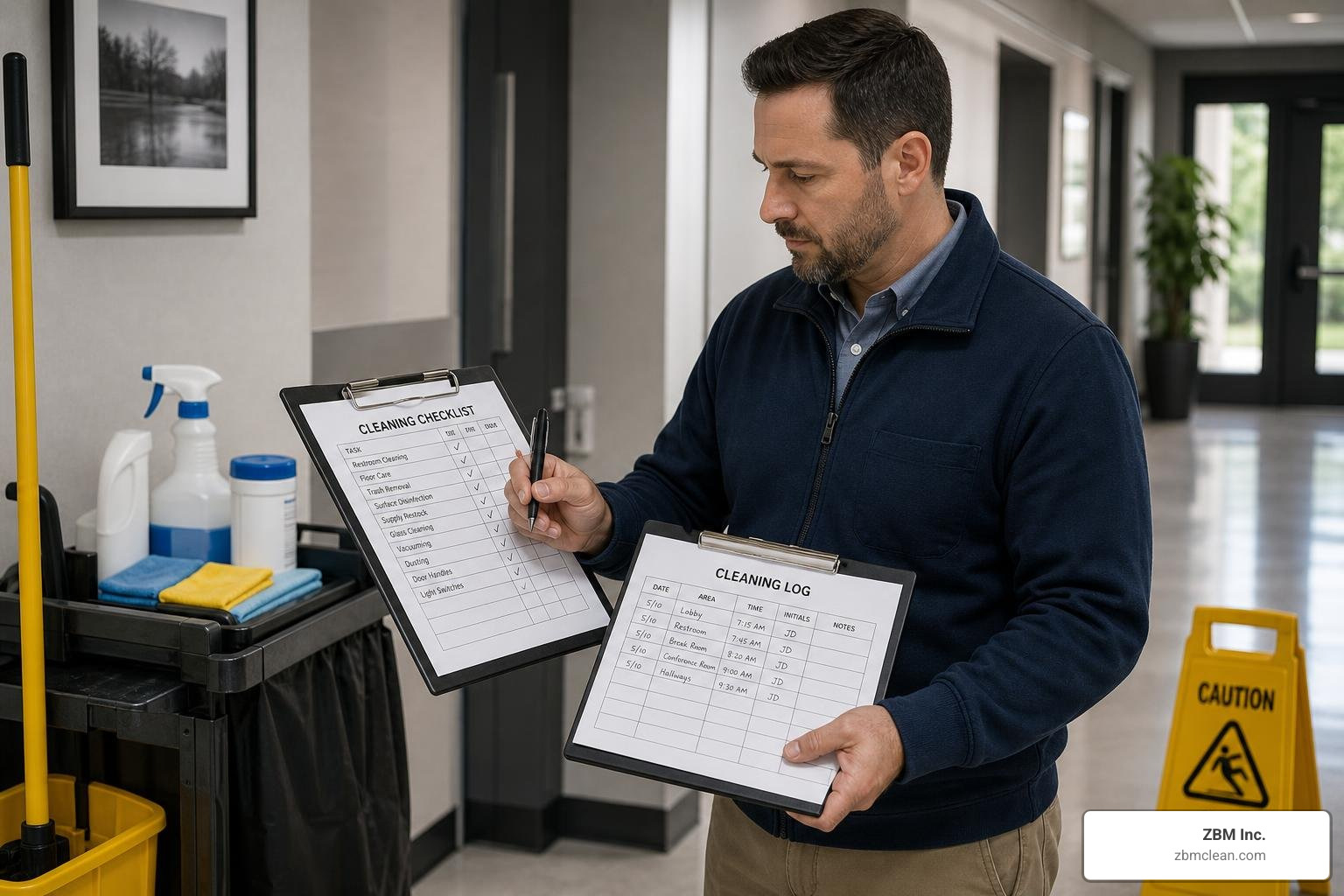
- Digital Logs or Mobile Apps: Have your cleaning team log tasks in real-time. Many modern facilities use QR codes placed in restrooms or breakrooms that cleaners scan to sign off on completed work.
- Photo Evidence: Require cleaners to upload photos of critical areas (like polished lobbies or restocked supply closets) at the end of their shift.
- A Rotating Matrix: Avoid employee burnout by rotating tedious tasks (like high dusting or deep floor scrubbing) among different team members weekly.
- Weekly Audits: Walk the facility with your checklist in hand to verify that the work matches the logs. If you are struggling to find the right team for the job, consult our guide on Finding Reliable Business Cleaners Near Me Without the Headache.
In-House Cleaning vs. Outsourcing: When to Hire Professionals
While nearly 46% of facility managers attempt to keep their cleaning in-house, many quickly realize the hidden costs of DIY operations. Managing an in-house crew means handling hiring, background checks, training, payroll, purchasing expensive commercial equipment, and managing staff call-offs.
Outsourcing your program to a specialized commercial cleaning partner removes these headaches entirely. Professional commercial cleaners bring industrial-grade equipment (like electrostatic sprayers and truck-mounted extractors), OSHA-trained personnel, and automatic backup coverage if a cleaner falls ill.
If you are evaluating your options, reading about 7 Convincing Reasons to Hire Watertown WI Cleaning Companies can help you decide if outsourcing is the right financial and operational move for your business.
Frequently Asked Questions about Office Hygiene
What is the single largest error made during office cleaning?
The single largest error is ignoring chemical dwell time and practicing visual cleaning only. Spraying a disinfectant on a desk and wiping it off immediately only removes surface dust; it does not kill viruses. Additionally, using the same cloth to clean a breakroom table that was just used in a restroom is a major source of dangerous cross-contamination.
How often should office carpets and upholstery be deep cleaned?
At a minimum, high-traffic office carpets and upholstered furniture should undergo professional hot-water extraction twice a year (spring and fall). In Wisconsin, salt and slush tracked in during the winter can destroy carpet fibers if not extracted promptly in the spring, while heavy dust and pollen accumulation in summer requires a deep clean before winter sets in.
How do we prevent cross-contamination between restrooms and breakrooms?
Implement a strict color-coded cleaning system. Use red microfiber cloths and mop heads exclusively for restrooms, yellow for high-risk clinical or touchpoint areas, green for food preparation zones (breakrooms), and blue for general office dusting. These tools must be washed and stored in separate containers to prevent any crossover.
Conclusion
A clean, safe, and professional workplace is not a luxury—it is a foundation for your business’s success. By implementing a structured office cleaning checklist, you protect your employees’ health, boost daily productivity, and project an image of excellence to every visitor who walks through your doors.
Whether you need a reliable partner to handle your daily disinfection, or you want to establish a comprehensive commercial cleaning program in Watertown, Dodge County, Jefferson County, or Lake Mills, we are here to help. At ZBM Inc., we are a licensed, bonded, insured, and family-owned commercial cleaning company. Our certified professionals have been keeping Wisconsin businesses safe and sparkling for decades.
Ready to elevate your facility’s hygiene standards? Contact us today for a custom quote on our Professional Commercial Cleaning Services. Let our family take care of your business so you can focus on what you do best!