Core Foundations of a Functional Office Cleaning Schedule
Establishing a dependable commercial routine relies on understanding what professional operational sanitation entails. In high-traffic office environments, chaos quickly ensues when janitorial contractors or building specifications rely on vague definitions of clean. An effective routine does not merely address surface clutter; it systematically targets soil, bacteria, and viral vectors to protect employee health and support workplace productivity.
Research shows that daily tasks in high-traffic areas such as restrooms and pantries can reduce germ presence by up to 80%. When a facility benefits from a structured approach to environmental health, companies experience a 15% to 25% reduction in employee sick days. Understanding the technical boundaries of surface hygiene helps facility managers set appropriate expectations. For detailed guidelines on maintaining a healthy facility, explore our insights on how to keep your office germ free.
Differentiating Cleaning, Sanitizing, and Disinfecting
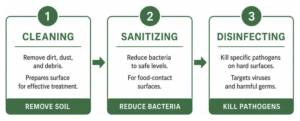
A common failure point in commercial maintenance programs is treating cleaning, sanitizing, and disinfecting as identical tasks. Professional janitorial operations divide these responsibilities into distinct phases:
- Cleaning: The physical removal of organic matter, dust, debris, and surface soil using friction, water, and detergents. Cleaning does not necessarily kill microorganisms, but it lowers their numbers and removes the organic shield that protects pathogens from chemical treatment.
- Sanitizing: Applying chemicals to cleaned surfaces to reduce bacterial counts to levels deemed safe by public health standards. This is standard protocol for food-contact surfaces in office breakrooms.
- Disinfecting: Using specialized, EPA-registered solutions to kill specific pathogens on hard surfaces. Daily disinfection of high-touch points like shared phones, door hardware, and elevator controls prevents 90% of surface pathogens.
Crucially, disinfectants require designated “dwell times”—the period a chemical must remain visibly wet on a surface to destroy targeted organisms—ranging from 30 seconds to 10 minutes depending on the formula. Skipping the initial cleaning step or wiping away disinfectants prematurely renders the chemical ineffective. Facility managers can review the dos and donts of office disinfection to ensure commercial protocols comply with industry health standards.
Zoning Office Spaces by Risk and Foot Traffic
Rather than treating every square foot of an office building equally, a professional office cleaning schedule organizes floor plans into functional zones based on traffic density and consequence of failure. High-density areas present a much higher cross-contamination risk than executive offices or storage rooms.
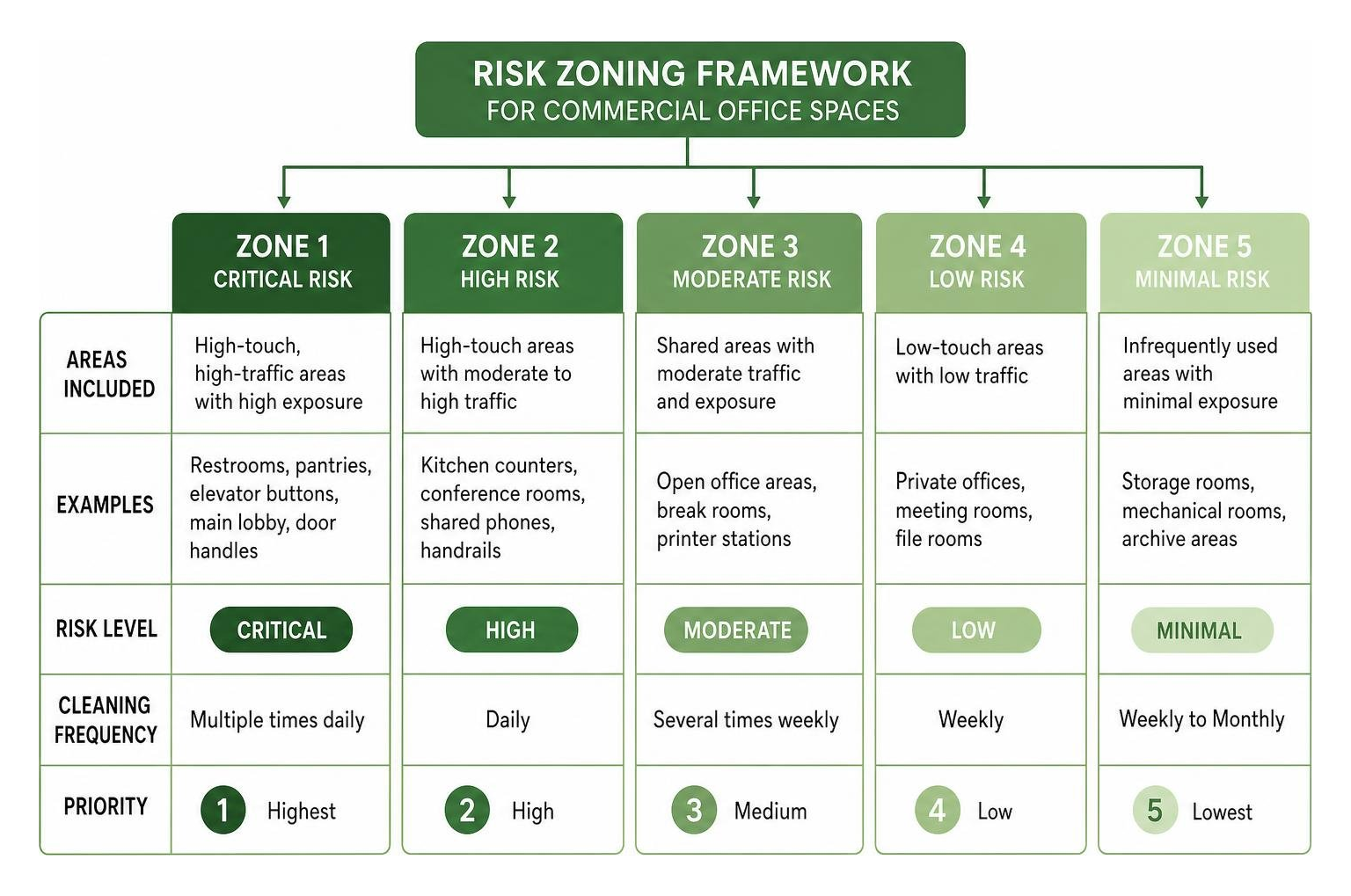
Under commercial operational standards, high-touch zones (such as rest stops, kitchen counters, door handles, and conference tables) demand frequent interventions. Evaluating the consequence of missing a task allows professional janitorial providers to assign labor efficiently. For example, neglecting a main lobby entrance for one day damages client perception and tracks debris across building carpets, whereas skipping a weekly store room dusting has minimal immediate impact.
Structuring Tasks by Frequency: Daily, Weekly, Monthly, and Quarterly
A balanced janitorial program separates routine nightly sweeps from labor-intensive deep care projects to protect service quality and prevent overlooked building areas.
Roughly 40% of standard maintenance programs experience breakdown due to inconsistent task execution. Establishing clear daily, weekly, monthly, and quarterly boundaries ensures every corner of the facility receives appropriate care. Review your complete commercial office cleaning checklist to evaluate standard task distributions.
Daily and Weekly Maintenance Routines
Daily maintenance focuses on high-risk infection vectors, trash accumulation, and visual appearance. Weekly tasks tackle lower-touch surfaces and preventive care before soil embeds into building materials.
Weekly tasks introduce detailed care. Incorporating weekly edge damp mopping and monthly baseboard scrubbing into vendor scope leads to a 28% increase in quality audit scores. Weekly commercial operations also include clearing out expired food items and sanitizing internal appliances—a process outlined in your office kitchen deep clean checklist.
Monthly, Quarterly, and Seasonal Maintenance
Infrequent maintenance items protect the longevity of physical assets like floor coatings, carpets, and air distribution systems.
- Monthly Tasks: High-surface dusting above six feet, deep cleaning tile grout lines, vacuuming HVAC return vents, and treating leather or vinyl office seating.
- Quarterly Tasks: Hot-water carpet extraction, hard floor stripping and refinishing, exterior and interior window washing, and deep cleaning fabric cubicle partitions.
- Seasonal Transitions: Aligning filter changes and vent cleaning with seasonal HVAC shifts prevents allergen build-up and maintains indoor air quality.
Neglecting periodic deep tasks quickly leads to permanent surface degradation. Learn more about overlooked areas by reading 20 office cleaning tasks that dont get done.
Essential Template Components and Digital CMMS Migration
Transitioning from informal maintenance expectations to a structured program requires standardizing documentation. A poorly defined scope leads to guesswork and missed requirements.
Facility managers seeking flexible structural ideas can inspect an office cleaning schedule template in PDF, Pages, Word, Google Docs – Download | Template.net to evaluate format layouts.
Crucial Fields for an Effective Office Cleaning Schedule
To eliminate ambiguity, every commercial task library requires concrete operational fields beyond basic descriptions:
- Zone Identifier: The specific location code or room designation (e.g., Zone A – 2nd Floor Restroom).
- Task Library Item: The precise action required (e.g., Disinfect sink faucets and handles).
- Execution Standard: Clear criteria defining completion (e.g., Surface free of streaks, residue, and water spots; dwell time maintained for 5 minutes).
- Frequency & Service Window: How often and exactly when the task occurs (e.g., Daily, between 7:00 PM and 9:00 PM).
- Assigned Role: The party responsible (e.g., Nighttime Janitorial Shift B).
- Verification Record: The method used to confirm completion (e.g., Digital QR scan timestamp).
For additional structural details on template design, read the comprehensive guide on office cleaning schedule template: A complete guide (2026) – facility management insights.
Moving From Paper Checklists to Digital CMMS
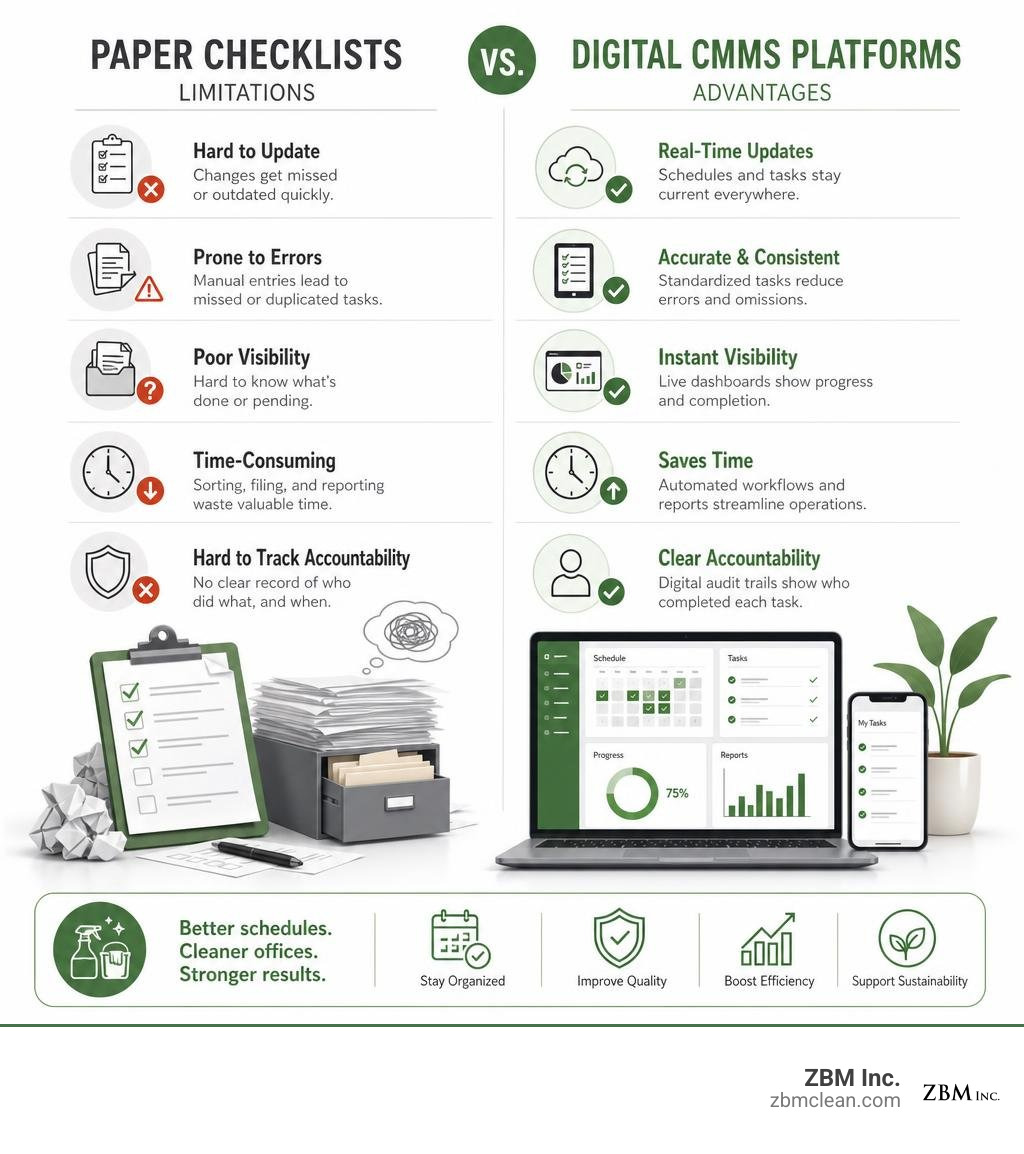
Paper sheets posted behind doors often lead to 25% to 30% task non-compliance because they lack real-time oversight and generate non-actionable historical records. Standardized digital workflows solve these operational gaps.
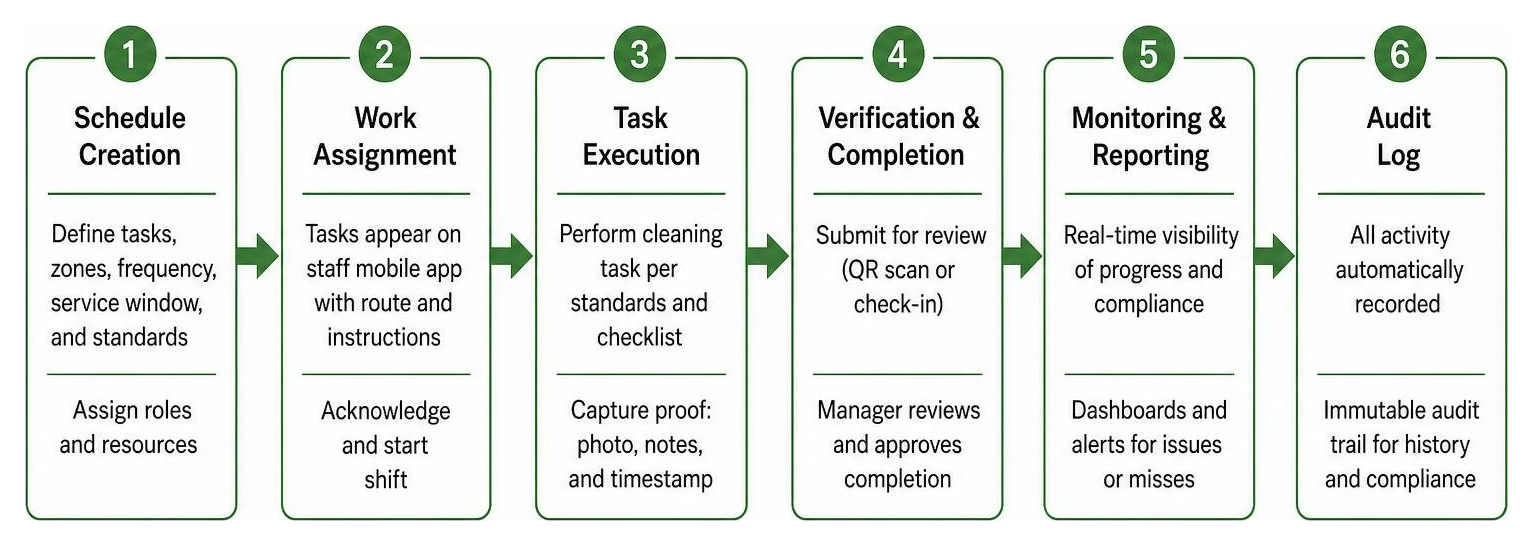
A 2025 IFMA survey revealed that 68% of facility professionals rely on digital platforms for maintenance scheduling. Shifting to a Computerized Maintenance Management System (CMMS) allows managers to attach photo verification, capture real-time route timestamps, and track work orders instantly.
Management, Auditing, and Adapting for Hybrid Environments
Executing an office cleaning schedule consistently requires active quality control, defined labor structures, and adaptability for variable floor plan usage.

Selecting the right operating approach directly impacts facility cleanliness and accountability. Business managers can review the benefits of outsourcing your office cleaning and maintenance to evaluate their operational options.
Managing In-House Staff vs Outsourced Janitorial Services
Facility operations generally choose between managing in-house custodial employees or partnering with a professional commercial cleaning vendor:
| Consideration | In-House Cleaning Staff | Outsourced Janitorial Partner |
|---|---|---|
| Labor Management | Direct hiring, training, and shift coverage handling | Turnkey staffing, managed absence coverage |
| Equipment & Supplies | Capital expenditure for machinery, stock management | Vendor provides commercial equipment & chemicals |
| Compliance & Risk | Internal management of SDS sheets, PPE, and OSHA standards | Vendor manages safety compliance, bonding, and liability |
| Flexibility | Fixed overhead regardless of building occupancy | Scalable service schedules tied to operational demand |
Notably, 46.42% of facility managers surveyed prefer keeping their janitorial operations in-house or strictly managed under direct operational control, proving that direct oversight remains a priority for many organizations.
Adapting an Office Cleaning Schedule for Hybrid Workspaces
The modern rise of variable hybrid schedules makes static calendar routines inefficient. A floor plan that operates at 30% capacity on Mondays but 90% capacity on Tuesdays requires demand-driven adjustment.
Commercial cleaning strategies accommodate hybrid usage through key operational adjustments:
- Resource allocations shift according to actual occupancy data or badge-swipe metrics rather than overall headcount.
- Professional vendors scale back nightly deep cleaning in unused office wings while increasing mid-day touchpoint sanitization in active hot-desking hubs.
- Standardized desk-signage protocols allow cleaning crews to easily identify which flexible workstations were utilized during the workday.
Frequently Asked Questions About Office Cleaning Routines
| Maintenance Scope | Daily Routine Focus | Quarterly Deep Clean Focus |
|---|---|---|
| Restrooms & Breakrooms | Disinfecting fixtures, refilling soap, trash removal, floor spot-mopping | Tile grout scrubbing, high-vent vacuuming, deep drain treatments |
| Open Workspace Areas | High-touch wipe downs, desk trash collection, high-traffic vacuuming | Full carpet hot-water extraction, upholstery steam cleaning, window washing |
| Building Entrances & Glass | Spot cleaning entry glass, mat vacuuming, lobby desk sanitation | Exterior glass washing, hard floor stripping/polishing, high dusting |
How do green cleaning requirements affect the routine?
Integrating eco-friendly practices into a commercial schedule involves using products certified by recognized standards (such as Green Seal or Safer Choice) and maintaining automated dilution systems. Professional cleaning programs detail green chemical selections directly within task libraries and route sheets. Proper Safety Data Sheet (SDS) compliance is maintained for all eco-friendly products to ensure workplace safety while minimizing environmental impact.
What methods work best for auditing cleaning performance?
Effective auditing relies on a combination of visual inspection walkthroughs, objective surface verification, and occupant feedback loops. While visual walkthroughs verify baseline organization, tools like Adenosine Triphosphate (ATP) bioluminescence swabs measure residual organic matter objectively on critical surfaces. Combining digital audit scores with tenant feedback forms ensures service discrepancies are caught before affecting building hygiene.
How often should an office maintenance schedule be updated?
An office cleaning schedule typically undergoes a comprehensive operational review at least once per year. However, trigger events—such as seasonal shifts, facility layout changes, tenant feedback trends, or shifts in building occupancy—frequently prompt immediate service adjustments by commercial cleaning providers. Maintaining an adaptable scope ensures service levels stay aligned with real-time building requirements.
Finding the Right Professional Cleaning Partner
Establishing and keeping up with a rigorous office cleaning schedule demands time, specialized commercial equipment, and continuous quality control. While structured checklists and digital tools provide clear oversight, executing daily hygiene tasks across complex commercial spaces requires dedicated expertise. Partnering with an experienced, professional janitorial service removes administrative friction, protects your facility assets, and guarantees a healthy environment for your staff and visitors every day.
When evaluating potential service providers for your office, prioritize licensed, bonded, and insured companies that employ certified cleaning professionals and maintain transparent communication standards. If your organization operates in Southeast Wisconsin—including Dodge County WI, Jefferson County WI, or Northwoods WI—working with a locally trusted, family-owned provider ensures responsive management tailored to your specific facility goals. To explore professional building maintenance services in Dodge and Jefferson Counties, visit ZBM Inc. Commercial Cleaning Services or check local community building standards via Jefferson County, WI.