The Blueprint for an Effective Facility Maintenance Checklist
A facility maintenance checklist is a comprehensive, scheduled guide used by building operators to inspect, service, and maintain physical infrastructure and operating assets.
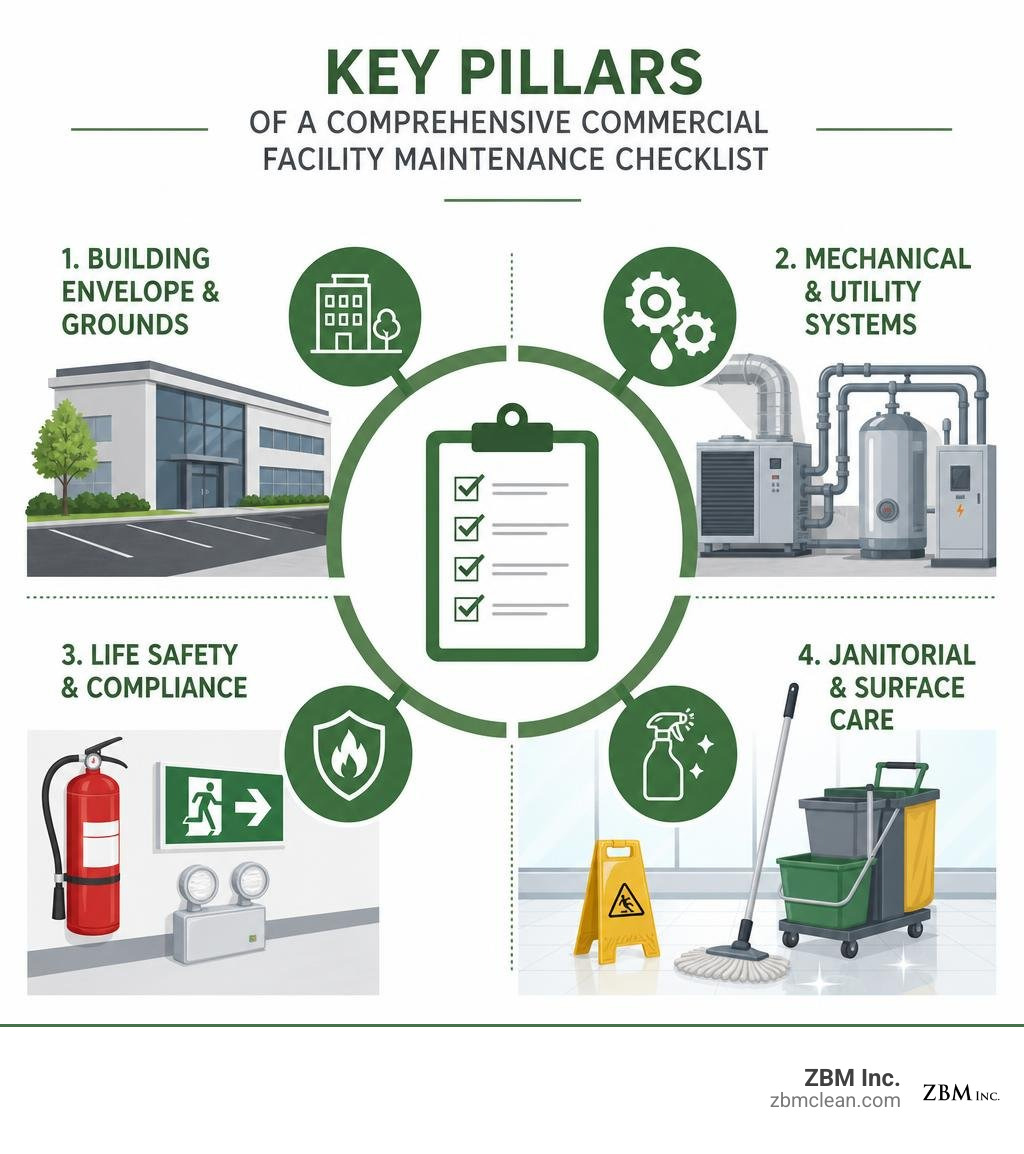
To prevent costly breakdowns, maintain safety codes, and maximize asset lifespan, every commercial checklist must cover four key operational pillars:
- Building Envelope and Grounds: Roof membrane inspections, drainage clearing, door weatherstripping, and parking lot pavement repairs.
- Mechanical and Utility Systems: HVAC filter changes, seasonal boiler tune-ups, domestic water pressure monitoring (target: 40–80 psi), and electrical switchgear clearances.
- Life Safety and Compliance: NFPA fire extinguisher checks, 90-minute emergency lighting battery discharge tests, and ADA-compliant path clearance.
- Janitorial and Surface Care: Daily disinfection routines, restorative floor care, and environmental hazard mitigation.
While routine daily visual checks are easily handled during regular staff walkthroughs, deep maintenance and biohazard sanitization demand specialized equipment, industrial chemistry, and formal training. Attempting do-it-yourself fixes for heavy grime, pest issues, or suspected mold often masks deeper structural issues, consumes valuable staff hours, and increases liability—making partnership with an experienced, certified cleaning company the safest approach.
I’m Terry Zastrow, owner of ZBM, Inc., where our certified team has spent over thirty years helping commercial property managers design and execute complete facility maintenance checklist systems. In this guide, I’ll show you how to structure your maintenance routines, maintain audit-ready compliance, and extend the lifespan of your critical building assets.
Core Components of an Effective Facility Maintenance Checklist
A well-structured checklist bridges the gap between architectural design, engineering intent, and day-to-day operations. Rather than relying on scattered notes or informal walkthroughs, a reliable maintenance system establishes clear baselines across every piece of facility infrastructure.
Every complete checklist requires specific foundational elements:
- Comprehensive Asset Inventory: Clear identification of every maintainable unit, distinguishing in-house assets from vendor-serviced equipment.
- Manufacturer Specifications: Operating tolerances, service intervals, and lubrication schedules established by original equipment manufacturers.
- Measurable Numerical Parameters: Hard operational thresholds (such as pressure differentials, voltage ratings, or temperature bands) rather than vague subjective notes.
- Strict Pass/Fail Criteria: Objective definitions of what constitutes acceptable performance versus an immediate defect.
- Equipment Tagging: Physical barcode, RFID, or QR asset tags attached directly to mechanical equipment.
- Clear Accountability: Designated roles specifying who conducts the inspection, who reviews the logs, and who authorizes corrective work.
To align with modern engineering standards, operations teams frequently adapt asset classification systems based on proven models like the Maintenance Management Order guidelines. These guidelines help structure inventory codes and preventive maintenance staffing workhour estimates.
| Maintenance Strategy | Primary Focus | Cost Profile | Risk Level | Optimal Application |
|---|---|---|---|---|
| Preventive (PM) | Scheduled routine servicing | Predictable, budgeted operational expense | Low | Critical base systems (HVAC, plumbing, roofing) |
| Condition-Based (CBM) | Real-time sensor monitoring | Moderate setup cost; high long-term efficiency | Very Low | High-value rotating equipment, chillers, boilers |
| Risk-Based (RBM) | Prioritizing high-consequence assets | Targeted resource allocation | Controlled | Regulated environments, life-safety panels |
| Reactive (Run-to-Failure) | Unplanned repairs post-breakdown | Highly volatile; premium emergency labor rates | High | Non-critical, redundant, or disposable assets |
Attempting complex remediation or deep mechanical overhauls without certified equipment or formal training exposes properties to expensive risks. When internal teams encounter structural damage, widespread contamination, or complex electrical hazards, selecting an established, certified professional partner ensures safety and preserves capital investment.
Maintenance Strategies: Preventive, Condition-Based, and Reactive
Balancing maintenance approaches keeps operational budgets steady while reducing emergency downtime.
- Preventive Maintenance (PM): Time- or usage-based servicing that replaces worn parts, replenishes lubricants, and cleans critical components before failure occurs.
- Condition-Based Maintenance (CBM): Utilizing real-time data—such as oil sampling, vibration analysis on motors above 5 HP, or infrared thermographic scans on 480V+ electrical panels—to service machinery based on actual mechanical wear.
- Risk-Based Prioritization (RBM): Allocating labor and budget based on the operational impact of a potential failure, ensuring essential production and life-safety systems receive primary attention.
- Reactive Maintenance: Running non-essential equipment to failure when replacement is cheaper than ongoing preventive upkeep.
Industry operational benchmarks recommend maintaining an 80/20 ratio of planned maintenance to reactive repairs. When reactive work orders exceed 20%, operations face spiraling overtime costs, premature asset degradation, and cascading equipment failures.
Six Core Standard Operating Procedures for Facility Teams
A checklist outlines what to inspect, but Standard Operating Procedures (SOPs) define how the work must be done. Every facility management program relies on six core SOPs:
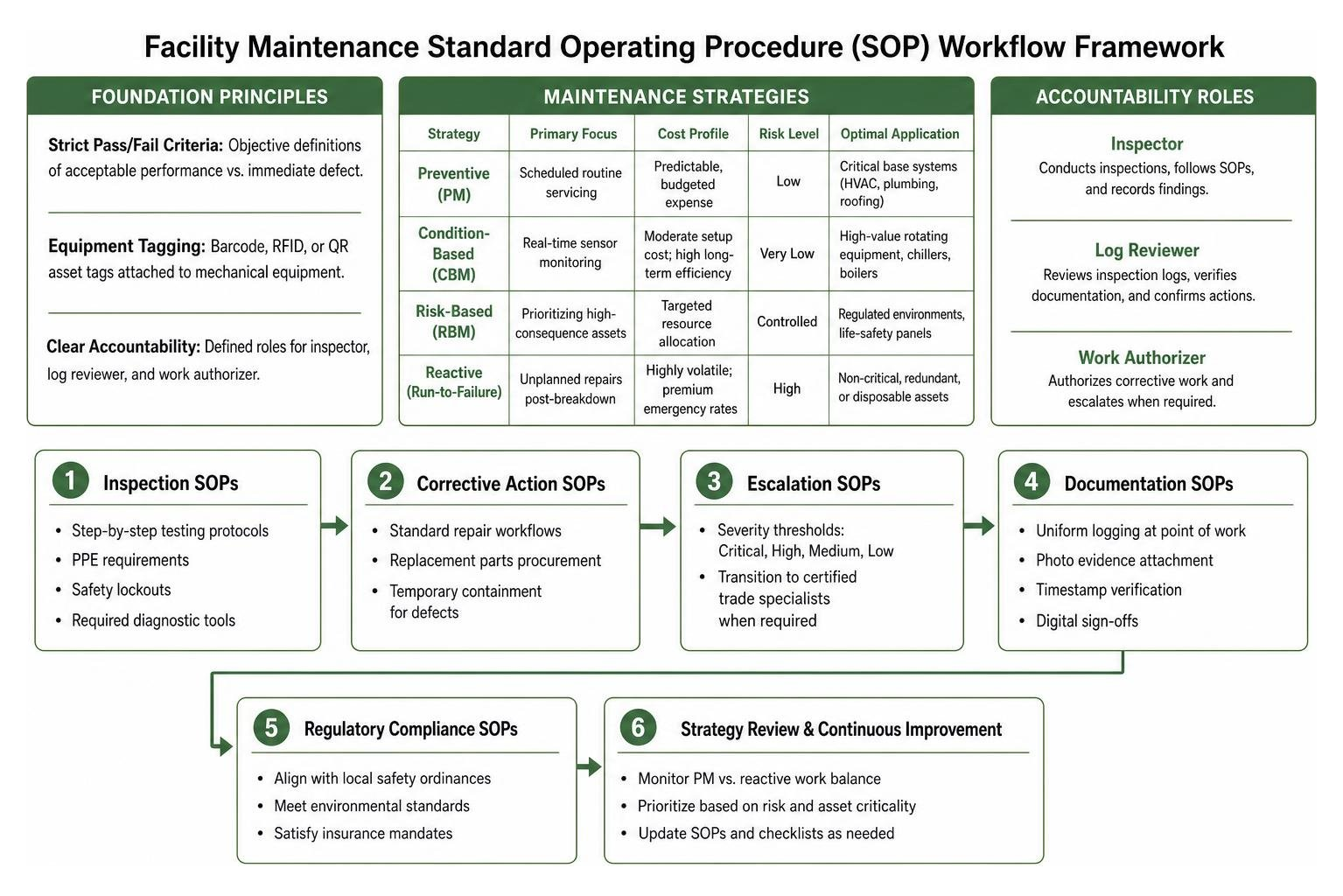
- Inspection SOPs: Outline step-by-step testing protocols, personal protective equipment (PPE) requirements, safety lockouts, and required diagnostic tools.
- Corrective Action SOPs: Define standard repair workflows, replacement parts procurement, and temporary containment measures for identified defects.
- Escalation SOPs: Specify clear severity thresholds (Critical, High, Medium, Low) and define when an issue transitions from in-house handling to external certified trade specialists.
- Documentation SOPs: Mandate uniform logging at the point of work, photo evidence attachment, timestamp verification, and digital sign-offs.
- Regulatory Compliance SOPs: Ensure operational alignment with local safety ordinances, environmental standards, and insurance mandates.
- Contractor and Vendor SOPs: Govern contractor check-in, badging, site safety orientation, scope-of-work verification, and work-order completion sign-offs.
Organizing Facility Systems, Infrastructure, and Operational Cadences

Large facilities operate smoothly when maintenance tasks are organized along three dimensions: building system, operational use case, and inspection cadence. Applying a comprehensive building facilities inspection checklist allows teams to systematically address structural, mechanical, and environmental requirements without missing steps.
Building Envelope and Exterior Grounds Management
A building’s outer envelope protects interior operations against the elements. Systematic exterior reviews prevent structural deterioration, foundation shifting, and costly building envelope penetrations.
Key exterior inspection priorities include:
- Roofing Systems and Drainage: Inspecting flat roof membranes for blisters, ponding water, punctured flashing, and clear scuppers. UV exposure degrades polyurethane sealants long before the membrane itself fails.
- Parking Lots and Walkways: Pavement cracking, potholes, bollard stability, and surface water drainage. Over 20% of vehicle accidents occur in parking lots, making clear lane markings, proper lighting, and trip-free pavement essential safety items.
- Doors and Windows: Verifying weatherstripping, commercial door closers, latching hardware, and caulking to prevent conditioned air loss.
- Grounds and Foundation: Assessing soil grading away from building perimeters and checking concrete footings for seasonal shift cracks.
Using a complete facility exterior maintenance checklist helps facilities manage seasonal transitions smoothly. For instance, cold-weather climates require targeted winter facility preparation to insulate exterior pipes, protect exposed backflow assemblies, and maintain building interiors safely above 55°F.
Interior Infrastructure, HVAC, Electrical, and Plumbing Systems
Interior systems require regular maintenance to maintain energy efficiency, indoor air quality, and tenant comfort.
- HVAC and Air Handling: Commercial HVAC units have an expected operational lifespan of 10 to 15 years. Monthly filter checks (replacing filters when pressure drop exceeds 0.5 in. w.c.), semi-annual coil cleanings, and economizer calibrations protect energy efficiency. Fouled evaporator and condenser coils reduce cooling capacity by 20% to 30%.
- Boiler and Heating Systems: A commercial boiler designed to last 25 to 30 years can fail in as few as 15 years if water treatment, blowdown routines, and burner calibrations are neglected.
- Plumbing and Water Pressure: Commercial plumbing networks must maintain steady water pressure between 40 and 80 psi. Backflow prevention devices require annual certified testing, while hot water temperature-pressure relief (TPR) valves and sump pump float switches require routine verification.
- Electrical Distribution: Main panels require a minimum 36-inch clear clearance zone in front of enclosures per OSHA 1910.303. Annual infrared thermographic scans detect loose connections or thermal anomalies (investigating any delta exceeding 18°F).
- Floor Care and Sanitization: High-traffic flooring quickly accumulates ground-in grit, salt residue, and moisture that degrade commercial coatings. Regular care, including keeping commercial facility floors clean, preserves flooring investments. Deep floor stripping, machine scrubbing, and tile extraction require commercial-grade equipment and specialized chemistry that are best handled by certified commercial cleaning professionals.
Categorizing Tasks by Frequency and Operational Use Case
Dividing facility maintenance into distinct cadences keeps workloads manageable and prevents minor issues from compounding into major repairs.
Grouping simplistic inspections (such as steam traps, isolation valves, and air handler visual checks) along common geographic routes within large facilities significantly cuts technician transit time and streamlines labor efficiency.
Safety Protocols and Regulatory Compliance Standards

Facility safety checklists are essential for preserving life safety, preventing injuries, and meeting strict municipal, state, and federal compliance mandates. Maintaining documented logs demonstrates due diligence and duty of care during insurance audits or local safety reviews.
Facilities in Dodge County WI, Jefferson County WI, and across Southeastern WI must coordinate regular maintenance with municipal building safety compliance offices to verify that life safety, structural modifications, and fire suppression systems satisfy current building codes.
Critical Safety Inspections on a Facility Maintenance Checklist
Safety checklists must cover code-mandated emergency systems:
- Fire Extinguishers: OSHA requires fire extinguishers and carbon monoxide detectors to be checked once a year by a certified technician, with monthly visual checks confirming gauge pressure, unbroken seals, and clear access.
- Emergency and Exit Lighting: NFPA 101 mandates a monthly 30-second functional illumination test and an annual 90-minute battery discharge test to ensure emergency illumination remains operational during power outages.
- Emergency Eyewash and Showers: Plumbed stations require routine flushing to clear sediment and verify proper flow and water temperature.
- ADA Accessibility Clearances: Main accessible routes require a minimum continuous clear width of 36 inches, with automatic door operators and entrance ramps kept free of obstructions.
- Hazardous Materials and Biohazards: Chemical storage areas require updated Safety Data Sheets (SDS), compliant spill kits, and proper secondary containment. When facilities encounter mold outbreaks, sewage backups, or biohazards, relying on internal custodial staff can lead to cross-contamination. Partnering with a licensed, certified cleaning and disaster restoration firm ensures safe containment and legal disposal.
Customizing Your Facility Maintenance Checklist for Audits and Risk
Every commercial property has a unique risk profile based on its operational environment, age, and occupancy. Standard off-the-shelf templates should always be customized.
To customize effectively:
- Incorporate Regional Operational Benchmarks: Reference guidelines from regional industry groups, such as the IFMA regional operational benchmarks, to align maintenance practices with local operational standards.
- Analyze Historical Failure Logs: Review past work order history over 90-day intervals to identify recurring problem assets, adjusting inspection frequency accordingly.
- Apply Severity Tiering: Define explicit escalation paths for identified defects:
- Critical: Immediate life safety hazard or structural threat; requires immediate isolation and emergency dispatch.
- Major: Significant mechanical impairment; requires formal work order creation and resolution within 28 days.
- Minor: Cosmetic or non-urgent wear; scheduled for the next routine maintenance cycle.
- Establish High-Risk Asset Protocols: Production machinery, high-voltage transformers, and pressurized boilers require separate, detailed checklists aligned directly with vendor warranty terms.
Modernizing Maintenance Management and Measuring Program Success
Relying on paper binders or standalone spreadsheets creates blind spots, lost inspection records, and delayed repairs. Modern facility operations leverage digital platforms to streamline field execution and maintain audit-ready records.
Digitization Best Practices and SOP Integration
Digitizing maintenance workflows improves visibility across shifts, buildings, and maintenance teams:
- QR Asset Tagging: Attaching durable QR labels to equipment lets technicians scan an asset with a mobile device to immediately view past maintenance logs, operating manuals, and step-by-step SOPs.
- Mobile Point-of-Work Documentation: Technicians log numerical readings, select pass/fail statuses, and attach date-stamped photos directly in the field.
- Automated Work Order Triggers: When an inspection item fails or a numerical parameter falls outside safe operating ranges, the system automatically creates a prioritized corrective work order.
- Standardized Shift Handoffs: Digital logs provide incoming crews with an accurate, real-time overview of open work orders, offline equipment, and pending vendor visits.
Key Performance Metrics and Continuous Improvement
A maintenance program’s performance should be measured using objective operational metrics:
- PM Compliance Rate: The percentage of scheduled preventive maintenance tasks completed on time within an acceptable window (target: 95%+).
- Planned vs. Reactive Labor Ratio: Tracking hours spent on scheduled maintenance versus emergency repairs (target: 80% planned, 20% reactive).
- Mean Time to Repair (MTTR): The average time required to troubleshoot, repair, and recommission failed equipment.
- Work Order Backlog: The volume of open, pending maintenance tasks. A healthy backlog averages between 5% and 10% of total capacity; a zero backlog suggests overstaffing, while backlogs above 20% point to operational bottlenecks.
- Root Cause Analysis (RCA): Conducting formal post-incident reviews on any unplanned downtime exceeding four hours to prevent repeat failures.
Frequently Asked Questions About Facility Maintenance Checklists
What is the recommended ratio between planned and reactive facility maintenance?
The industry standard is an 80/20 ratio, where 80% of maintenance hours are dedicated to planned preventive tasks and no more than 20% to reactive repairs. Maintaining this balance reduces emergency repair costs, extends equipment lifespan, and prevents operational disruptions across the facility.
How often should commercial HVAC systems and boilers be serviced?
Commercial HVAC systems require monthly filter and belt inspections, quarterly condensate drain flushes, and comprehensive semi-annual service before peak cooling and heating seasons. Boilers require daily operational logging, monthly safety valve checks, and annual professional teardowns, cleanings, and burner calibrations. Without proper maintenance, an HVAC system’s 10–15 year lifespan or a boiler’s 25–30 year lifespan can be cut in half.
Why should facilities partner with certified professional cleaning services for deep maintenance?
Routine surface cleaning can be handled by in-house staff, but deep restorative maintenance—such as complete floor care, mold remediation, biohazard cleanup, and specialized disaster recovery—requires commercial-grade extraction systems, industrial antimicrobial chemistry, and formal certification. Attempting DIY solutions for severe contamination or hoarding conditions is time-consuming, labor-intensive, and often fails to address hidden moisture or airborne spores. Hiring a licensed, bonded, and certified cleaning company ensures compliance with health codes, protects building occupants, and resolves underlying environmental issues completely.
Conclusion
A structured, well-executed facility maintenance program protects capital investments, ensures regulatory compliance, and provides a safe, productive environment for building occupants. By organizing tasks across logical systems, adhering to strict cadences, and supporting inspections with clear Standard Operating Procedures, facility managers can eliminate unexpected equipment failures and control operating costs.
While preventive checklists streamline day-to-day building operations, specialized cleaning, deep sanitization, and hazard recovery demand experienced professionals. At ZBM Inc., our certified, licensed, bonded, and family-owned team in Watertown, WI delivers comprehensive commercial cleaning, floor maintenance, biohazard remediation, and disaster recovery across Dodge County, Jefferson County, and throughout Southeastern Wisconsin.
To elevate your facility care standards and ensure audit-ready maintenance, partner with our team for comprehensive building maintenance services in Wisconsin.