The Hidden Threat: Why Mold Inside Your Walls Demands Immediate Attention
Is mold inside the walls dangerous? Yes — even when you can’t see it, smell it, or find any visible damage.
Here’s what you need to know right away:
| Key Fact | Detail |
|---|---|
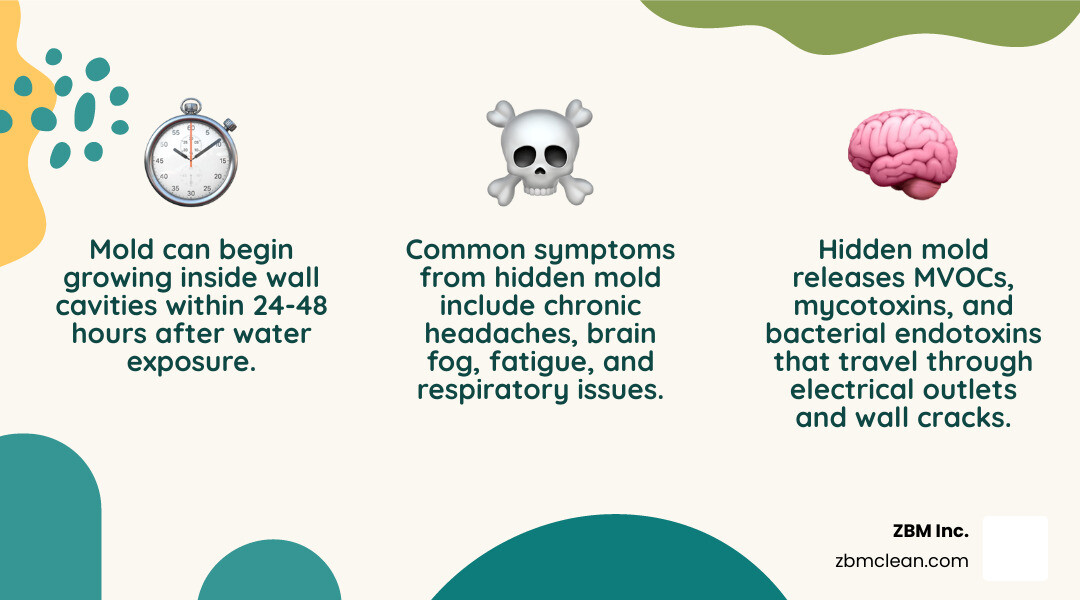
| Mold can start growing | Within 24-48 hours of water exposure |
| Hidden mold releases | MVOCs, mycotoxins, and bacterial endotoxins into your air |
| These toxins travel through | Electrical outlets, baseboard gaps, and wall cracks |
| Common symptoms include | Headaches, brain fog, fatigue, and respiratory issues |
| 40% of remediated homes | See mold return within 12 months if moisture isn’t fixed |
Most people assume that if mold is sealed behind a wall, it’s not their problem. That assumption is wrong.
Mold doesn’t need to be visible to affect the air you breathe. Toxic gases and microscopic fragments can seep out of wall cavities and into occupied spaces — day and night, without any obvious warning signs.
Consider this: an office worker developed severe headaches and brain fog that disappeared on weekends. Testing eventually traced the cause to Stachybotrys mold growing behind the wall next to her desk, caused by a slow roof leak nobody had noticed.
That kind of hidden contamination is more common than most property owners realize — and it’s exactly the kind of problem that gets worse the longer it goes unaddressed.
I’m Terry Zastrow, owner of ZBM, Inc., a certified IICRC firm with approximately 30 years of experience responding to mold, water damage, and biohazard situations for commercial properties, housing authorities, and municipalities — including many cases where mold inside the walls was dangerous long before anyone knew it was there. In this guide, I’ll walk you through what hidden wall mold really means for your building, your occupants, and your next steps.
Is mold inside the walls dangerous even if you can’t see it?
When we talk about mold, most people picture the fuzzy green stuff on a loaf of bread or the black spots in a damp shower corner. But in professional remediation, the most concerning mold is the kind you can’t see.
Is mold inside the walls dangerous when it’s tucked away behind layers of drywall and paint? Absolutely. The wall cavity acts like a biological incubator. Once a pipe leaks or condensation builds up, the mold has everything it needs: darkness, warmth, and a buffet of cellulose-rich drywall paper and wood studs.
As the mold colony matures, it doesn’t just sit there. It produces three primary invisible threats:
- MVOCs (Microbial Volatile Organic Compounds): These are the gases produced during mold metabolism. They are responsible for that “musty” smell and can pass through porous drywall with ease.
- Mycotoxins: These are toxic chemicals produced by certain molds, like Stachybotrys chartarum (black mold). Research shows that mycotoxins can be found in household dust even when air samples appear normal.
- Bacterial Endotoxins: Mold rarely travels alone. It is often accompanied by bacteria that produce endotoxins, which can be even more inflammatory to the human respiratory system than the mold itself.
These contaminants don’t stay trapped. They find their way into your living space through “pathways of least resistance.” Every electrical outlet, light switch, baseboard gap, and hairline crack in your wall acts as a vent, allowing these microscopic hazards to circulate in the air you breathe. This is why The 5 Types of Toxic Mold: Why You Need Biohazard Cleanup is such a critical topic for homeowners in Watertown and Southeast Wisconsin to understand. According to experts at Indoor Environmental Testing Inc., the idea that mold is “sealed” inside a wall is a dangerous myth.
Why dried or dormant mold inside the walls is dangerous
We often hear clients say, “The leak was months ago; the wall is dry now, so the mold must be dead.” This is a misconception that can lead to long-term health issues.
When mold “dries out,” it doesn’t disappear. Instead, it becomes brittle and fragile. In this state, the mold structure shatters into millions of microscopic fragments. These fragments are highly inflammatory and often carry a higher concentration of mycotoxins than living spores. Because they are so light, they can remain suspended in the air for long periods or settle into your carpets and furniture.
Furthermore, dormant mold is just waiting for a “re-wetting” event. A humid Wisconsin summer day (where relative humidity exceeds 60%) can provide enough moisture for that dormant colony to reactivate and begin growing again. The Wisconsin Department of Health Services emphasizes that moisture control is the only way to stop this cycle. Even if you can’t see it, DNA testing of household dust often reveals the “fingerprint” of a hidden wall infestation that is actively shedding inflammatory material into the home.
How toxins travel from wall cavities into living spaces
Think of your home as a living, breathing system. Because of something called the “stack effect” and the way HVAC systems operate, your home often experiences negative pressure. This means the house is essentially “sucking” air from the wall cavities into the rooms.
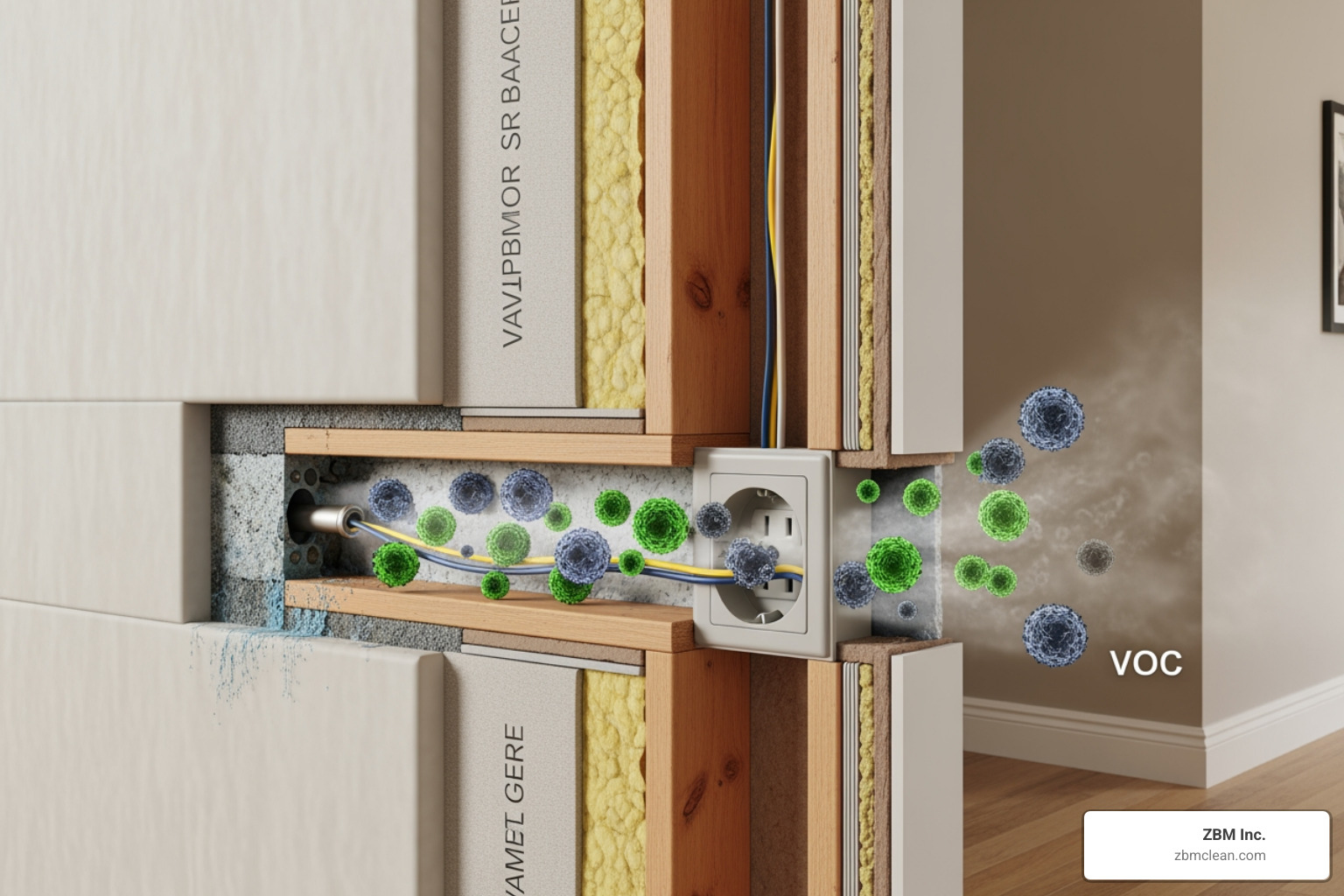
As air moves through the wall, it picks up MVOCs, mycotoxins, and spores, carrying them through:
- Electrical Outlets: These are essentially holes in your “seal.”
- Baseboards: The small gap between the floor and the wall is a major highway for mold-laden air.
- Recessed Lighting: These fixtures often pull air directly from the ceiling or attic cavities.
- Cracks and Seams: Even tiny cracks in the plaster or drywall can allow gases to escape, similar to how sewer gas or carbon monoxide can migrate through a building.
The Mechanics of Hidden Contamination and Health Risks
To understand why is mold inside the walls dangerous, you have to understand the physics of water. Drywall is incredibly efficient at moving moisture through a process called capillary action.
If you have just one inch of standing water on a floor from a burst pipe, that water doesn’t just sit there. The drywall acts like a sponge, wicking the moisture upward 18 to 24 inches against gravity. This means even if you dry the floor quickly, the insulation and the back side of the drywall inside the wall cavity remain saturated.
Because the wall cavity is a “sealed” environment with limited airflow, it becomes a terrarium. We often see Aspergillus fumigatus in these environments, a species strongly linked to fungal asthma and severe respiratory distress. According to MoldNewsHub, these microenvironments can compromise the structural integrity of your home’s wood framing in as little as one week.
Common health symptoms caused by hidden mold
Because the mold is hidden, many people don’t realize their physical symptoms are related to their environment. They may assume they have “seasonal allergies” or are just “feeling run down.”
A key indicator of hidden mold is the “improvement factor.” Do your symptoms get better when you go to work or leave for a weekend in the Northwoods? If so, your home may be the culprit.
| Symptom | Allergy (Pollen/Dust) | Toxic Mold Exposure |
|---|---|---|
| Headaches | Rare | Common (Chronic/Migraine-like) |
| Brain Fog | No | Frequent (Difficulty concentrating) |
| Congestion | Seasonal/Intermittent | Persistent (Worse in the morning) |
| Fatigue | Mild | Severe/Chronic |
| Skin Rash | Rare | Possible (Itching/Redness) |
| Dizziness | No | Reported in high-mycotoxin cases |
Recognizing the Signs of a Silent Infestation
Since you can’t always see the problem, you have to use your other senses and a bit of “detective work” to find hidden mold. Here are the most common warning signs we look for in Southeastern WI homes:
- The “Musty” Smell: If you notice an earthy, damp-basement smell that doesn’t go away after cleaning, it’s likely MVOCs from a wall cavity.
- Paint Abnormalities: Bubbling, peeling, or cracking paint is often a sign that moisture is pushing its way out from behind the drywall.
- Tide Lines: Look for faint yellowish or brownish stains on the lower parts of your walls. These “tide lines” indicate where water has wicked up and dried.
- Warped Baseboards: If your baseboards are pulling away from the wall or feel soft to the touch, there is almost certainly mold growth behind them.
At ZBM Inc., we don’t just guess. We use advanced technology to “see” inside the walls without tearing them down immediately.

Thermal Imaging: These cameras detect temperature anomalies. Since wet materials are cooler than dry ones, we can pinpoint exactly where moisture is hiding. Deep-Probe Moisture Meters: These tools allow us to measure the moisture content of the studs and insulation behind the drywall, giving us a clear picture of the risk.
The Danger of DIY: Why You Shouldn’t Paint Over Mold
It is incredibly tempting to see a small damp spot and think, “I’ll just scrub it with bleach and paint over it.” According to wellness experts cited by The Times of India, this is one of the most dangerous mistakes a homeowner can make.
When you paint over mold, you are creating a “paint-film petri dish.” The paint traps the moisture against the organic drywall paper, providing a constant food source. The mold won’t stop growing; it will simply travel laterally (sideways) behind the plaster, infecting a much larger area while remaining hidden from your sight.
Furthermore, DIY cleaning often does more harm than good:
- Bleach Failure: Chlorine bleach is mostly water. On porous surfaces like drywall, the chlorine stays on the surface while the water soaks in, actually feeding the mold roots (hyphae).
- Spore Release: Scrubbing mold without proper containment (like plastic sheeting and negative air pressure) stirs up millions of spores and fragments, which your HVAC system then spreads throughout the entire house.
This is why we always recommend Stop the Spore with Professional Mold Abatement Services.
When professional remediation for mold inside the walls is dangerous to skip
If the affected area is larger than 10 square feet (about a 3×3 foot patch), or if the mold is inside a wall cavity, the EPA and IICRC S500 standards dictate that professional remediation is necessary.
Professional remediation involves:
- Containment: Using 6-mil poly sheeting to seal off the work area.
- Negative Air Pressure: Using industrial air scrubbers with HEPA filtration to ensure no spores escape during the removal process.
- Flood Cuts: Removing the drywall at least 12 inches above the highest moisture reading to ensure all contaminated material is gone.
- Antimicrobial Treatment: Cleaning the remaining wood studs with specialized solutions that actually kill the mold roots.
- Structural Drying: Using LGR (Low Grain Refrigerant) dehumidifiers to bring the wood framing down to below 15% moisture content before the walls are closed back up.
Frequently Asked Questions about Hidden Mold
How does water get inside walls to cause mold?
Water is sneaky. The most common culprits include:
- Pin-hole pipe leaks: A tiny leak can spray a mist inside a wall for months before showing a spot on the outside.
- Roof Leaks: Water can travel down rafters and into wall cavities far away from the actual hole in the roof.
- Condensation: In Watertown and Jefferson County, poor insulation can cause warm, humid indoor air to hit cold exterior wall surfaces, creating dew inside the wall.
- Foundation Seepage: Water can wick up from a damp basement floor into the bottom of the upstairs walls.
Can I detect mold behind walls without tearing them down?
Yes, to an extent. Professional mold inspectors use “cavity sampling.” This involves drilling a tiny hole (the size of a pen) and using a specialized pump to pull air from inside the wall onto a testing slide. This, combined with thermal imaging and moisture meters, can confirm a problem without major demolition.
How can I prevent mold from growing inside my walls?
The secret is moisture management:
- Maintain Humidity: Keep your indoor relative humidity between 30-50%. Use a hygrometer (they cost about $10-$20) to monitor this.
- Fix Leaks Fast: If you have a leak, you have a 24-48 hour window to dry it before mold germinates.
- Ventilation: Ensure your bathroom fans and dryer vents exhaust completely to the outside, not into the attic or wall spaces.
- Airflow: Don’t push furniture directly against exterior walls. Leave a 2-inch gap to allow air to circulate and prevent condensation.
Conclusion
At the end of the day, your home is likely your biggest investment, and your health is your greatest asset. Is mold inside the walls dangerous? The science and our 30 years of experience in Watertown, WI, say a resounding “Yes.”
Ignoring a musty smell or painting over a damp patch doesn’t make the problem go away—it just gives the mold more time to compromise your air quality and your home’s structure. If you suspect your walls are “whispering” about a hidden mold problem, don’t wait for the symptoms to get worse.
ZBM Inc. is a family-owned, licensed, and insured firm dedicated to helping our neighbors in Dodge County, Jefferson County, and across Southeastern Wisconsin breathe easier. We follow strict IICRC standards to ensure that when we remove mold, it stays gone for good.
Ready to clear the air? Learn Everything You Need to Know About Professional Mold Remediation Experts or contact us today for a professional assessment. We’re here to help you protect what matters most.