
Professional Walkway Concrete Power Washing: What Property Managers Should Know
For walkway concrete power washing, property managers in Watertown need a contractor who understands concrete’s porous structure and the risks of improper pressure. Certified crews clear debris, protect nearby plants, pre-treat oil or grease, and test a wide fan nozzle on a small area before washing in steady, overlapping passes. A pinpoint nozzle or excessive pressure can permanently etch the concrete surface, leaving rough patches that trap future dirt and moisture.
For property managers, a clean walkway looks better and is less likely to become slick with grime or algae. Professional crews check for cracks and worn coatings before washing, and manage dirty runoff to keep it out of storm drains.
I’m Terry Zastrow, owner of ZBM Inc., a certified cleaning firm with about 30 years of experience serving public and private properties. My technician certifications and safety training guide the practical advice in this walkway concrete power washing article.
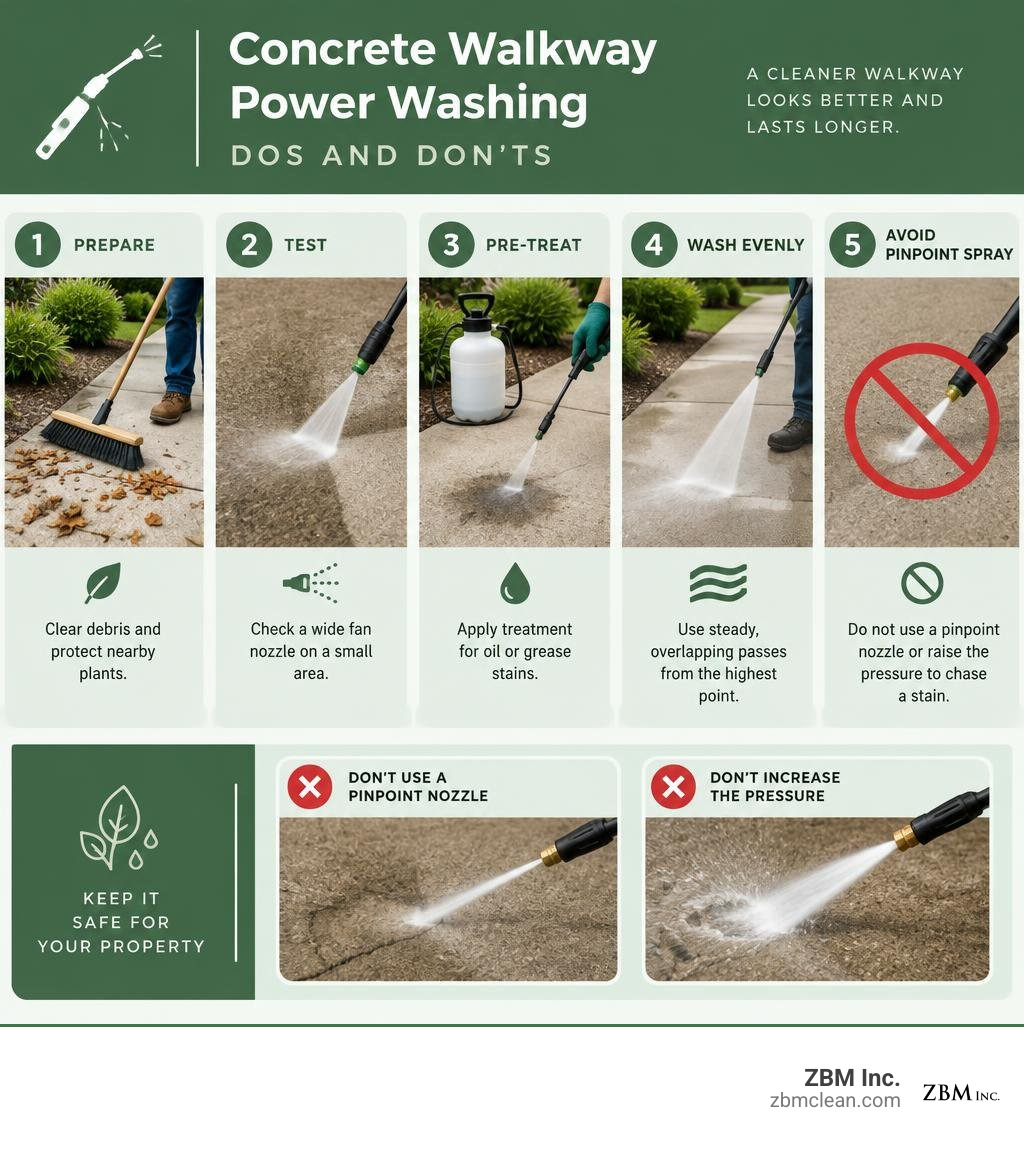
Quick look at walkway concrete power washing:
Walkway Concrete Power Washing: Critical Technical Standards and Best Practices
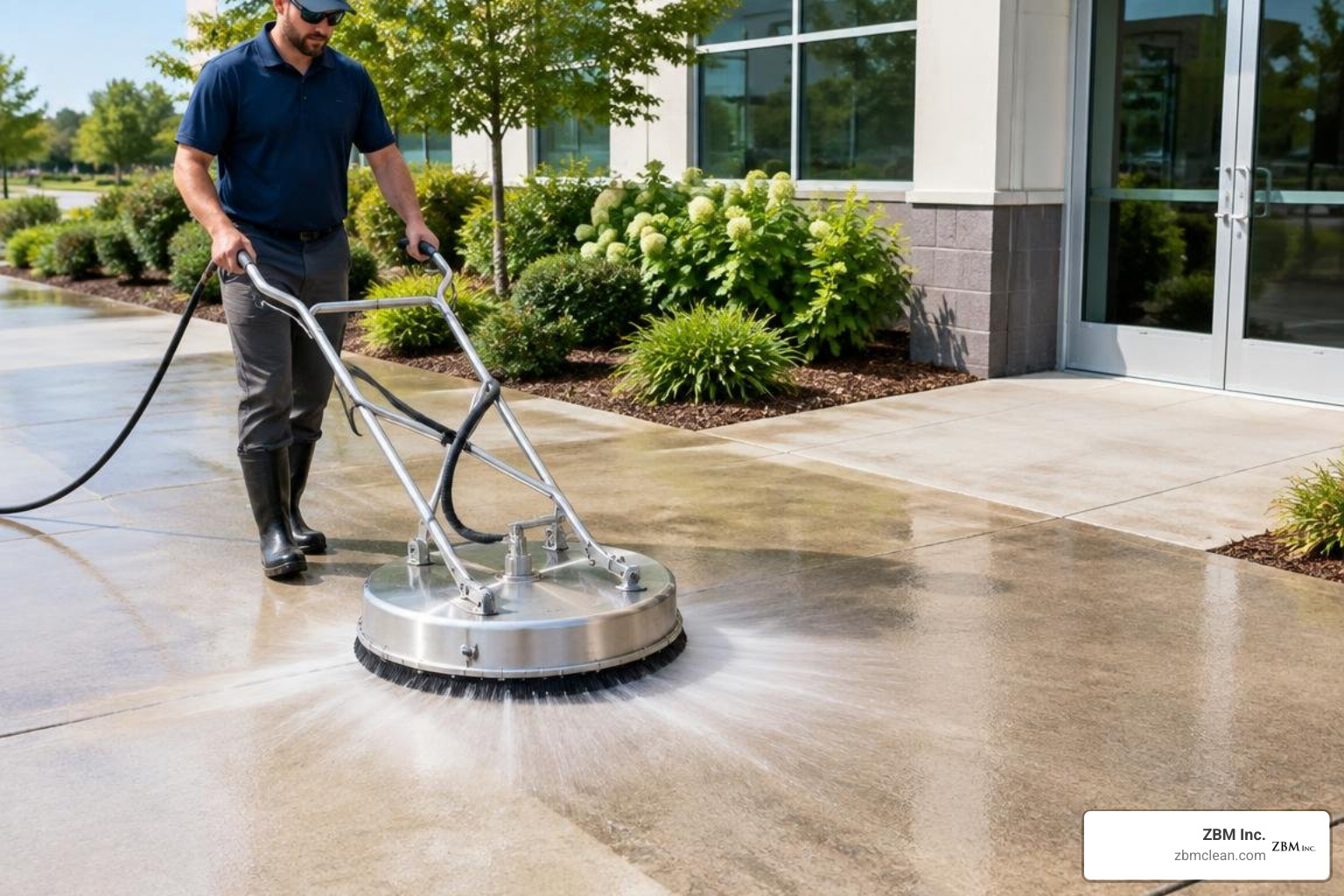
Maintaining pedestrian flatwork across commercial properties requires balancing hydraulic force with material chemistry. Concrete is durable, but it remains a porous, cementitious composite that reacts poorly to brute mechanical force. Facility executives overseeing sites in Jefferson County or Dodge County must establish strict operational standards to protect property assets while keeping pedestrian paths pristine.
A comprehensive program for facility exterior cleaning considers total cleaning power. Total cleaning power equals water pressure multiplied by flow rate (Cleaning Power = PSI × GPM). Relying solely on high pressure without adequate water volume forces operators to work slowly, increasing the risk of surface damage. Higher water volume flushes loosened silt, heavy sand, and dissolved contaminants out of deep microscopic concrete pores without eroding the substrate.
Managing environmental runoff is equally vital. Landscape beds, ornamental plantings, and turf bordering commercial walkways require pre-soaking with fresh water before washing begins. This saturates the root zones, preventing soil from absorbing dislodged cleaning solutions or concentrated mineral run-off. Understanding the mechanics of power washing by surface type helps prevent unintended damage to adjacent masonry, softscapes, or structural building materials.
Calibrating PSI and Temperature for Power Washing Concrete Walkways
Selecting correct pressure settings and water temperatures prevents premature concrete failure. Uncoated, mature concrete tolerates higher mechanical impact, but sealed, decorative, or green concrete requires precise calibration. Certified contractors assess each walkway’s condition before selecting equipment settings.
Bare concrete can tolerate between 2,000 and 3,500 PSI delivered through a 15-degree to 25-degree fan nozzle held at a consistent standoff distance of 6 to 12 inches. Coated, stained, or sealed walkways demand a gentler approach: drop the pressure to 1,200 to 2,000 PSI and widen the fan tip to 25 or 40 degrees. This wider dispersion prevents high water pressure from shearing protective topcoats from the concrete substrate.
Thermal dynamics also play a major role in stain mitigation:
| Operational Feature | Cold Water Pressure Washing | Thermal Hot-Water Power Washing |
|---|---|---|
| Water Temperature | Ambient (50°F – 70°F) | Heated (160°F – 210°F) |
| Primary Mechanism | Mechanical impact force | Thermal emulsification + mechanical force |
| Target Contaminants | Loose surface dirt, light mud, superficial dust | Embedded motor oil, food grease, chewing gum |
| Chemical Requirement | High detergent dependence | Reduced chemical volume required |
| Pore Penetration | Flushes open, loose surface voids | Melts and extracts deep hydrocarbon binders |
While cold-water pressure washing efficiently clears seasonal dirt and dust, it cannot break down polymerized grease or petroleum spills. High thermal power washing liquefies oils and gum at molecular levels, allowing thorough rinsing without excessive surface impact.
Professional Chemical Pre-Treatments and Degreasing Methods
Directly blasting stained flatwork with high-pressure water drives oils and stains deeper into the concrete matrix. Certified exterior crews rely on targeted chemical pre-treatments instead of relying solely on water pressure.
Alkaline degreasers formulated for industrial use target hydrocarbon deposits like automotive fluids, delivery truck drips, and cooking grease tracked outside commercial kitchens. These chemical agents break down petroleum bonds during a controlled dwell time of 10 to 15 minutes. The surface must be misted during this period to prevent the detergent from drying out on the slab.
For stubborn mineral marks, specialized rust and dirt removal solutions lift inorganic oxides without etching the surface paste. Biological growth like black algae (Gloeocapsa magma), lichen, and moss requires dedicated algaecides to neutralize the root spores deep inside the concrete. Once these chemical agents break the bond between the contaminant and the concrete, low-to-moderate rinse pressure easily carries the suspended soil away.
Rotary Surface Cleaners vs. Handheld Wand Striping Risks
Washing extensive commercial walkways using standard handheld wands is slow, uneven, and prone to operator error. Handheld wands naturally arc across the path, causing irregular standoff distances that leave behind dark, irregular lines known as “zebra striping.”
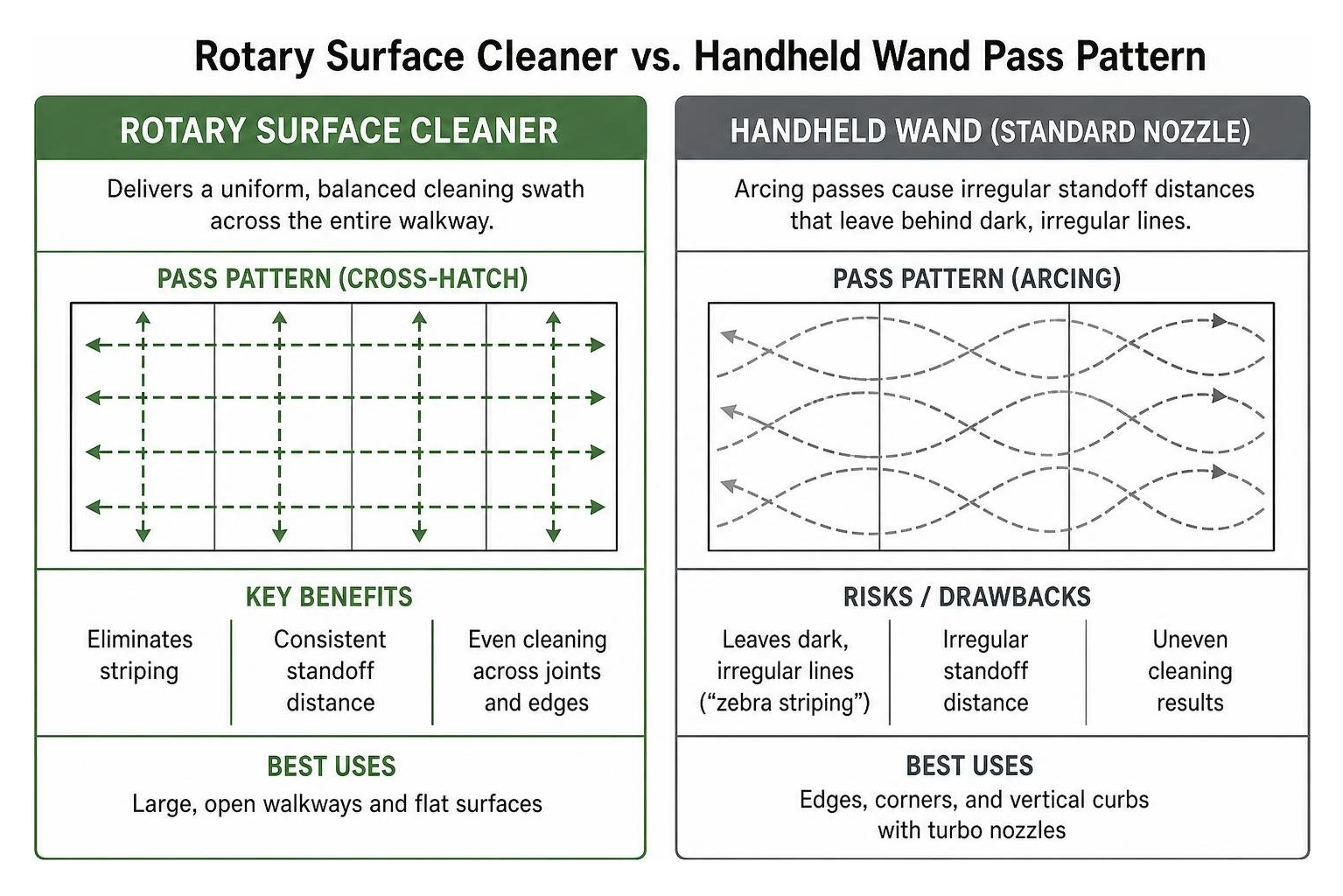
Commercial rotary surface cleaners eliminate striping by enclosing dual or triple spray nozzles beneath a circular housing. As pressurized water enters the spray bar, it spins rapidly at a fixed distance from the concrete surface. This delivers a uniform, balanced cleaning swath across the entire walkway.
Professional crews operate rotary cleaners in structured cross-hatch passes to ensure complete coverage across all expansion joints and edges. Specialized turbo nozzles handle the borders, corners, and vertical curbs, creating a consistent, clean finish across the property.
Key Pitfalls to Avoid and Managing Walkway Maintenance Long-Term
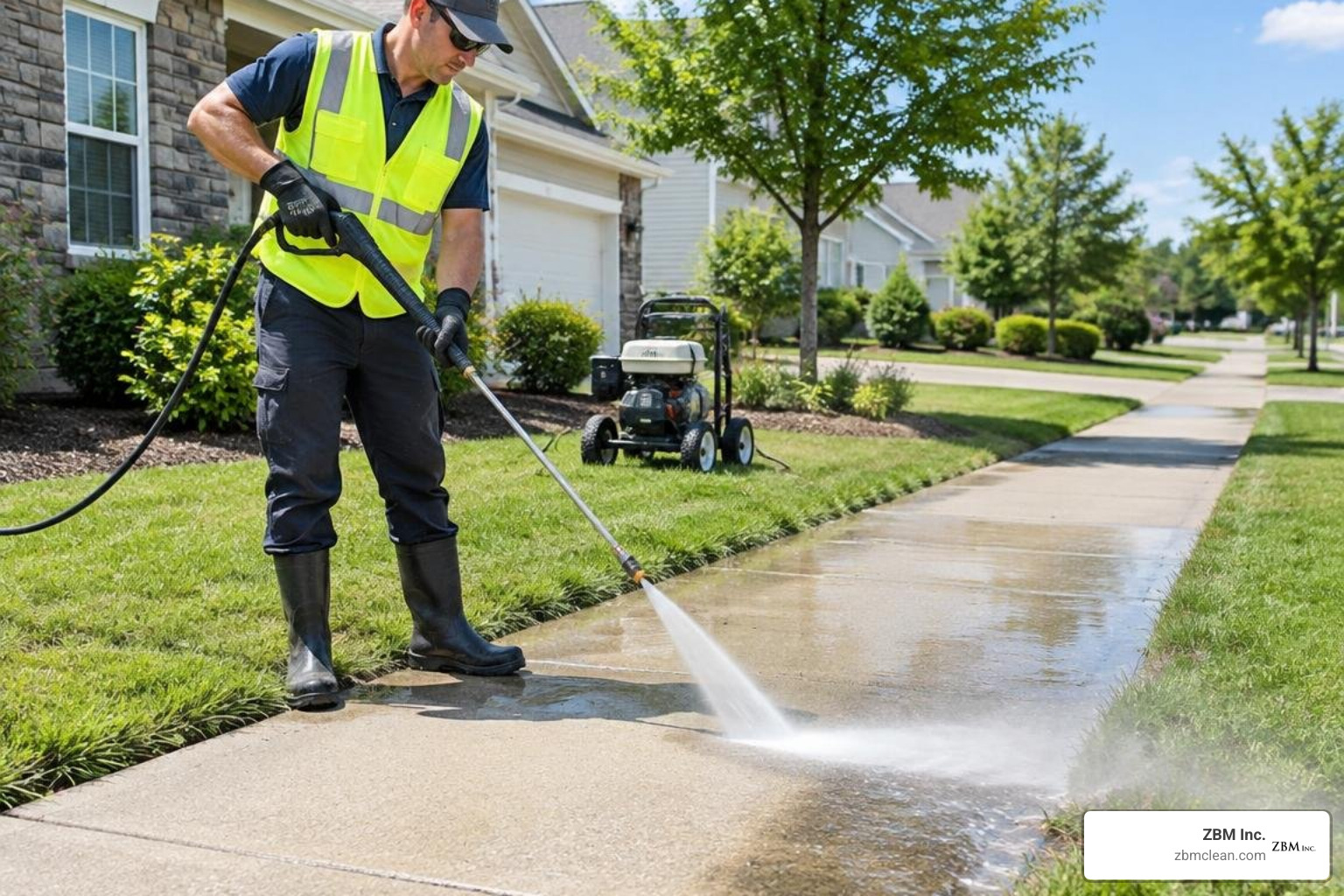
Walkway management goes beyond routine cosmetic cleaning. Property managers must balance slip-and-fall safety, environmental regulations, and long-term asset preservation.
Attempting to manage exterior flatwork using internal custodial crews or rental machines often leads to costly complications. Rental machines generally offer low water output, turning a standard walkway wash into a multi-day ordeal. Untrained operators facing persistent stains frequently swap in destructive zero-degree pinpoint nozzles or hold the spray tip inches from the slab, causing permanent concrete etching.
Common Mistakes in Walkway Concrete Power Washing Operations
The most common operational failure on commercial walkways is surface gouging caused by excess pressure. When water pressure exceeds the tensile strength of the concrete cream, it blasts away the smooth top layer. This exposes the underlying coarse aggregate, leaving rough, pitted patches that trap future dirt and moisture.
Other frequent pitfalls include:
- Using 0-Degree Red Pinpoint Nozzles: Concentrating thousands of pounds of pressure onto a single pinpoint carves deep grooves into the walkway.
- Ignoring Grade and Slope: Washing uphill pushes dirty runoff over freshly cleaned concrete, depositing silt lines and requiring repeated passes.
- Neglecting Drainage and Wastewater Regulations: Pushing chemical run-off and hydrocarbon residues directly into municipal storm drains violates local environmental standards.
- Failing to Address Structural Cracks: High-pressure water forced into unsealed joints and cracks erodes the underlying base aggregate, leading to slab settling and trip hazards.
Contracting certified commercial pressure washing services protects building assets and mitigates property liabilities.
Post-Wash Concrete Sealing and Freeze-Thaw Protection Protocols
In regions like Southeastern Wisconsin, where winters bring recurring freeze-thaw cycles, unsealed concrete is vulnerable to rapid structural decay. Porous concrete naturally absorbs moisture from melting snow and freezing rain. When that trapped water freezes, it expands by approximately 9%, generating internal pressures that lead to surface spalling, scaling, and cracking.
Applying a penetrating concrete sealer (such as a silane/siloxane blend) post-wash establishes an invisible, hydrophobic barrier inside the concrete pores. Unlike heavy film-forming coatings that can peel under heavy foot traffic, penetrating sealers bond with the concrete matrix, allowing interior moisture vapor to escape while repelling liquid water and deicing salts.
Professional concrete seals generally perform for 2 to 5 years, though high-traffic pathways and harsh winter environments in Watertown and Jefferson County benefit from resealing every 2 to 3 years. For pedestrian ramps, stairways, and entryways, mixing anti-slip aggregate into topcoats ensures reliable slip resistance even during wet transitional seasons. After application, standard sealers cure for pedestrian foot traffic within 24 to 48 hours, fully locking out moisture before winter arrives.
Choosing Certified Commercial Contractors Over Risky In-House Labor
Tasking general maintenance staff with complex concrete restoration often pulls personnel away from daily operations while delivering uneven results. Commercial-grade power washing requires specialized equipment, continuous pressure calibration, and strict wastewater management.
At ZBM Inc., our family-owned company brings decades of industry experience to commercial facilities throughout Watertown, Minocqua, Lake Mills, and across Southeast Wisconsin. As a fully licensed, bonded, insured, and certified cleaning organization, we utilize truck-mounted thermal power systems, industrial rotary surface cleaners, and eco-friendly detergents to restore walkways without damaging surfaces.
Integrating scheduled concrete power washing into your broader facility exterior maintenance checklist protects your physical assets, enhances curbside appeal, and ensures safe, slip-resistant pathways for employees and visitors year-round.