Why Every Facility Needs a Structured Commercial Cleaning Checklist
Maintaining a clean commercial facility requires structured systems. When teams rely on memory or informal routines, critical touchpoints get skipped, dust accumulates on hidden ledges, and sanitation standards fluctuate between shifts. A comprehensive checklist establishes an uncompromised standard for operational hygiene across every square foot of your building.
A well-architected checklist delivers tangible benefits:
- Service Consistency: Standardizes cleaning quality across day porters, evening crews, and weekend custodial teams.
- Operational Risk Reduction: Prevents slip-and-fall hazards through structured floor care protocols while maintaining compliance with health mandates, such as those monitored throughout Jefferson County, WI.
- Audit Readiness: Creates a traceable paper or digital trail demonstrating that sanitation protocols meet or exceed regulatory requirements.
- Staff Accountability: Outlines specific duties so employees understand their exact responsibilities before their shift begins.
Attempting to manage facility sanitation with informal, ad-hoc task lists leads to operational gaps. By integrating everything you need in a building facilities inspection checklist, property managers establish measurable criteria that eliminate miscommunication and keep facilities operating safely.
Core Facility Zones to Include in Your Template
A successful checklist separates a building into dedicated operational zones. Each zone presents unique cleaning challenges, soil loads, and germ transmission risks. Segmenting tasks by area allows custodial crews to prevent cross-contamination by utilizing color-coded microfiber systems and area-specific cleaning agents.
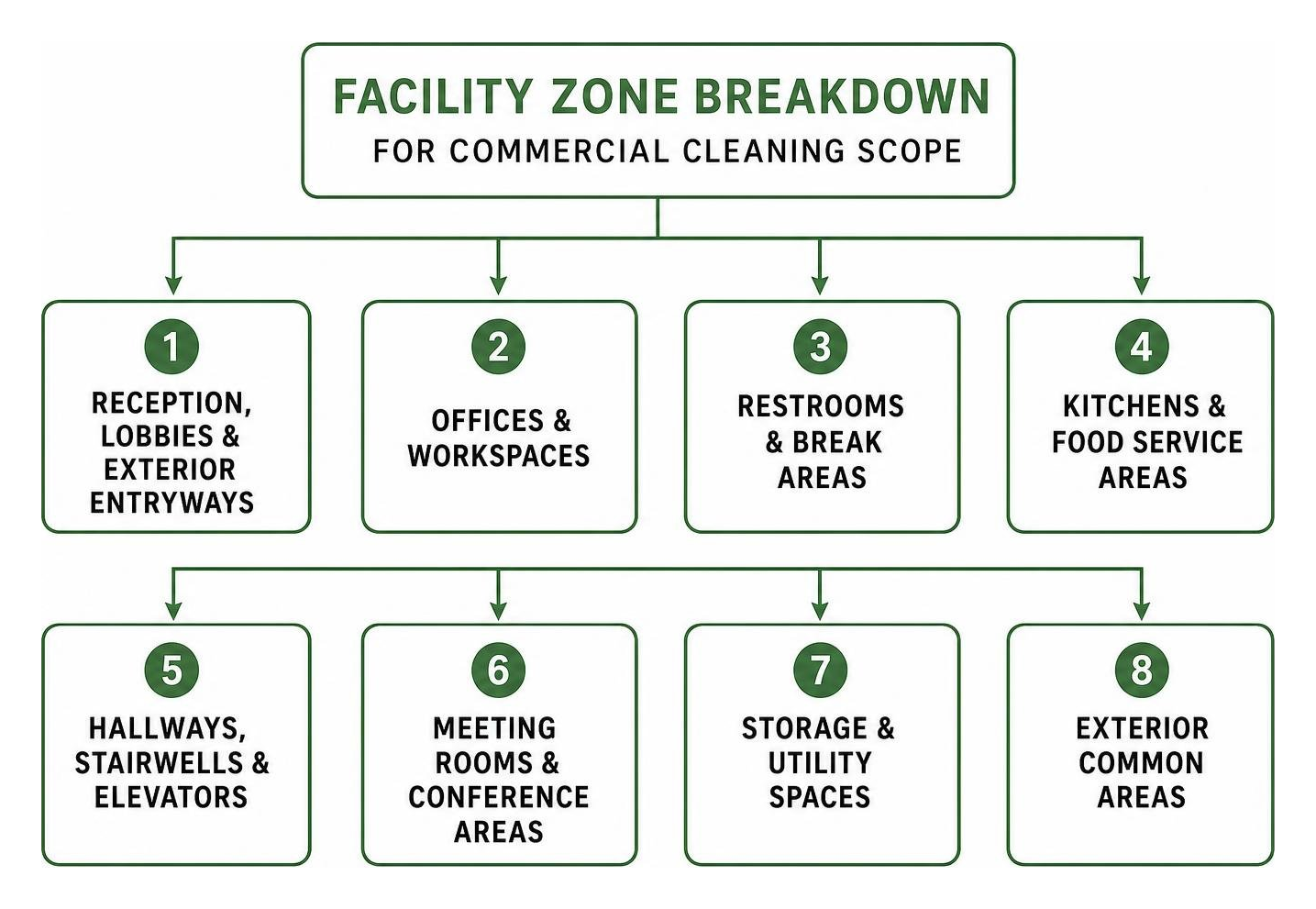
Reception, Lobbies, and Exterior Entryways
Your lobby is the public face of your business. It experiences the highest foot traffic and bears the brunt of outdoor dirt, moisture, and road contaminants.
Key focus items for this zone include:
- Entrance Glass and Doors: Removing fingerprints, smudges, and dirt from exterior push bars and glass panes.
- Floor Runner Maintenance: Daily vacuuming and positioning of walk-off mats to capture soil before it reaches interior flooring.
- HVAC Diffusers and High Ledges: Periodic dusting to ensure overhead vents do not blow particulate matter onto clean surfaces.
- Waste Receptacle Care: Emptying trash bins before they reach capacity and sanitizing exterior lids.
For a deeper look into front-of-house procedures, review our commercial cleaning checklist and tips.
Office Workspaces, Desks, and Conference Rooms
Workspaces require a delicate balance between thorough sanitization and respecting employee privacy. Janitorial teams must navigate technical equipment, sensitive documents, and personal belongings daily.
Checklist priorities for office spaces:
- High-Touch Electronics: Wiping down shared conference phones, AV controllers, and light switches with electronics-safe disinfectants.
- Partition and Ledge Dusting: Cleaning cubicle partition caps, window sills, and baseboards to remove dust buildup.
- Seating and Upholstery: Vacuuming fabric chairs and spot-cleaning leather or vinyl conference seating.
- Desk Clearance Rules: Sanitizing open desk surfaces while leaving stacks of paperwork and personal items undisturbed unless authorized.
To streamline this workflow, consult your complete commercial office cleaning checklist.
Structuring Restrooms and High-Touch Zones on Your Commercial Cleaning Checklist
Restrooms present the highest microbial risks in any facility. Surface wiping alone is insufficient; checklists must incorporate multi-step sanitation protocols that eliminate pathogens and control odors at the molecular level.
Essential restroom components:
- Fixture Decontamination: Applying hospital-grade disinfectants to toilets, urinals, flush handles, and sinks, ensuring full chemical dwell time.
- Dispenser Management: Checking, cleaning, and refilling soap, paper towel, and hand sanitizer dispensers daily.
- Partition and Wall Cleaning: Washing stall doors, latches, and splash zones around urinals and sinks.
- Floor Care: Mopping tile floors using dedicated wet-mop heads or flat-mop systems with neutral or disinfectant cleaners to prevent grout fouling.
For complete hygiene workflows, see our complete office sanitation checklist and tips for a healthy facility.
Breakrooms and Commercial Kitchen Areas
Shared breakrooms combine biological contaminants with food residues, creating an environment ripe for bacterial growth and pest infestations if neglected.
Key breakroom priorities:
- Countertops and Food Prep Areas: Sanitizing food-contact surfaces using sanitizers certified for food prep environments.
- Small Appliances: Degreasing microwave interiors, wiping coffee stations, and cleaning toaster crumb trays.
- Refrigerator Purges: Establishing scheduled clearing of expired food followed by interior shelf washing and sanitizing.
- Sink Basin and Drain Sanitization: Scrubbing basins, faucets, and splash backs to eliminate grease and biofilm buildup.
For more kitchen-specific priorities, explore our corporate office cleaning checklist 5 things you cant forget.
10 Actionable Tips for Optimizing Your Cleaning Checklist Scope
Designing a functioning checklist requires strategic planning. Use these ten practical recommendations to refine your template and align expectations between building managers and service teams.

1. Distinguish Service Frequency from Task Frequency
A common error in commercial cleaning scopes is confusing how often a crew visits with how often a specific job is performed.
- Service Frequency: How many days per week the cleaning team enters the building (e.g., five nights a week).
- Task Frequency: How often an individual task occurs within that schedule (e.g., trash removal is daily, while baseboard washing is monthly).
Clearly separating these elements in your checklist avoids paying for unnecessary daily repetitions of low-priority tasks while ensuring deep-cleaning rotations are not forgotten. Learn more about balancing these intervals by reviewing How To Set Up A Stress Free Office Cleaning Schedule.
2. Differentiate Routine Cleaning from Antimicrobial Disinfection
Cleaning and disinfecting are two distinct scientific steps governed by Environmental Protection Agency (EPA) and Centers for Disease Control and Prevention (CDC) standards.
- Cleaning: The physical removal of dirt, grease, and organic matter from surfaces using detergents and water.
- Disinfection: The application of EPA-registered antimicrobial chemicals to kill pathogens on clean surfaces.
Disinfectants cannot penetrate layers of grease or dust. Your checklist must instruct cleaners to remove visible soils first, then apply disinfectant and allow it to remain wet for the manufacturer’s specified dwell time (often 3 to 10 minutes) before wiping.
3. Separate Routine Janitorial from Restorative Specialty Care
Routine daily maintenance is designed to preserve standard cleanliness, not reverse years of heavy wear, neglected grout, or damaged floor finishes. Specialty restorative tasks require dedicated machinery, specialized chemistry, and certified technicians. Attempting to tackle deep restoration without professional equipment or experience can be exceptionally time-consuming, physically demanding, and may fail to resolve underlying problems like deep carpet mold or ground-in subfloor contaminants. Hiring a certified professional cleaning company ensures these assets are properly protected.
| Service Level | Typical Tasks | Standard Frequency | Primary Objective |
|---|---|---|---|
| Routine Maintenance | Emptying trash, dusting, vacuuming, damp mopping, basic restroom sanitation | Daily to 3x Weekly | Preserve daily hygiene and basic facility presentation |
| Deep Cleaning | High dusting, detail edging, interior refrigerator washing, wall spot cleaning | Monthly to Quarterly | Address hidden dirt and slow-accumulating debris |
| Restorative Care | Hot-water carpet extraction, floor stripping and waxing, tile/grout machine scrubbing | 1 to 2x Annually | Restore material condition, extend flooring lifespans, improve indoor air quality |
4. Calibrate Tasks by Foot Traffic and Occupancy Levels
A single desk worker generates far less wear than a hundred visitors traversing a main lobby corridor. Checklists must reflect your building’s foot traffic patterns.
High-density zones—such as elevators, customer service desks, and central corridors—require daily damp mopping, frequent carpet vacuuming, and multiple daily touchpoint sanitization sweeps. Conversely, low-occupancy executive boardrooms or back-office storage rooms may only require weekly vacuuming and surface dusting. To better understand how building size and density impact cleaning plans, check What To Expect For Commercial Cleaning Services.
5. Adapt Cleaning Protocols for Seasonal Weather Shifts
Wisconsin weather patterns create distinct seasonal challenges for commercial floor care. A static checklist that ignores seasonal moisture will lead to damaged flooring and safety hazards.
- Winter & Early Spring: Snow, slush, and salt crystals get tracked indoors. The checklist must prioritize wet-vacuuming entry mats, neutralizer rinsing to dissolve white ice-melt residues on VCT or tile, and daily safety runner realignment.
- Late Spring & Summer: High pollen counts and dust require increased HVAC filter inspections, entryway glass cleaning, and electrostatic surface dusting.
6. Establish Clear Boundaries on Access, Keys, and Workspace Readiness
Checklists must document the operational handoff between your internal staff and the custodial provider. Unclear protocols regarding locked suites, alarm codes, or cluttered desks lead to skipped tasks.
Define the following operational boundaries:
- Access Protocols: Keycard issuance, lockbox procedures, and designated alarm disarm/arm time windows.
- Desk Policies: Instructions regarding whether cleaners should sanitize around desktop monitors and paperwork or only clean completely cleared desks.
- Consumables Provision: Clarify whether the property management supplies hand towels, soap, and trash liners, or if the commercial cleaning provider manages this inventory.
7. Mandate Chemical Safety Data Sheets (SDS) and Dilution Standards
A professional commercial cleaning program complies strictly with Occupational Safety and Health Administration (OSHA) hazard communication standards.
Your operational checklist should require that:
- All chemical containers, including secondary spray bottles, feature OSHA-compliant product labels.
- Safety Data Sheets (SDS) are accessible in the primary janitorial closet for every chemical used on site.
- Technicians utilize closed-loop chemical dilution dispensers to prevent improper chemical mixing, surface etching, and hazardous chemical fumes.
8. Use Checklists for Employee Onboarding and Quality Audits
Checklists serve as an invaluable training framework for new custodial hires. Walking a new employee through a facility room-by-room with a checklist standardizes operational expectations from day one.
Supervisors should use the exact same checklist to conduct regular quality assurance audits. By grading completed tasks against objective criteria, management can identify performance trends, provide targeted retraining, and eliminate recurring service oversights before clients notice them.
9. Upgrading from Paper to a Digital Commercial Cleaning Checklist
While laminated paper clipboards have been used for decades, modern facilities benefit significantly from cloud-based digital checklists and janitorial tracking software.
Key benefits of digital checklists include:
- QR Code Verification: Technicians scan a unique QR code in each room to load that zone’s specific task list, verifying their physical presence and completion time.
- Photo Documentation: Cleaners attach real-time photos of completed specialty tasks or report maintenance issues (such as leaking plumbing or burnt-out ballasts).
- Instant Reporting: Facility managers receive automated completion reports and timestamps, building transparency and trust.
10. Implement an Inspection Feedback Loop to Prevent Scope Creep
Over time, informal client requests—such as asking a cleaner to wash personal dishes or clear out a storage closet—can lead to “scope creep.” When cleaners perform unscheduled courtesy tasks, they are forced to rush or skip contracted checklist items.
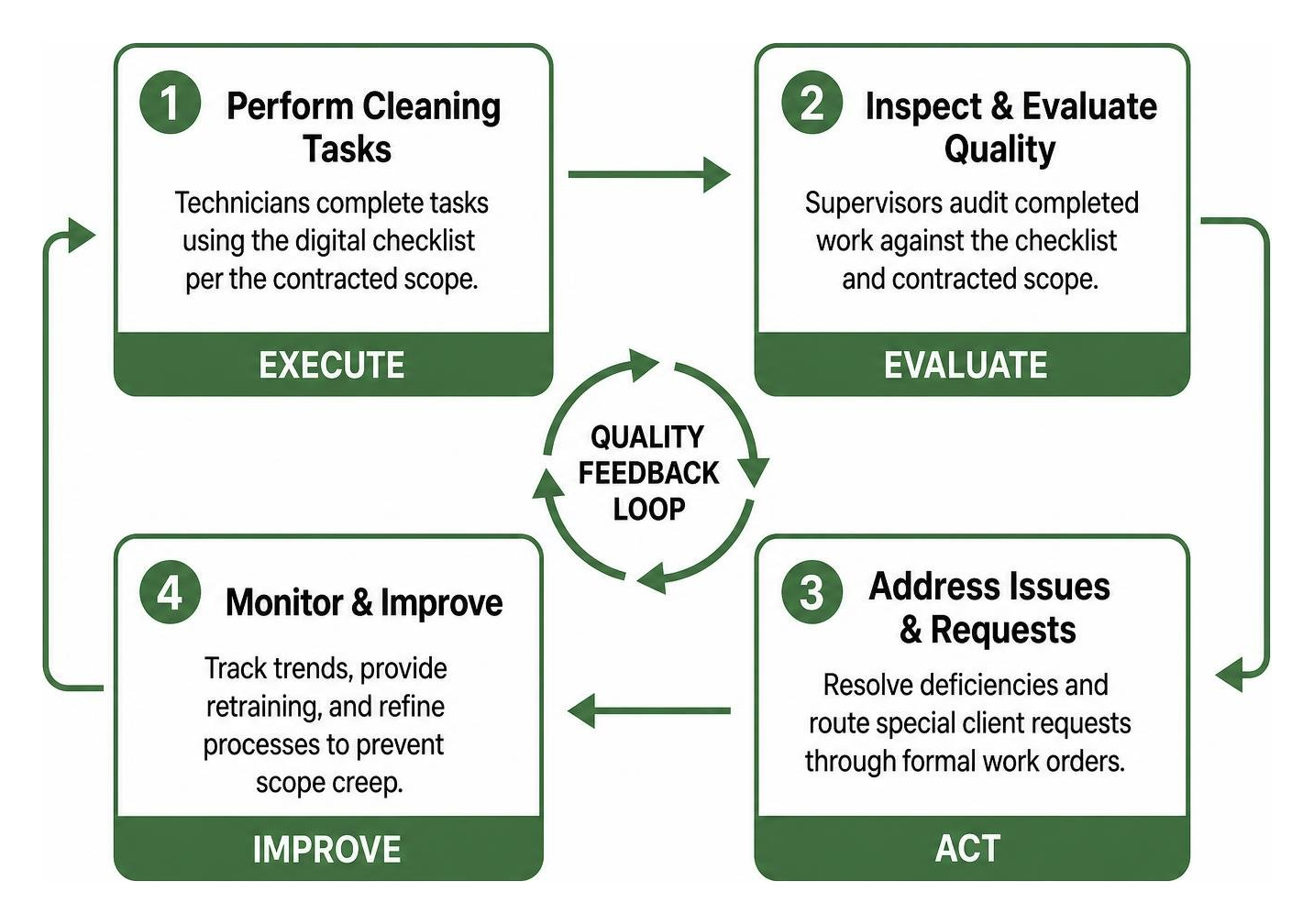
Implement a formal inspection loop where supervisors evaluate work quality, compare completed tasks against the contracted scope, and address special client requests through formal work orders rather than off-the-cuff verbal requests. To see how structured operational programs support long-term facility health, explore Commercial Cleaning Services How We Can Help.
Frequently Asked Questions About Commercial Cleaning Checklists
How often should deep cleaning tasks be scheduled compared to routine cleaning?
Routine cleaning should occur on every service visit (daily or multiple times per week) to handle waste removal, restroom sanitation, and high-traffic floor vacuuming. Deep cleaning tasks—such as high-level vent vacuuming, interior appliance scrubbing, and washing partition walls—should be scheduled on a monthly or quarterly rotation.
Heavy restorative services, such as hot-water extraction for carpets and stripping and waxing resilient hard floors, are typically scheduled one to two times per year depending on traffic volume and soil exposure.
What is the distinction between cleaning and disinfecting high-touch surfaces?
Cleaning uses soap, water, and mechanical friction to loosen and remove visible dirt, body oils, and organic matter from surfaces. Disinfecting uses specific EPA-registered chemicals to destroy pathogens, bacteria, and viruses.
Disinfection cannot work effectively if a surface is coated in dirt, as organic material shields pathogens from the chemical. The gold standard procedure is a two-step process: clean the surface to remove soil, then apply disinfectant and allow it to sit undisturbed for the full labeled dwell time.
How do facility foot traffic and weather conditions affect cleaning frequency?
Building occupancy and outdoor weather directly dictate soil accumulation rates. A facility with hundreds of daily visitors requires daily floor care and frequent daytime touchpoint sanitization.
Inclement weather dramatically increases the amount of grit, moisture, and chemical ice melt tracked inside, necessitating multiple daily floor mat cleanings and seasonal floor neutralizer treatments. When conditions or traffic overwhelm evening crews, facility managers often implement day porter services to maintain restrooms and entryways continuously. For additional guidance on tailoring your maintenance plan, consult All Your Commercial Cleaning Services Questions Answered.
Conclusion
An effective cleaning program relies on clear communication, disciplined execution, and structured standard operating procedures. A customized commercial checklist ensures that your building maintains exceptional hygiene, protects its interior investments, and provides a welcoming environment for employees and visitors every day.
Managing commercial facility sanitation in-house can quickly become overwhelming, labor-intensive, and costly without industrial machinery, certified staff, and structured safety protocols. At ZBM Inc., we are a family-owned, licensed, bonded, and insured cleaning firm with certified professionals based in Watertown, WI. We proudly serve commercial and institutional facilities throughout Dodge County, Jefferson County, Lake Mills, Minocqua, the Northwoods, and all of Southeastern Wisconsin.
Contact our team today to discover how our tailored commercial cleaning services can keep your facility pristine, healthy, and operating smoothly year-round.