What “Clean Crime” Really Means — and Why It Matters for Property Owners
Clean crime is the process of safely removing blood, bodily fluids, and other biohazardous materials left behind after a violent death, accident, or trauma event — and it falls entirely on the property owner, not law enforcement.
If you need the short version:
- Who is responsible? The property owner, landlord, or next of kin — not police, paramedics, or the coroner
- What needs cleaning? Blood, bodily fluids, decomposition matter, and any other potentially infectious materials (OPIM)
- Can you DIY it? No — biohazard cleanup requires specialized training, PPE, and licensed waste disposal
- Who should you call? A certified biohazard remediation company with OSHA-compliant training and proper disposal documentation
Here is what most people don’t realize: once law enforcement releases a scene, their job is done. The body is removed. The investigation wraps up. And then the family — or the property manager — is left standing in a room that may still be covered in blood.
That’s not a rare edge case. It’s standard procedure across the country.
Crime scene cleanup (also called biohazard remediation or forensic cleanup) is a specialized service that most ordinary cleaning companies are not equipped to handle. The risks are real — human blood can carry HIV, Hepatitis B, and Hepatitis C — and the rules around waste disposal are strictly regulated by OSHA, the EPA, and the DOT.
This guide walks you through everything you need to know: the health risks, the regulations, the equipment, and how to choose the right cleanup company when it matters most.
I’m Terry Zastrow, owner of ZBM, Inc., a certified IICRC firm with nearly 30 years of experience in professional clean crime remediation, biohazard decontamination, and disaster recovery for commercial and public-sector clients across Wisconsin. In the sections below, I’ll break down exactly what this work involves — and what to look for when you need help fast.
What Clean Crime Means After Law Enforcement Leaves
When a traumatic event occurs, the immediate response is a whirlwind of emergency lights, sirens, and yellow caution tape. Police, paramedics, and coroners swarm the scene to secure evidence, provide emergency medical care, and respectfully remove the deceased.
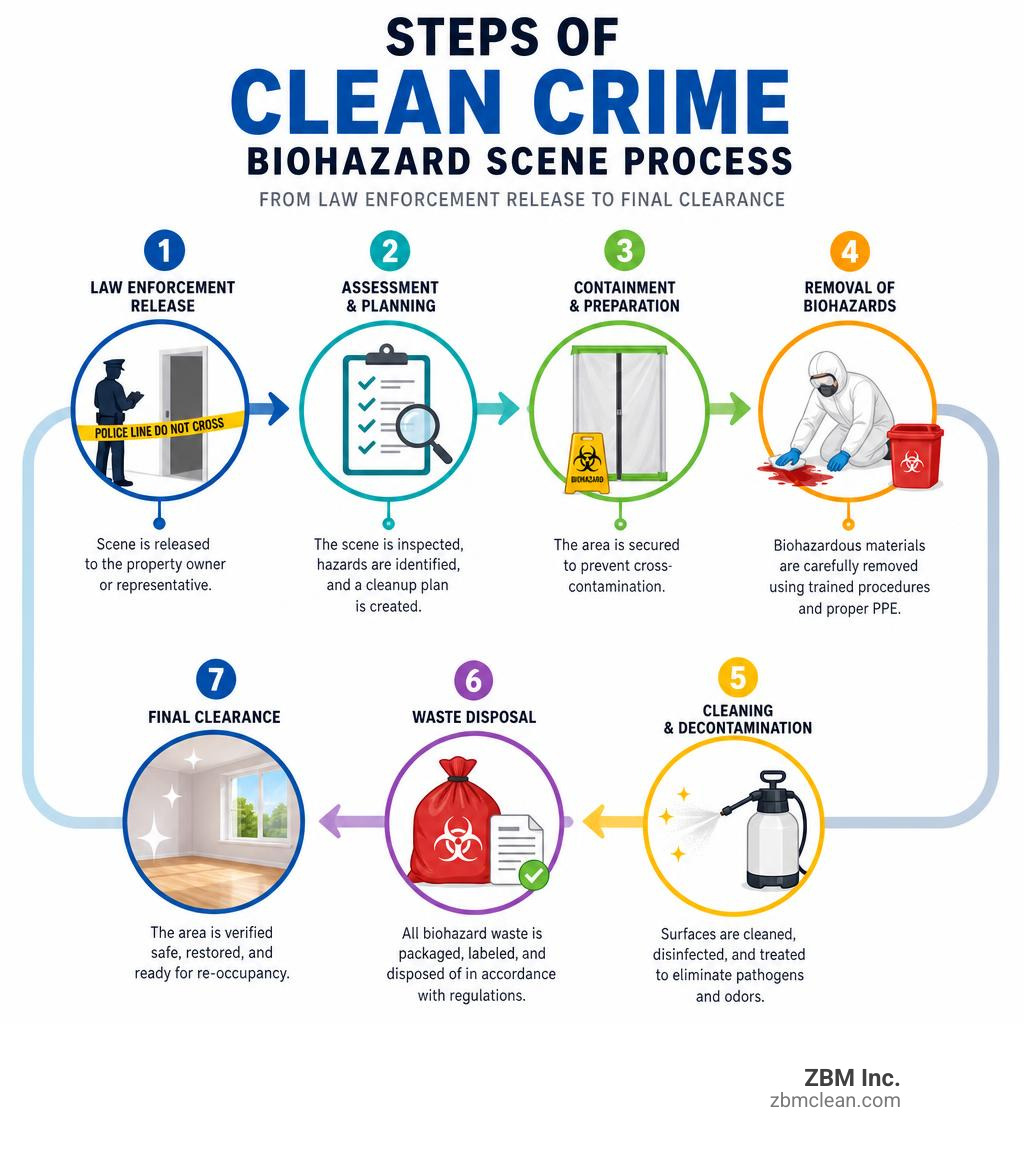
But once the flashing lights fade and the yellow tape is cut, a cold, stressful reality sets in. The authorities do not sweep, mop, or decontaminate. They leave the physical aftermath behind, and the scene is officially released.
At this point, the burden of restoring the property shifts entirely to private citizens. Whether the event was an unattended death, a homicide, a suicide, an industrial accident, or an infectious disease contamination, the space is left in a highly hazardous state. This is where the concept of clean crime transitions from a legal term to a physical, demanding job.
To understand what happens next, it is helpful to look at what do crime scene cleanup companies do to safely return a home or business back to a safe, livable condition.
Who Is Legally Responsible for Cleanup?
Legally, the responsibility to remediate a trauma scene falls on the owner of the property.
- Residential Properties: The homeowner, landlord, or the next of kin is responsible for organizing and funding the cleanup. If you are a landlord, you have a strict “implied warranty of habitability,” meaning you cannot legally rent a unit containing biohazards to another tenant.
- Commercial Properties: Business owners and property managers are responsible. They must ensure a safe working environment under OSHA regulations. Failing to properly clean a commercial site can lead to severe regulatory fines and massive liability. For businesses in our region, trauma scene restoration helping WI businesses recover is an essential service to protect employees and patrons alike.
Fortunately, most homeowners and commercial property insurance policies cover the cost of biohazard remediation. A professional cleanup company will document the damage, take pre-and-post-remediation photos, and handle the complex chain of custody and scene release paperwork required by your insurance adjuster.
Clean crime vs ordinary household cleaning
You might wonder, “Can’t I just put on some thick gloves, grab a bucket of bleach, and clean this up myself?”
The short answer is: absolutely not. There is a massive operational and safety difference between standard janitorial cleaning and professional clean crime remediation.
Standard household cleaners are designed to remove surface dirt and common bacteria. They cannot handle the deep, structural contamination associated with blood and other potentially infectious materials (OPIM).
When blood or decomposition fluids spill onto a surface, they do not just sit on top. They sink into porous materials like carpet, padding, wood subfloors, and drywall. If you simply wipe down the surface, biohazards will remain trapped underneath, creating a breeding ground for dangerous pathogens and leaving behind a permanent, toxic odor.
Furthermore, improper cleaning techniques—like spraying bleach directly onto a wet blood pool—can cause aerosolization, turning liquid pathogens into airborne particles that you can easily breathe in. Attempting a DIY cleanup also places an immense emotional toll on grieving families, forcing them to scrub the biological remains of their loved ones. This is why you should use pros for trauma clean up to protect both your physical health and your mental well-being.
Health Risks, Regulations, and Credentials That Matter
The biological hazards present at a trauma scene are invisible but highly dangerous. Human blood and bodily fluids can carry bloodborne pathogens that remain infectious outside the body for days, or even weeks.
Main Health and Safety Risks
When dealing with a clean crime scene, technicians face a wide array of biological hazards:
- Bloodborne Pathogens: Viruses like Human Immunodeficiency Virus (HIV), Hepatitis B (HBV), and Hepatitis C (HCV) can live on surfaces and are easily transmitted through direct contact, open cuts, or accidental needlesticks.
- Other Biohazards: Feces, urine, vomit, saliva, and decomposition fluids harbor dangerous bacteria like MRSA, E. coli, and C. difficile.
- Decomposition Risks: Unattended deaths often involve advanced decomposition, which attracts insects and releases volatile organic compounds (VOCs) that cause overpowering, toxic odors and respiratory irritation.
- Secondary Trauma: Beyond physical hazards, the sheer visual and emotional weight of a scene can trigger severe psychological distress for untrained individuals.

Because of these extreme risks, we always stress a safety-first approach. You can read more about these protocols in our safety first why professional crime scene cleanup is essential guide.
Training, Certifications, and Regulatory Requirements
A reputable biohazard remediation company does not just hire standard cleaners and hand them sponges. Technicians must undergo rigorous, specialized training to meet strict federal and state standards.
- OSHA Bloodborne Pathogens Standard (29 CFR 1910.1030): This is the foundation of biohazard safety. It requires companies to have a written Exposure Control Plan, provide annual employee training, offer Hepatitis B vaccinations, and enforce the use of proper Personal Protective Equipment (PPE). (Note: OSHA does not actually issue certifications; rather, companies must seek third-party training that complies with OSHA standards).
- HAZWOPER (29 CFR 1910.120): Hazardous Waste Operations and Emergency Response training ensures technicians know how to safely handle, package, and transport toxic or chemical substances.
- IICRC S540 Standard: The Institute of Inspection, Cleaning and Restoration Certification (IICRC) establishes the industry-standard methodology for trauma and crime scene cleanup.
- ABRA Credentials: The American Bio Recovery Association (ABRA) is a premier third-party credentialing body that certifies companies and technicians in bio-recovery.
- State Licensing and Waste Transport: While only California and Georgia require explicit state-level registration for biohazard cleanup companies, every state has strict Department of Transportation (DOT) and EPA regulations regarding the packaging, transport, and disposal of regulated medical waste.
In Wisconsin, we adhere strictly to all local DNR (Department of Natural Resources) and federal regulations to ensure biohazard waste is safely incinerated or autoclaved, protecting the local environment and community.
How Professionals Decontaminate, Deodorize, and Verify the Scene
Remediating a biohazard scene is a highly systematic process. It requires specialized equipment and a meticulous multi-step protocol to transform a contaminated space back into a safe environment.
Specialized Equipment, PPE, and Cleaning Techniques
When our teams arrive at a scene, we do not walk in wearing street clothes. Technicians suit up in comprehensive personal protective equipment (PPE), including full-body liquid-impermeable suits, double nitrile gloves, cut-resistant gloves, boot covers, and full-face respirators equipped with HEPA and organic vapor cartridges.

Once protected, we utilize specialized tools and techniques:
- Containment Barriers: Setting up plastic sheeting and negative air pressure machines to prevent cross-contamination to other rooms.
- EPA-Registered Disinfectants: We do not use household bleach. We use broad-spectrum, hospital-grade disinfectants with specific “dwell times” proven to kill robust pathogens like Hepatitis and MRSA.
- Advanced Deodorization: Hydroxyl generators and ozone machines are deployed to break down odor molecules at a molecular level, rather than just masking them.
- ATP Testing: Adenosine Triphosphate (ATP) monitors are used to scientifically verify cleanliness. By measuring cellular energy on a surface, we can prove that a space is biologically clean and free of organic matter.
For a detailed look at what to expect during this process, read our guide on biohazard cleanup services what to expect.
Waste Disposal, Odor Removal, and Final Verification
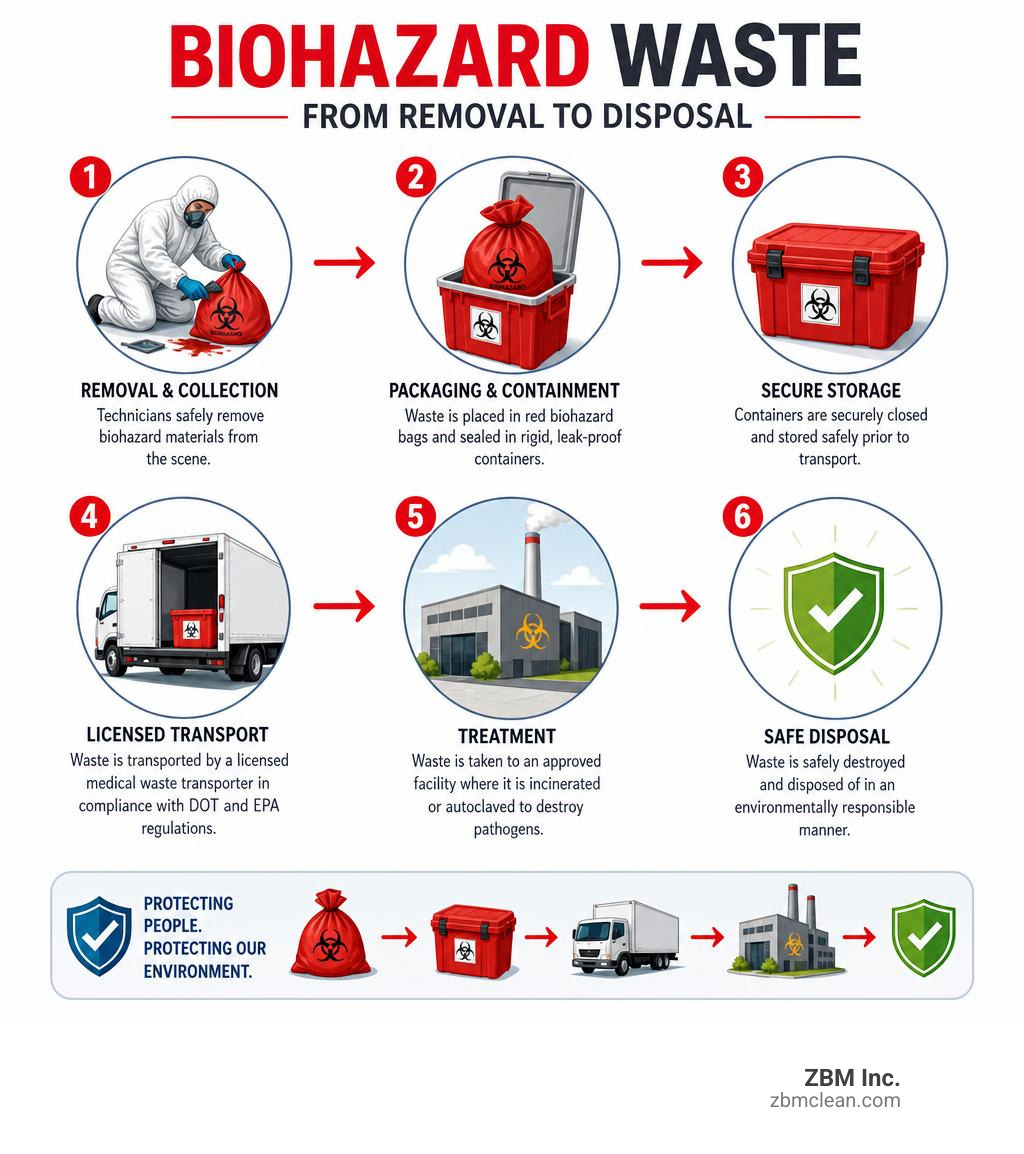
Any material saturated with blood or bodily fluids is classified as regulated medical waste. This waste cannot be thrown into a standard dumpster.
Instead, it must be placed into specially marked red biohazard bags, stored in rigid, leak-proof containers, and transported by a licensed medical waste transporter to an approved treatment facility. There, the waste is incinerated or autoclaved to completely destroy any pathogens.
Once all biohazard waste is removed, we address structural issues. If blood has seeped into floorboards or drywall, those materials must be carefully cut out and disposed of.
Finally, we perform rigorous ATP testing and provide the property owner with a Certificate of Decontamination, which is crucial for real estate disclosures, insurance claims, and peace of mind. To learn more about this entire journey, you can explore what happens during a crime scene cleanup.
Real-World Cleanup vs Games, Movies, and Media
In recent years, the concept of “cleaning up crime scenes” has exploded in popular culture. From video games to Hollywood movies, the public has developed a fascination with the gritty, behind-the-scenes work of biohazard remediation. However, media representations often gloss over the strict regulations, emotional gravity, and safety protocols that define real-world work.
How clean crime in games differs from professional biohazard remediation
A prime example of this pop-culture phenomenon is the hit video game Crime Scene Cleaner on Steam. The game has captured a massive audience, boasting an “Overwhelmingly Positive” rating with 98% positive reviews among 14,752 English-language users, and a 97% positive score across recent reviews (with over 30,775 total reviews across all languages).
In the game, players step into the shoes of a single father who cleans up blood, disposes of bodies, and hides evidence for the mob to pay for his daughter’s medical care. While it is an engaging simulator, the gameplay mechanics differ wildly from the rigorous standards of real-world biohazard remediation.
| Game Mechanic in Crime Scene Cleaner | Real-World Cleanup Standard (ZBM Inc.) |
|---|---|
| Power-washing blood indoors | High-pressure spraying is strictly avoided because it aerosolizes pathogens, putting workers and HVAC systems at risk. |
| Stealing valuables & hiding evidence | Technicians maintain a strict chain of custody, coordinate with law enforcement, and document all personal property. |
| Cleaning without proper PPE | Technicians wear full-body Tyvek suits, double-gloves, and respirators to prevent chemical and biological exposure. |
| Throwing biohazard waste in dumpsters | Regulated medical waste must be tracked, manifest-documented, and legally incinerated at licensed facilities. |
While the game’s “True Cleaner’s Mode” and upgradeable power washers make for fantastic entertainment, the reality of clean crime remediation is built on safety, compliance, and deep respect for the families involved. For those interested in the mobile side of this genre, games like Crime Scene Cleaner: Mobile 3D have earned a 4.7/5 rating from 2.3K reviews on the App Store, proving that the public’s curiosity about this field remains incredibly high in 2026.
Pop Culture Creates Interest but Not Training
It is not just video games capturing our attention. The movie industry has also leaned into the theme with releases like The Clean Up Crew, a 2024 action-thriller starring Antonio Banderas. Despite grossing $94,262 worldwide and holding a modest 4.1/10 rating on IMDb, the film highlights a common Hollywood trope: a cleanup crew finding a briefcase of cash and getting tangled in a violent battle with a crime boss.
In literature, international bestsellers like Clean by Alia Trabucco Zerán examine the psychological and social dynamics of domestic cleaning, showing how deeply the theme of “cleaning up after tragedy” resonates with audiences worldwide.
While these movies, books, and games are great for entertainment, they do not prepare anyone for the physical and emotional reality of a real-world biohazard event. Real trauma cleanup requires deep empathy, strict adherence to OSHA guidelines, and an understanding of the psychological toll that these events take on survivors.
Conclusion: Choosing Safe Help After a Traumatic Event
If you are facing the aftermath of a traumatic event, you do not have to walk this path alone. Choosing a professional, reputable biohazard remediation company is the best way to protect your health, your property, and your emotional well-being.
At ZBM Inc., we provide compassionate, discreet, and highly professional clean crime and biohazard cleanup services. As a licensed, bonded, and insured family-owned business based in Watertown, WI, we serve families and businesses across:
- Dodge County, WI
- Jefferson County, WI
- Watertown, WI
- Lake Mills, WI
- Southeast & Southeastern Wisconsin
- Minocqua & The Northwoods, WI
If you are looking for local, trusted expertise, you can learn more about our specialized crime scene cleanup service Wisconsin program, or read about our dedicated team at restoring harmony ZBM Clean and compassionate crime scene cleanup in Wisconsin.
What Property Owners and Families Should Look For
When vetting a biohazard remediation company, make sure they check all of the following boxes:
- Proof of OSHA Compliance: They should easily provide documentation of Bloodborne Pathogens and HAZWOPER training.
- Proper Insurance: Ensure they carry comprehensive liability insurance specifically rated for biohazard and pollution cleanup.
- Licensed Waste Disposal: Ask for proof that they use licensed medical waste transporters and provide disposal manifests.
- Discreet Vehicles: A reputable company will arrive in unmarked or highly discreet vehicles to protect your privacy and prevent neighborhood gossip.
- Compassionate Communication: The team should treat you with kindness, patience, and absolute respect.
For a deeper dive into this hiring process, check out our guides on what to look for in a crime scene cleanup company and what to consider before hiring biohazard cleanup companies.
Questions to Ask Before Hiring
Before signing a contract, ask these key questions:
- Are your technicians certified by third-party organizations like the IICRC or ABRA?
- Can you provide a written scope of work and a clear, transparent estimate?
- Do you work directly with my homeowners or commercial insurance provider?
- How do you verify that the scene is completely safe and biologically clean?
Asking these questions ensures you get the professional service you deserve. For more help making this decision, read crime scene cleanup companies how to choose the right one and our your complete guide to crime scene cleanup companies.
Emotional Support and Next Steps
We understand that a trauma scene is not just a physical mess to be scrubbed away – it represents a profound moment of pain and loss. Our technicians are trained to work quietly, efficiently, and with the utmost respect for your family’s personal belongings and privacy.
By handling the physical burden of cleanup, we hope to give you the space and time you need to focus on healing, remembering, and taking care of your loved ones. As we often say, crime scene cleanup is more than just physical restoration – it is the first step toward reclaiming your peace of mind.
If you are facing a crisis, please do not go through it alone. We are here to help. You can read our complete guide to death cleanup companies, discover how biohazard cleanup services help in times of crisis, or review the crime scene cleanup 8 benefits of hiring a company to see how professional care can support your family during this difficult time.
Need Immediate, Compassionate Help?
We are available 24/7 to support you. Contact ZBM Inc. today to speak with a compassionate, certified biohazard specialist.
- Visit Us Online: zbmclean.com