What Are the Requirements to Become a Crime Scene Cleaner?
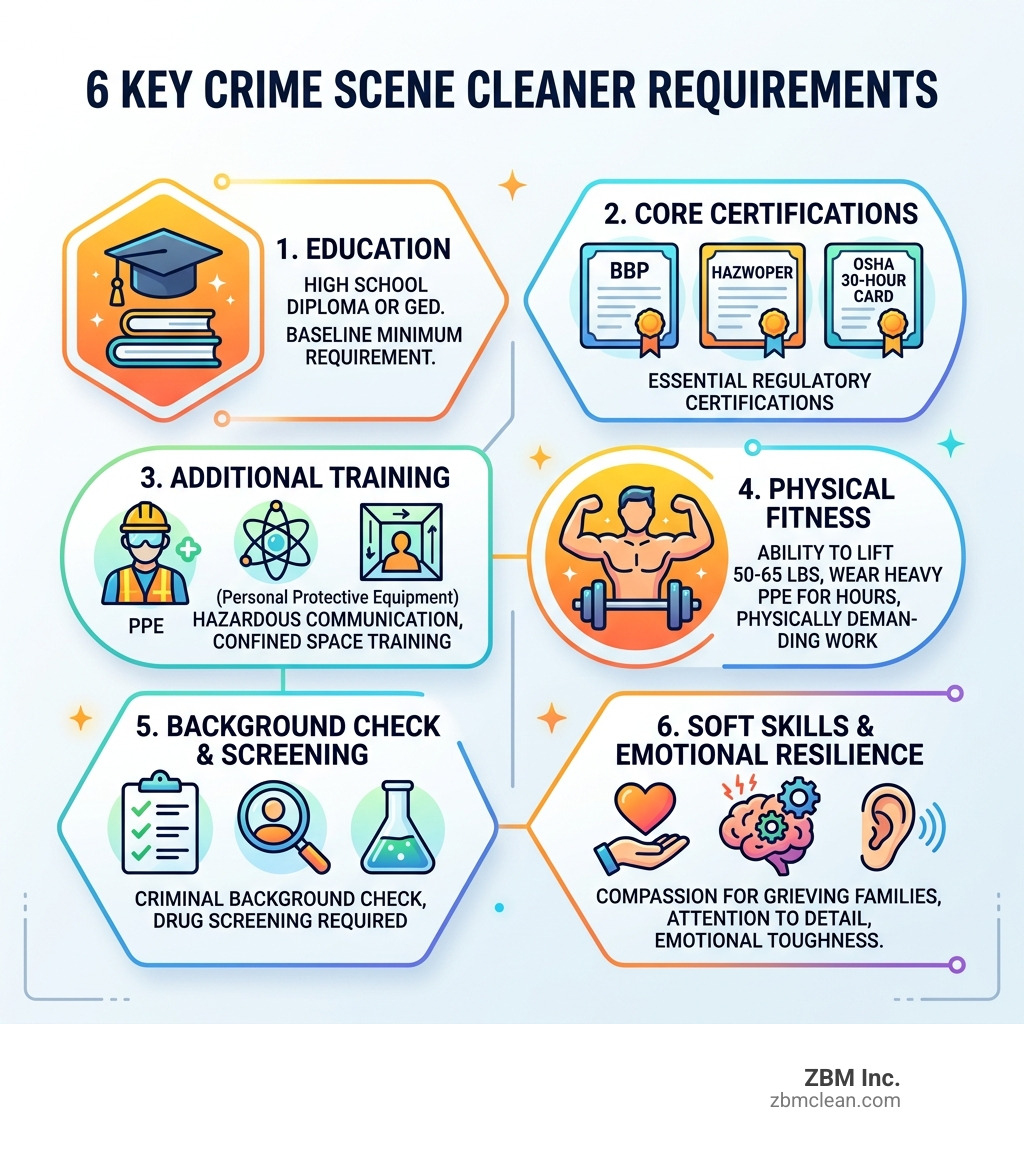
Crime scene cleaner requirements are more involved than most people expect. Here’s a quick summary of what you need to qualify:
Minimum Requirements at a Glance:
| Requirement | Details |
|---|---|
| Education | High school diploma or GED |
| Core Certifications | Bloodborne Pathogens (BBP), HAZWOPER, OSHA 30-Hour Card |
| Additional Training | Confined Space, PPE, Hazardous Communication |
| Physical Fitness | Able to lift 50-65 lbs, wear heavy PPE for hours |
| Background Check | Criminal background check and drug screening |
| Licensing | Varies by state; some require biohazard waste permits |
| Soft Skills | Attention to detail, compassion, emotional resilience |
No college degree is required. But this is far from a typical cleaning job.
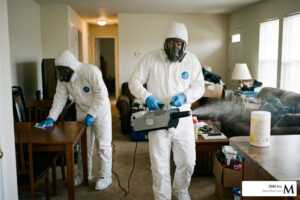
Crime scene cleaners — also called biohazard remediation technicians — step in after police investigations are complete. They sanitize and restore spaces after homicides, suicides, unattended deaths, and other traumatic events. They work with blood, bodily fluids, and hazardous chemicals. They wear full hazmat suits. And they do it while supporting grieving families in some of the worst moments of their lives.
It takes specialized training, the right certifications, and a level of emotional toughness that most jobs simply don’t demand. As one industry source puts it, the danger rating for this work is a 10 out of 10.
I’m Terry Zastrow, owner of ZBM Inc., a certified IICRC firm with nearly 30 years of field experience navigating the exact crime scene cleaner requirements outlined in this guide — from HAZWOPER training to FEMA Incident Command. In the sections ahead, I’ll walk you through everything you need to know to enter this field with confidence.
Essential Crime Scene Cleaner Requirements: Education and Training
If you’re looking to start a career in this field, the first thing you should know is that you don’t need to spend four years in a university lecture hall. Most employers, including us at ZBM Inc., look for a high school diploma or a GED as the baseline educational requirement.
However, “no degree” doesn’t mean “no knowledge.” While a college degree isn’t mandatory, having a background in criminal justice or forensic science can give you a significant leg up. These fields help you understand the “why” behind what we do—especially when it comes to preserving evidence integrity and coordinating with law enforcement.
If you’re curious about the nitty-gritty of the career path, becoming a crime scene cleanup specialist involves a mix of formal safety education and hands-on experience. At ZBM Inc., we emphasize that what it takes to become a crime scene cleanup professional is a blend of technical competence and a “whatever it takes” attitude.
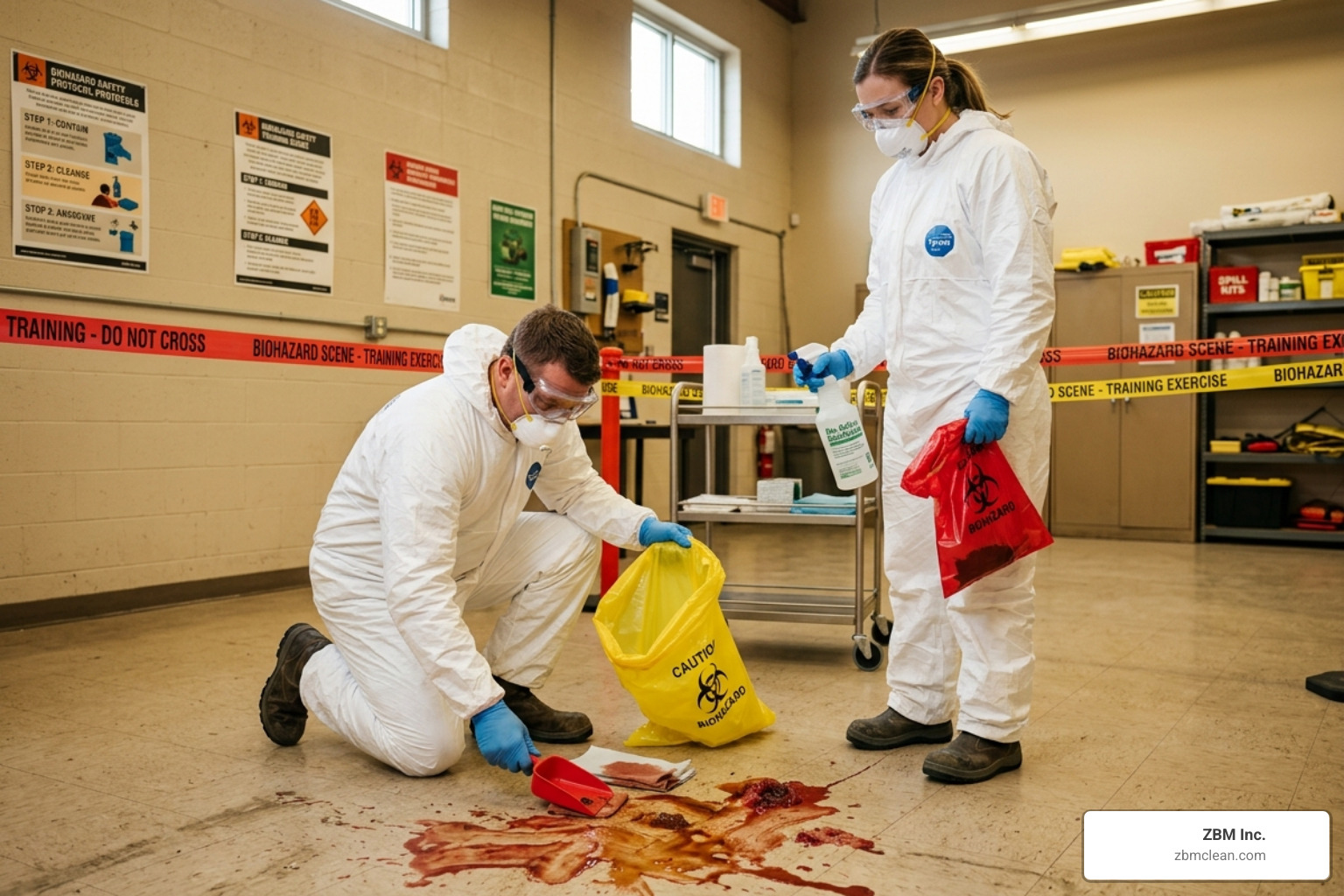
The training process usually begins with an orientation that covers health and safety, followed by biohazard handling and the use of specialized equipment. Many companies use “mock scenes”—sometimes using pig blood or simulated biological materials—to train new hires in a controlled environment before they ever step foot on a real scene.
Mandatory Certifications for Biohazard Technicians
This is where the real work begins. You can’t just grab a bottle of bleach and a mop; you need specific, federally mandated certifications to handle biohazards safely.
- OSHA 30-Hour Card: This provides a comprehensive overview of workplace safety and health standards.
- Bloodborne Pathogens (BBP) Training: This is perhaps the most critical. It teaches you how to protect yourself and others from diseases like Hepatitis B, Hepatitis C, and HIV, which can be present in blood and bodily fluids.
- HAZWOPER 40-hour: This stands for Hazardous Waste Operations and Emergency Response. It’s a deep dive into handling hazardous materials and responding to emergencies.
- Confined Space Certification: Many scenes occur in tight, poorly ventilated areas like attics, crawlspaces, or small vehicles. You need to know how to work in these spaces without compromising your oxygen supply or safety.
Obtaining a crime scene cleanup certification isn’t just about checking a box; it’s about survival. In our industry, safety first is why professional cleanup is essential. Without these certifications, you are a liability to yourself, your team, and the property owner.
State-Specific Licensing and Crime Scene Cleaner Requirements
While OSHA sets the federal standard, individual states often have their own hoops to jump through. In Wisconsin—specifically in areas like Watertown, Dodge County, and Jefferson County—we have to adhere to strict Department of Health and Department of Natural Resources (DNR) regulations regarding medical waste.
Some states require a “Trauma Scene Waste Practitioner” permit. While Wisconsin doesn’t have a single “crime scene license,” we must be strictly compliant with medical waste handling and transportation laws. If you are looking for a crime scene cleanup service in Wisconsin, you must ensure the company is licensed, bonded, and insured to handle these specific risks.
For those specifically looking for biohazard and crime scene cleanup in Watertown, WI, the requirements often include passing a rigorous criminal background check and drug screening. Because we are often given access to private homes and sensitive environments, integrity is just as important as technical skill.
Physical and Emotional Demands of the Job
Let’s be honest: this job is physically exhausting. You aren’t just “cleaning”; you are often performing minor demolition. This might involve ripping up saturated carpet, cutting out sections of drywall, or moving heavy furniture that has been contaminated.
Physical Requirements:
- Lifting: You must be able to lift 50 to 65 pounds regularly.
- Stamina: You might spend 9 to 10 hours on a single site, often in a non-climate-controlled environment while wearing a non-breathable hazmat suit.
- Respiratory Health: You must pass a respiratory fit test to ensure your mask or PAPR (Powered Air-Purifying Respirator) has a perfect seal.
- Vaccinations: Per OSHA standards, employers must offer the Hepatitis B vaccination series to all employees with occupational exposure within 10 days of starting work.
The Emotional Toll: The physical labor is only half the battle. Research shows that 68% of crime scene cleanup technicians experience secondary traumatic stress (STS) in their first year. You will see things that most people only see in horror movies—unattended deaths where decomposition has set in, violent crime scenes, and the profound grief of the families left behind.
At ZBM Inc., we believe crime scene cleanup is more than just physical restoration. It requires immense compassion. You are a “second responder.” While the police and coroners deal with the evidence and the body, we deal with the aftermath. We help the family begin the healing process by removing the physical reminders of the tragedy.
The Technical Toolkit: PPE and Specialized Equipment
Standard janitorial tools have no place at a crime scene. Using a regular vacuum on a biohazard scene, for example, could actually aerosolize pathogens, making the room more dangerous.
| Tool/Equipment | Purpose in Biohazard Remediation |
|---|---|
| Hazmat Suit (Level C or D) | Full-body protection against splashes and contact. |
| PAPR/Full-Face Respirator | Filters out pathogens and odors from decomposition. |
| ATP Surface Testing | Uses bioluminescence to verify that a surface is biologically clean. |
| Enzyme Solvents | Specialized chemicals that break down organic matter at a molecular level. |
| Ozone Machines/Hydroxyl Generators | Used to permanently eliminate odors rather than just masking them. |
| HEPA Air Scrubbers | Filters the air to remove airborne contaminants and spores. |
Understanding what happens during a crime scene cleanup involves mastering these tools. We don’t just “wipe down” surfaces; we decontaminate them. This often involves a multi-stage process of assessment, containment, cleaning, and finally, verification.
When you are researching what to look for in a crime scene cleanup company, ensure they use industrial-grade equipment. At ZBM Inc., we use ATP meters to ensure that we aren’t just “guessing” if a room is safe—we are proving it.
Career Outlook: Salary and Crime Scene Cleaner Requirements in 2026
As of April 2026, the demand for professional biohazard remediation continues to grow. This is partly due to an aging population (leading to more unattended deaths) and a greater public awareness of the health risks associated with DIY biohazard cleaning.
The Numbers:
- Median Annual Wage: Approximately $45,270 for hazardous material removal workers.
- Hourly Rates: Starting pay typically ranges from $17.50 to $27.50 per hour, depending on experience and location. Experienced technicians in high-demand areas can earn upwards of $35 per hour.
- Job Growth: The industry is expected to grow by about 8% through the end of the decade.
However, keep in mind that this is rarely a “9-to-5” job. Most companies require 24/7 on-call availability. Traumatic events don’t wait for business hours. If you’re looking into crime scene cleaner pay and what you can expect to earn, remember to factor in the potential for overtime and “on-call” bonuses.
The field offers a unique sense of job security—there is always a need for these services. For a deeper look at the industry landscape, check out your complete guide to crime scene cleanup companies.
Frequently Asked Questions about Biohazard Careers
Is a college degree necessary to become a crime scene cleaner?
No, a college degree is not a mandatory crime scene cleaner requirement. A high school diploma or GED is the standard. However, vocational training or a background in forensics, biology, or criminal justice can make you a much more attractive candidate and may lead to faster promotion into supervisory roles.
How does crime scene cleaning differ from regular janitorial work?
The difference is night and day. Regular cleaning focuses on aesthetics—making things look and smell nice. Biohazard cleaning focuses on safety and decontamination. We deal with OSHA-regulated materials, use EPA-registered disinfectants, and follow strict legal protocols for medical waste disposal. If you want to know more about the specifics, we’ve outlined what crime scene cleanup companies do in detail on our blog.
Do employers provide the necessary training and equipment?
Reputable employers should provide all necessary Personal Protective Equipment (PPE), specialized tools, and paid training. At ZBM Inc., we believe that why professionals excel in crime scene restoration is because they are properly equipped and supported. You should never have to pay for your own hazmat suit or cleaning chemicals as an employee. If a company asks you to provide your own biohazard equipment, that’s a major red flag.
Conclusion
Breaking into the biohazard business isn’t for everyone. It requires a rare combination of physical strength, technical precision, and deep emotional empathy. But for those who feel called to this work, it is one of the most rewarding ways to serve your community. You aren’t just cleaning a room; you are restoring a home and helping a family find peace after a tragedy.
At ZBM Inc., we take these crime scene cleaner requirements seriously. As a family-owned business serving Watertown, Lake Mills, and the surrounding Southeastern Wisconsin and Northwoods areas, we pride ourselves on being licensed, bonded, and insured. Our team consists of certified professionals who understand the weight of the work we do.
If you are facing a difficult situation and need professional help, we are here for you. We specialize in restoring harmony through compassionate crime scene cleanup in Wisconsin. Whether it’s a crime scene, an unattended death, or a hoarding situation, ZBM Inc. has the expertise and the heart to handle it right.