What It Really Means to Be a Crime Scene Cleanup Technician
A crime scene cleanup technician is a trained professional who safely removes blood, bodily fluids, and other biohazardous materials from spaces after traumatic events — so that families, businesses, and communities can move forward.
Here’s a quick overview of what the role involves:
| Area | What to Know |
|---|---|
| What they do | Remove biohazards, disinfect, deodorize, and restore contaminated spaces |
| Who they serve | Families, law enforcement, businesses, and property managers |
| Key certifications | OSHA Bloodborne Pathogen, HAZWOPER, IICRC TCST |
| Typical salary | $40,000-$60,000/year; up to $80,000+ with experience |
| Job outlook | ~8% growth projected (BLS) |
| Biggest challenges | Emotional toll, 24/7 on-call demands, physical labor |
This is not a typical cleaning job.
Crime scene cleaners work after homicides, suicides, unattended deaths, industrial accidents, and other traumatic events. They wear full protective gear. They use specialized chemicals and equipment. And they often work alongside grieving families or exhausted first responders.
One former technician described arriving at their very first scene this way: “Nothing can really prepare you for that moment when you open a door to a murder. It’s a side of life that very few people get to see.”
That weight is real. So is the importance of the work.
For property managers in particular — whether you oversee offices, warehouses, or commercial spaces — knowing what these technicians actually do (and what it takes to become one) helps you make smarter decisions when an incident happens on your property.
This guide breaks it all down: the role, the training, the tools, the pay, and the day-to-day reality of cleaning up on someone else’s worst day.
What is a Crime Scene Cleanup Technician?
At its core, a crime scene cleanup technician is a specialist in biohazard remediation and forensic cleaning. While the title suggests they only work at “crime” scenes, the reality is much broader. These professionals are the ones called in when an environment has been contaminated by materials that pose a health risk—specifically blood, bodily fluids, and other potentially infectious materials (OPIM).
At ZBM Inc., we understand that this work is fundamentally different from standard janitorial work. A regular cleaner might mop a floor to make it look shiny; a technician decontaminates a floor to make it biologically safe. We deal with invisible threats like infectious diseases (Hepatitis B, C, and HIV) and various bloodborne pathogens that can linger on surfaces long after a scene looks “clean.”
The scope of the job includes:
- Homicides and Suicides: Removing evidence of violence and restoring the space.
- Unattended Deaths: Handling scenes where a body may have remained for days or weeks, leading to decomposition.
- Trauma scene restoration: Cleaning up after serious workplace or industrial accidents.
- Mass Trauma: Responding to large-scale incidents that affect communities.
Key Differences from Regular Cleaning
The distinction between “cleaning” and “remediation” is vital. Regular cleaning uses off-the-shelf products to remove dirt. In contrast, forensic cleanup requires:
- Specialized Chemicals: We use enzyme solutions that re-liquefy dried blood and EPA-registered disinfectants that kill pathogens on a molecular level.
- Regulatory Compliance: Every step must follow OSHA, EPA, and DOT regulations. Fines for improper biohazard handling can reach up to $70,000 per violation.
- Safety Protocols: Technicians must follow strict cross-contamination prevention rules, often setting up “clean zones” and “buffer zones” to ensure pathogens don’t spread to other parts of a building.
- Medical Waste Disposal: You cannot simply throw biohazardous material in the trash. It must be placed in specific containers and transported to licensed incineration facilities.
The Path to Becoming a Crime Scene Cleanup Technician
Becoming a crime scene cleanup technician doesn’t usually require a college degree, but it does require a specific set of credentials and a very high level of personal fortitude. Most companies, including ours, require a minimum of a high school diploma or GED.
Before stepping onto a site, candidates must pass rigorous background checks and drug screenings. Because we work in private homes and sensitive business environments, integrity and discretion are non-negotiable.
The professional training requirements are where the real education begins. Key certifications include:
- OSHA Bloodborne Pathogen standards: This is the foundation, teaching how to handle blood safely.
- HAZWOPER (Hazardous Waste Operations and Emergency Response): Usually a 40-hour course covering the handling of dangerous substances.
- IICRC TCST (Trauma and Crime Scene Technician): This is the industry gold standard for technical proficiency in trauma scene restoration.
- Respiratory Protection Training: Ensuring technicians know how to use and fit-test gas masks and respirators.
Essential Skills for a Crime Scene Cleanup Technician
Beyond the certifications, there are “soft skills” that can’t be taught in a classroom.
- Attention to Detail: Missing a single drop of fluid behind a baseboard can lead to structural rot, lingering odors, and health risks.
- Compassionate Communication: We are often the first people a family talks to after the police leave. We must be able to explain the process with empathy without being clinical or cold.
- Physical Stamina: Technicians often work 9 to 10 hours in non-breathable Hazmat suits, sometimes in Wisconsin summers without air conditioning.
- Technical Proficiency: You need to know how to operate air scrubbers, foggers, and ATP (Adenosine Triphosphate) testing meters to verify that a surface is truly sterile.
Starting Your Career as a Crime Scene Cleanup Technician
Most people start in entry-level roles, often coming from backgrounds in construction, demolition, or restoration. On-the-job training is the most common way to learn, often through an apprenticeship where a new hire works under a veteran supervisor for several months.
Choosing the right company is critical. Aspiring technicians should look for established, licensed, and insured firms—like ZBM Inc.—that prioritize employee safety and provide the necessary PPE and mental health support.
Day-to-Day Realities: Responsibilities and Equipment
The life of a crime scene cleanup technician is defined by the phone call. We are on-call 24/7 because trauma doesn’t keep office hours. When a dispatch comes in, the team must often respond within the hour.
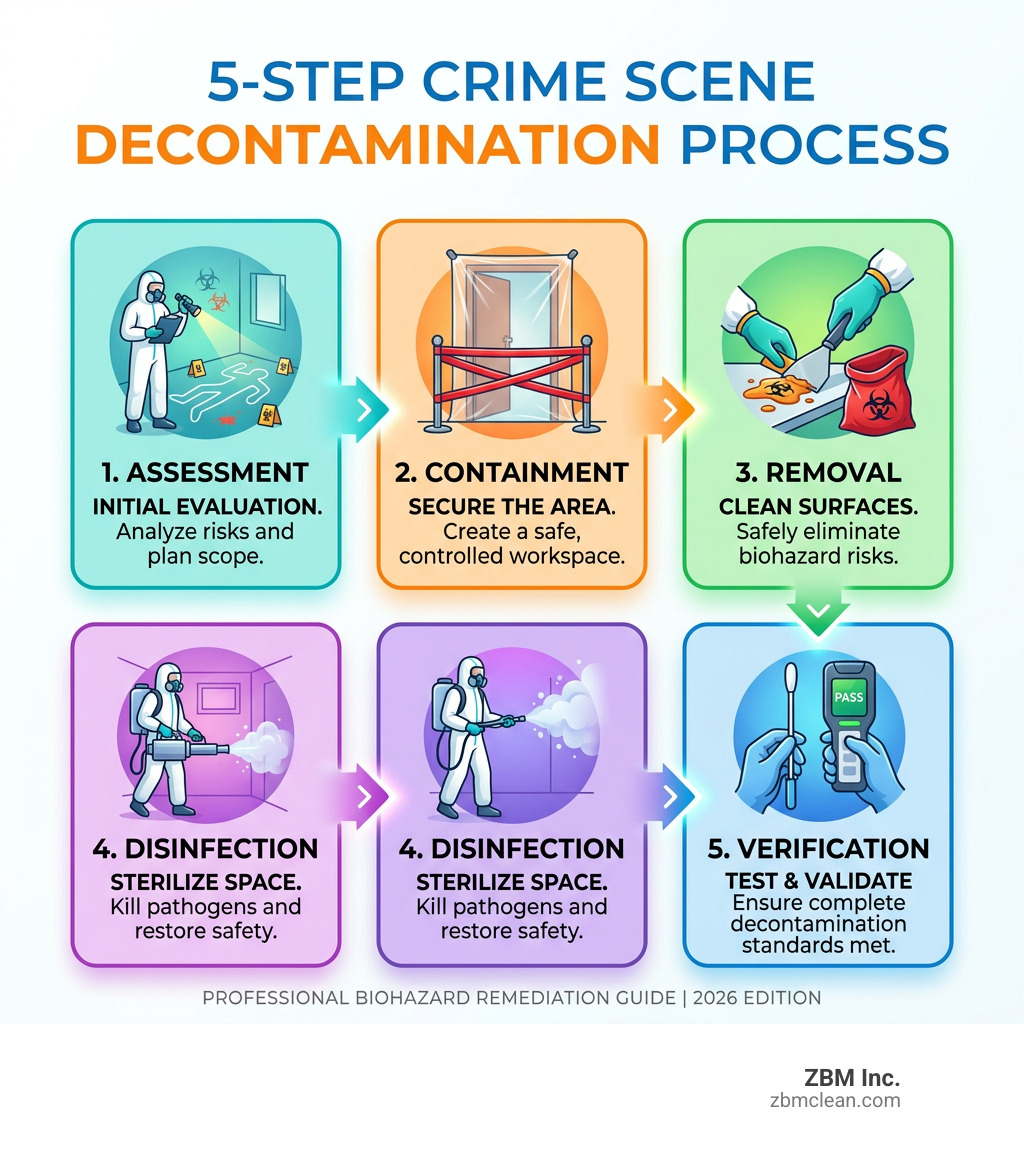
Once on-site, the process begins with a site assessment. We look for “primary” and “secondary” contamination. For example, if a person was injured in a hallway, the primary site is the hallway, but footprints or air currents may have carried biohazards into other rooms.
The actual cleanup involves:
- Biohazard Removal: Physically removing blood, tissue, and contaminated porous materials (like carpet or drywall).
- Cleaning and Disinfecting: Using EPA-approved disinfectants and enzyme cleaners.
- Deodorization: Removing the “smell of death” using ozone generators or hydroxyl machines.
- Verification: We use ATP testing to measure microbial levels, ensuring the space is safer than a hospital operating room before we leave.
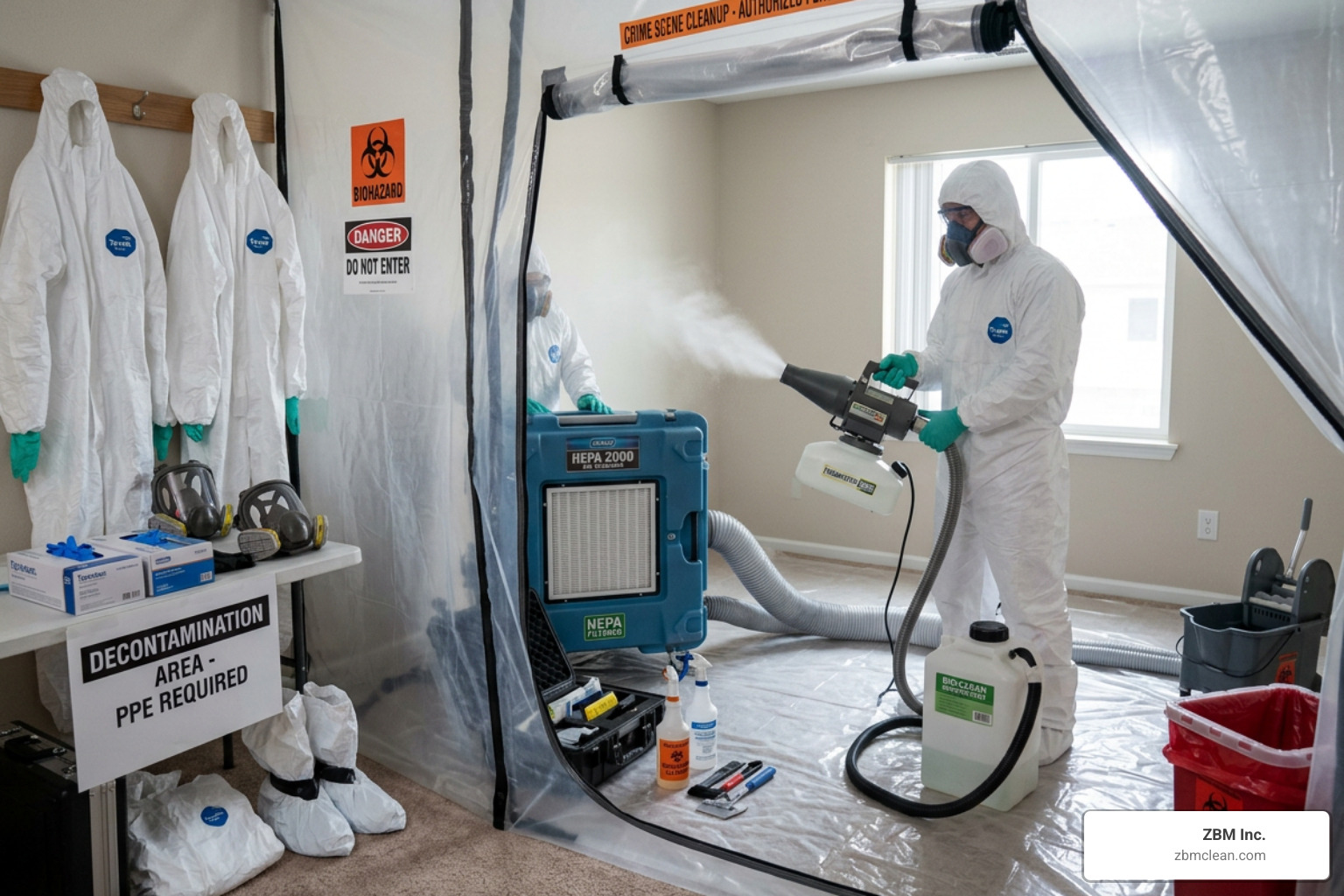
Proper ventilation importance cannot be overstated. A 2021 study found that 78% of post-cleanup failures—where odors returned or mold grew—stemmed from inadequate ventilation during the remediation process. We use negative air pressure systems to ensure that contaminated air is filtered through HEPA filters and exhausted outside, rather than circulating through the building’s HVAC system.
Specialized Tools and PPE
We don’t show up with a bucket and a mop. A technician’s “uniform” includes:
- Full-Body Hazmat Suits (Tyvek): To prevent any skin contact with biohazards.
- Respiratory Protection: Full-face respirators with P100 filters to protect against airborne pathogens and odors.
- Enzyme Solutions: Chemicals specifically designed to break down the complex proteins in human blood.
- Air Scrubbers: Large machines that pull air through HEPA filters to remove particulates.
- Biohazard Containers: Puncture-proof red bags and boxes for legal disposal.
- Fogging Machines: To distribute disinfectants into hard-to-reach cracks and crevices.
The Physical and Emotional Toll of Remediation
This is the part of the job that high-definition TV shows often skip. The physical labor is grueling—lifting 50+ pounds, scrubbing on hands and knees, and enduring extreme temperatures. However, the emotional toll is often heavier.
Secondary traumatic stress is a real risk. Research shows that 68% of technicians experience some form of traumatic stress in their first year. This contributes to an industry turnover rate of around 30%. It is not uncommon for a technician to develop insomnia or anxiety, especially after cleaning scenes involving children or extreme violence.
Mental health support is a vital part of the job. At ZBM Inc., we encourage our team to use coping mechanisms like debriefing after a tough job and maintaining a strict “work-life” boundary. Compartmentalization—the ability to focus on the technical task while acknowledging the tragedy—is a skill that takes years to master. As one Reddit AMA contributor noted, “It’s not a job to have if you’re a loner… you need someone to talk to.”
Career Outlook: Salary and Job Opportunities
If you can handle the demands, the career outlook is steady. The Bureau of Labor Statistics (BLS) groups crime scene cleaners with hazardous material removal workers, noting an average salary of approximately $45,270 per year. However, specialized crime scene cleaners often earn more due to the 24/7 on-call nature and the risks involved.
Salary ranges by region vary significantly. In the Midwest, including our service areas in Wisconsin, a crime scene cleanup technician typically earns between $40,000 and $60,000 annually. Experienced supervisors or those in high-demand urban areas can reach $80,000 or more.
The industry is expected to grow by about 8% through 2029. This growth is driven by an increasing awareness of biohazard safety and a shift away from expecting families or general janitors to handle these dangerous tasks.
For those considering the business ownership route, be warned: startup costs for a properly equipped and insured biohazard company can range from $50,000 to $100,000. While profit margins can be high (up to 60-70% for independent firms), the liability and emotional weight are equally high.
Frequently Asked Questions about Crime Scene Cleanup
Do technicians handle or move dead bodies?
No. This is a common misconception. The body is always removed by the coroner or medical examiner before we arrive. Our job is the post-removal cleanup—disinfecting the area where the body was found and neutralizing any odors or fluids left behind. We step in once the “scene” is released by law enforcement.
What chemicals are used in the cleanup process?
We use a variety of professional-grade chemicals that you won’t find at a hardware store. These include:
- Broad-spectrum disinfectants: To kill viruses and bacteria.
- Enzyme cleaners: To break down biological matter.
- Blood coagulation agents: To turn liquid blood into a gel for easier, safer removal.
- Peroxide-based solutions: For deep cleaning without the harsh fumes of bleach.
- Ozone and Hydroxyl: For total odor neutralization.
Is the job always on-call?
Generally, yes. Most crime scene cleanup services in Wisconsin operate on a 24/7 emergency response model. When a call comes in from a police department or a property manager, we must be ready to go. This requires technicians to have a flexible lifestyle and the ability to travel across our service areas, including Dodge and Jefferson Counties, at a moment’s notice.
Conclusion
Being a crime scene cleanup technician is about more than just cleaning blood; it’s about restoring a sense of peace to a place that has seen chaos. It is a career for the brave, the meticulous, and the compassionate.
At ZBM Inc., we take this responsibility seriously. As a family-owned, licensed, bonded, and insured professional crime scene cleanup company based in Watertown, WI, we pride ourselves on helping our neighbors through their most difficult days. Whether you are in Lake Mills, Minocqua, or anywhere in Southeastern WI, our certified professionals are here to handle the mess so you don’t have to.
If you are facing a traumatic event and need professional help, or if you are interested in learning more about this essential field, you don’t have to walk this path alone. We are here to help restore harmony to your home or business.